
Tracking research funding flows in India: bilateral cooperation, philanthropy, and open metadata
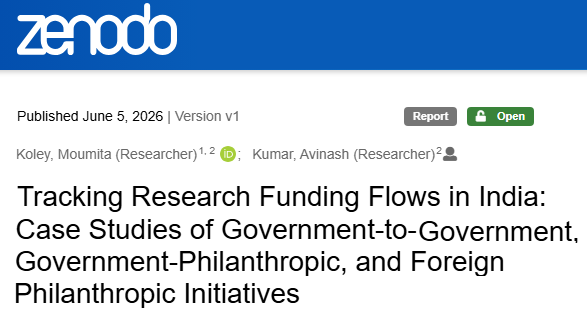
FOLEC-CLACSO recommends reading the study " Tracking Research Funding Flows in India: Case Studies of Government-to-Government, Government-Philanthropic, and Foreign Philanthropic Initiatives ," developed by the team at the Indian Institute of Science (DST-CPR) as part of the international project "Tracking Research Funding Flows ." The document examines how different international funding mechanisms operate within the Indian scientific ecosystem, combining analysis of public data, document review, and interviews with stakeholders involved in program management.
The study aligns with the same research agenda promoted by FOLEC-CLACSO to understand and highlight international research funding flows in Latin America and the Caribbean, and provides a particularly relevant comparative case for the Global South. India emerges as a system heavily led by the public sector: R&D spending remains around 0,6–0,7% of GDP, and approximately 55–60% of funding comes from public sources, with a significant share going to agencies focused on strategic objectives in defense, space, and energy.
The research analyzes in detail four bilateral cooperation mechanisms—India–Germany (IGSTC), India–France (CEFIPRA), India–Japan, and India–United States (USISTEF)—and two philanthropic initiatives linked to the Wellcome Trust/DBT and the Gates Foundation. Among its most interesting findings is the role of “2+2” models, which require the formation of consortia with academia and industry from both countries, seeking to reduce the so-called “ valley of death ” between research and commercialization. The IGSTC case shows how academia–industry collaboration is institutionalized through co-financing rules, shared intellectual property requirements, and milestone-based monitoring, while CEFIPRA illustrates a dual strategy that separates support for collaborative basic science from funding technology transfer projects aimed at Technology Readiness Levels (TRLs) 4–5.
Beyond the institutional description, the document offers valuable lessons for the debate on open funding metadata. The authors show that the availability and quality of public information on funded projects remains highly uneven across agencies, limiting comparability and the monitoring of international flows. The study proposes combining administrative project data, grant metadata, and qualitative analyses of instruments, conditions, and power relations to understand not only how much money circulates, but also under what rules, with what priorities, and with what effects on local research capacities. Therefore, we highly recommend this book to those working in science policy, international cooperation, research evaluation, and the governance of open scientific information infrastructures.
The full document can be found at: https://zenodo.org/records/20558743. A future update of the Zenodo record will also include a Spanish version of the document, with the aim of facilitating its access and circulation among academic and science policy communities in Latin America and the Caribbean.

