
Racism and genocide in Guatemala
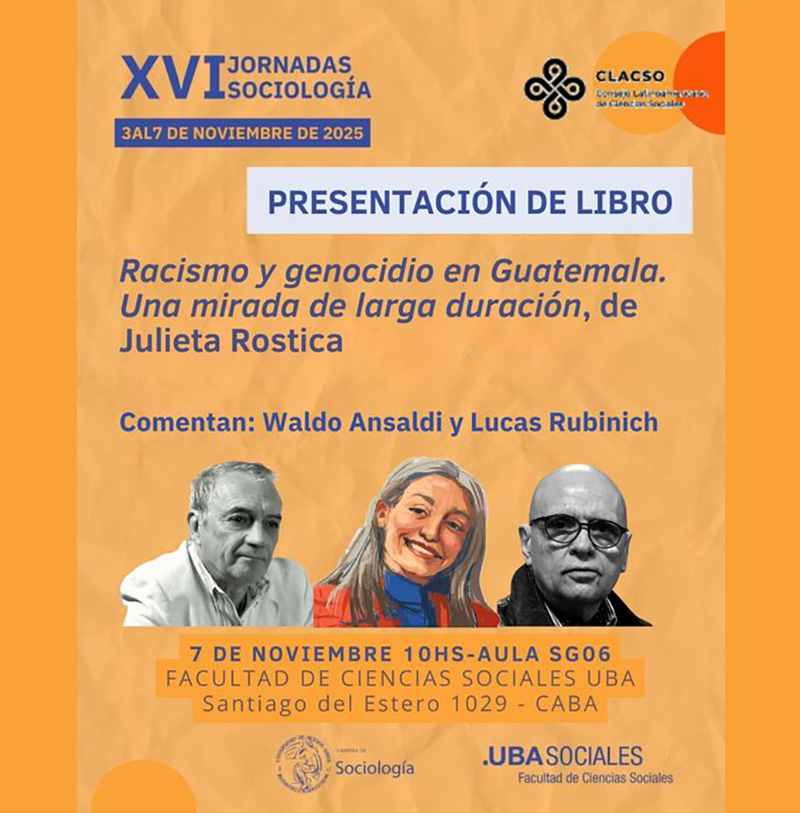
On Friday, November 7, the book “ Racism and Genocide in Guatemala. A Long-Term Perspective ” by Julieta Rostica will be presented in Buenos Aires, Argentina.
10:00 a.m. Argentina time (UTC-3) in Room SG06, Faculty of Social Sciences UBA, Santiago del Estero 1029, Buenos Aires.
Commentary by: Waldo Ansaldi and Lucas Rubinich
The CLACSO Working Group “Violence in Central America” is participating
The two hundred years of Guatemala's independent history have been stained with violence, terror, and pain. This book sets out to explore the roots of that violence and help unearth them. From the field of historical sociology, Julieta Rostica argues that the specific form of political violence that was the Guatemalan genocide of 1978–1989 was shaped by the racism that characterized the social and political order of this Central American country from its inception. Through comparison with South American experiences, this phenomenon is analyzed from its imaginaries, practices, discourses, and representations, down to its most basic forms (prejudice, segregation, discrimination, violence), its long-term transformations, and its different social and political spaces. Its chapters present diverse explanations for the genocide in Guatemala based on a chronology aligned with the process of memory, truth, and justice in the country, and the role of racism in four historical stages: during the process of construction, consolidation, and crisis of the oligarchic state (1821–1944); in the revolutionary state (1944-1954); during the national security state (1954-1978); and while the dictatorship of the Armed Forces was institutionalized (1982-1985).

