
Who watches the watchmen?
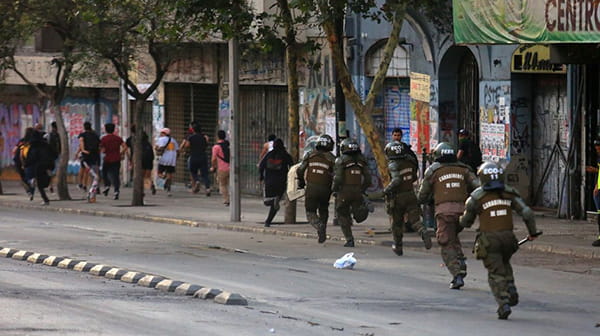
The creation of an observatory is urgently needed to monitor, evaluate, and oversee the current crisis in law enforcement and security functions. This would be a way for citizens to support the necessary and urgent process of change that the Carabineros (Chilean National Police) require. Above all, such an institution would emerge as a permanent mechanism of social control, capable of facilitating dialogue between citizens and the State on matters of law and security.
Since October 18 of this year, it has become evident to the public something that various organizations and experts had been warning about for several years: the actions of the Carabineros of Chile constantly involve the violation of human rights in the context of social protest or in other scenarios in which they must exercise their public function of restoring order.
The Chilean State has been warned of this situation through various reports since the 90s, yet we have reached October 2019 as if none of those warnings had been heeded. In 1995, the United Nations Committee against Torture made multiple references to the lack of an effective response from the Carabineros police force to allegations of ill-treatment and torture (Document A/50/44/ of 1995), with the institution being unable to conduct a full and impartial investigation into the allegations (Document CAT/C/CR/32/5 of 2004). This report was followed by several others from organizations such as the Human Rights Center of Diego Portales University, which since 2003 has included information on human rights violations committed by the Carabineros, and the reports of the National Institute for Human Rights, which since its creation has monitored police activity in relation to the protection of fundamental rights.
This situation, in turn, indicates the civil inability to subordinate the Chilean National Police (Carabineros) to political power. This is evident not only in their lack of capacity to fulfill police functions regarding the prevention and control of public order, but also in their accountability and excessive autonomy in operational, financial, and institutional development management. The latter became clear with the discovery in 2018 of multimillion-dollar frauds committed within the institution. This is also reflected in situations that demonstrate a significant lack of professionalism, such as misinformation or ignorance of the functioning of protocols, and a lack of understanding of the composition of elements used to "dissuade" protests, such as rubber bullets, tear gas, and the composition of the water in water cannons, which result in very serious physical harm to those attacked by these elements. These situations demonstrate the discretionary manner in which the Carabineros have operated, without effective or genuine oversight.
Following repeated reports from various state agencies (National Institute for Human Rights) and international organizations (Amnesty International, Human Rights Watch, the Inter-American Commission on Human Rights, and the Office of the United Nations High Commissioner for Human Rights), attention is now focused on the Carabineros police force. However, we cannot delude ourselves into thinking that an ad hoc reform or a special commission will solve the problem. This is primarily because, as with the Armed Forces, it is the civilian government that is called upon to exercise effective authority over law enforcement and security institutions and to ensure that their duties are carried out efficiently and in strict adherence to human rights.
In the more than fifty days that have passed since the beginning of the social uprising, it has become clear that the civilian authorities are either unable or unwilling to exercise their authority over the Carabineros (Chilean National Police). To date, Interior Minister Andrés Chadwick, who was in office when the protests began and to whom the Carabineros' high command is subordinate, has been removed from office and impeached. However, the Director General of the Carabineros, Mario Rozas, not only remains at the head of the institution, but also mocks the victims and public opinion by guaranteeing impunity for those responsible for human rights violations and minimizing the harm inflicted on the population.
Who's in charge?
In this context, we observe a related problem: the absence of an independent body capable of monitoring police functions in their various aspects, including crime investigation and prevention, public order control, and oversight regarding transparency and accountability. We are talking about the need for, and urgency of, an observatory or watchdog for order and security, which could include diverse actors from civil society, among them experts who have dedicated themselves to academic research in these areas for several years, as well as professionals who have held positions in government institutions related to the Carabineros (Chilean National Police) and the Armed Forces, among others.
Various columns and interviews have been published in the media in recent weeks by professionals and experts in the field, outlining concrete proposals and possible paths forward. However, as several of these opinions point out, we agree that the problem extends beyond planned interventions in the Carabineros (Chilean National Police) or the implementation of modernization processes. We believe the time has come for citizens to exercise their right to oversee those who oversee them, through a mechanism that strengthens and supports the capacity for subordination that civilian power must exercise over the police and military.
Therefore, the creation of an observatory is urgently needed to monitor, evaluate, and oversee the current crisis in law enforcement and security functions. This would be a way for citizens to support the necessary and urgent process of change that the Carabineros (Chilean National Police) require. Above all, such an entity would emerge as a permanent mechanism of social control, capable of facilitating dialogue between citizens and the State on matters of law and security. This observatory could be comprised of citizens and organizations interested in monitoring and supporting the implementation of public policy in the aforementioned areas of interest, through assessments, follow-up, and research, adhering to the principles inherent to this type of institution, which include independence, transparency, accountability and shared responsibility, objectivity, and timeliness.
An observatory would transcend the ad hoc parliamentary or governmental advice currently provided for policy design and implementation, or for legislative work, which has apparently failed to achieve the necessary institutional transformations. It would be a forum where knowledge and reflection are placed at the service of citizen political action, to achieve real influence on public decisions and actions. It would become an ally for other citizen organizations on related issues, and a national benchmark for international bodies and organizations.
We call upon all stakeholders involved in and interested in this initiative to undertake the creation of a law enforcement and security observatory. The time has come for citizens to assume their responsibility to monitor the law enforcement officers.
Carolina Aguilera, Institute of Urban and Territorial Studies-PUC / COES
Loreto López, Social Psychology of Memory Program, University of Chile
Claudia Fuentes, Alberto Hurtado University
The Disconcerting – 17-12-2019
If you would like to receive more information about CLACSO's training programs:
[widget id=”custom_html-57″]
to our email lists.

