
What is the First Line and what does it express?
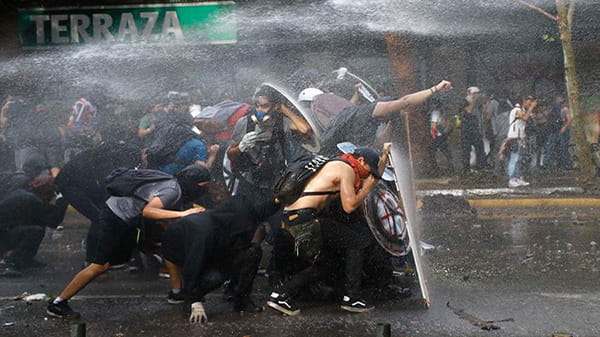
For many of the participants in the Front Line, this space has become a space of recognition and social appreciation that they had never had before, giving voice and visibility to people who have never had a space in the media and political participation.
Much has been said about the now-mythical space known as the First Line, though mostly from a place of ignorance, caricature, or the use of categories that don't correspond to the phenomenon in question. This space of collective action, primarily focused on confrontation with the Carabineros (Chilean police), and its symbolic characteristics, such as the use of hoods or scarves to cover the face, has been described by the government, political parties, and most of the media as a space where criminals operate, indistinguishable from those who loot and destroy supermarkets, pharmacies, and other stores. However, unlike these other expressions of violence, the hooded figures of the First Line have not been considered violent or criminal by a significant sector of the social movement, but rather as committed and courageous individuals who risk their physical safety to defend others demonstrating in public spaces from police violence. In this way, the participants in the front lines are not rejected but, on the contrary, applauded and supported, generating a recognition that invites reflection on how a traditionally stigmatized form of violent political action has achieved this social acceptance. Based on on-the-ground observations, conversations with front-line participants, and audiovisual material available on social media, I hope to contribute to a more complex understanding of the phenomenon, one that goes beyond a mere well-meaning rejection of the violence that unfolds there, without considering what this violence expresses within the context of the current social uprising.
A key element in understanding this expression of political violence and its social legitimization is that the front line has been seen as a space for protesters to defend themselves against police violence. Thanks to some media outlets, social media, reports on human rights violations from national and international organizations, and the protesters' own experiences, police repression has most often been characterized as brutal, indiscriminate, and unjustified. This has generated a deep-seated rejection of the Carabineros (Chilean police), who are no longer perceived as maintaining social order, but rather as a danger to people and an impediment to the legitimate right to protest. In this context, those who have confronted the Carabineros have come to be seen as a shield against police violence and abuse, a perception that has even led to displays of support and collaboration, such as providing them with water, food, and various forms of gratitude.
A second element to consider is that the First Line has also become a space for the participation of people who, directly or indirectly, have been victims of the prevailing socio-political model. Thus, unemployed and/or precariously employed youth, indebted students, children of parents and grandparents with salaries and pensions completely insufficient for a dignified life, young people from marginalized communities and even young people in the care of SENAME (National Service for Minors), excluded from any mechanism of social integration, members of Indigenous communities and LGBTQ+ groups, and, in general, people with the conviction that the country needs radical change, all come together. In this sense, the participants are not outsiders to the social movement, but rather an integral part of it.
A third element to consider is that for many of the participants in the Front Line, this space has become a place of social recognition and appreciation they had never experienced before, giving voice and visibility to people who have never had a place in the media or in political participation. It has also been a space for encountering others with similar or equivalent stories, a space where solidarity and commitment to the movement prevail, expressed in the phrase that many repeat, “we are here to defend the people so they can demonstrate peacefully.” It is worth noting that the Front Line coexists with other highly relevant social actors for the movement, such as healthcare volunteers, reporters from alternative media outlets, and musicians and artists from various disciplines who have been present since the beginning of the demonstrations, thus constituting a diverse, pluralistic, and massive space for social protest.
Much has been said about violence, mostly inaccurately and without distinction, simplifying the problem and thus contributing to the criminalization of the social movement. However, expressions like the First Line and the social recognition and legitimacy it has gained for a significant part of the social movement demonstrate the complexity of the phenomenon. In conclusion, we can hypothesize that the citizens' struggle for dignity and against abuses is also expressed in the rejection of police violence and abuses. And to the extent that these have not been punished or have been minimized or denied by the authorities, citizens have come to recognize in the First Line a just and legitimate way to defend themselves, both materially and symbolically, against police violence, while at the same time elevating its participants to figures valued for their courage and commitment to the social movement.
Roberto Fernández Droguett
The Disconcerting – 20-12-2019
If you would like to receive more information about CLACSO's training programs:
[widget id=”custom_html-57″]
to our email lists.

