
Protection of women's rights. Tools for measuring international obligations
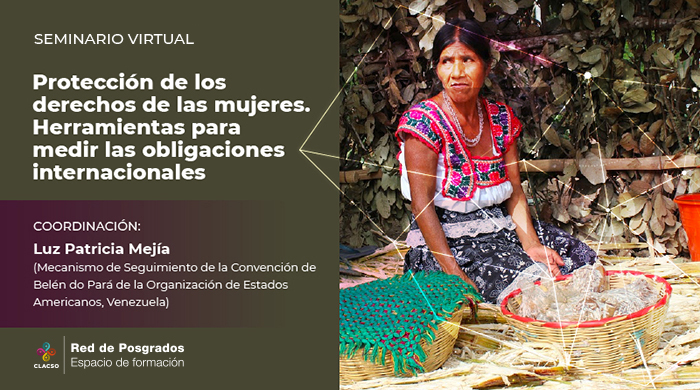
Seminar 2136
Coordination: Luz Patricia Mejía Guerrero (Follow-up Mechanism to the Belén do Pará Convention of the Organization of American States, Venezuela)
Start: 25/08/2021 | Registration: 28/05/2021 to 23/08/2021
Workload: 12 weeks – 90 hours.
The Seminar is a space for sharing knowledge and ideas regarding States' obligations in the prevention, protection, and eradication of violence against women. This training will examine the guiding principles of these international obligations within the framework of international human rights doctrine, as expressed in the Belém do Pará Convention, an international treaty binding on the States that have ratified it. In this context, we will also study how international human rights systems monitor compliance with these obligations, examining the functioning of the Follow-up Mechanism to the Belém do Pará Convention (MESECVI) and the System of Progress Indicators that this body has designed to carry out this important task. Studying the structure and functionality of the System of Progress Indicators will provide an opportunity for students to research and share data on the realities of their countries regarding the fight against violence against women. This activity will be extremely enriching in terms of understanding the region, providing information that will allow participants to analyze, compare, and identify the challenges not only of their own states but also of the region as a whole. At the end of this training experience, students will understand the operation of the Belém do Pará Indicators System and its connection to inter-American and universal human rights standards for women, such as the duty of due diligence. They will also learn how the use of these indicators can be helpful in monitoring public policies implemented to prevent, punish, and eradicate violence against women.
The Seminar is designed to offer a comprehensive space for theoretical and practical training on the tools available within the Inter-American System for the Protection of Human Rights for measuring public policies derived from international obligations to protect women's rights, and specifically on the Follow-up Mechanism to the Belém do Pará Convention (MESECVI). Throughout the Seminar, we will hold in-person meetings (via an online platform) and share some decisions of the Inter-American System to understand the importance of indicators. We will review some international standards in the field of human rights and analyze them in light of the States' obligations to act, as well as from the perspective of the principle of the progressive realization of these rights. The Seminar will foster a deeper connection with the Belém do Pará Convention and the measures that States do or do not take to implement it, the resources used, and the tools that guarantee women's participation in the monitoring, follow-up, and formulation of public policies, as well as the existing obstacles to participation. Likewise, the Seminar provides an opportunity to become familiar with the System of Progress Indicators for measuring the implementation of the Belém do Pará Convention and with the tools available in their countries for disseminating information of public interest to guarantee women's human rights. We will make available the responses from the States and discuss their effectiveness at the Seminar, as well as the existing gaps in public policies. We will work with indicators that allow us to measure the progress or setbacks of these measures, the state capacities of the States Parties, and, finally, the existing budgetary commitment to guaranteeing women's rights.
GENERAL OBJECTIVE To provide theoretical and practical tools on the System of Progress Indicators for Measuring the Implementation of the Belém Do Pará Convention of the Inter-American System for the Protection of Human Rights and the Follow-up Mechanism to the Convention MESECVI.
SPECIFIC OBJECTIVES That students: • Understand the main obligations of States in relation to the international instruments signed in the field of women's human rights, specifically the Belém do Pará Convention. • Understand the operation of the Follow-up Mechanism to the Belém do Pará Convention. • Understand and use the Progress Indicators System of the Belém do Pará Convention. • Research and analyze the situation in their States regarding the obligations acquired under the Belém do Pará Convention. • Understand and understand the situation in the region regarding the obligations of States under the Belém do Pará Convention. • Develop an objective view of the gaps and challenges in their States regarding the obligation to prevent, protect against, and eradicate violence against women. • Form groups and networks focused on working for the prevention and eradication of violence against women.
- Introduction to the Belém do Pará Convention. Background and basic concepts.
- The obligation to prevent and gender stereotypes
- Right to live a life free from violence
- MESECVI. Initiatives for measuring international obligations under the Belém Do Pará Convention.
- Introduction to the system of progress indicators of the Belém Do Pará Convention.
- Delving deeper into the system of progress indicators: obligation of transparency and publicity and right to participation.
- Indicators of national plans and budget in the progress indicator system.
- Indicators of access to justice in the system of progress indicators.
- Information and statistics indicators in the progress indicator system.
- Luz Patricia Mejía Guerrero. The Inter-American Commission of Women and the Belém do Pará Convention. Impact on the Inter-American Human Rights System. Journal of the Inter-American Institute of Human Rights. Volume 56. Pp. 190-212.
- Organization of American States (OAS). Inter-American Commission of Women (CIM), Follow-up Mechanism to the Belém do Pará Convention (MESECVI). 2015. Guide for the application of the Inter-American Convention on the Prevention, Punishment and Eradication of Violence against Women (Convention of Belém do Pará).
- Organization of American States (OAS). Inter-American Commission of Women (CIM), Follow-up Mechanism to the Belém do Pará Convention (MESECVI). (2014). Guide for the application of the Inter-American Convention to Prevent, Punish and Eradicate Violence against Women (Convention of Belém do Pará).
- Organization of American States (OAS). Inter-American Commission on Human Rights (IACHR). Rapporteurship on the Rights of Women. Access to Justice for Women Victims of Violence.
Organization of American States (OAS). Inter-American Court of Human Rights (IACHR). Jurisprudence Booklet No. 4. Gender and Women's Human Rights. - Organization of American States (OAS). Inter-American Commission of Women (CIM), Follow-up Mechanism to the Belém do Pará Convention (MESECVI). (2017). Third Hemispheric Report. Prevention of Violence against Women in the Americas. Paths to Follow.
- Organization of American States (OAS). Inter-American Commission on Human Rights (IACHR) (2007). Access to Justice for Women Victims of Violence in the Americas. Retrieved
- Organization of American States (OAS). Inter-American Commission on Human Rights (IACHR). Guidelines for the development of indicators of progress in the area of economic, social and cultural rights.
- Organization of American States (OAS). Inter-American Court of Human Rights. Judgments of the Inter-American Court of Human Rights.
- Pará (MESECVI). (2015). Practical guide for the application of the system of progress indicators for measuring the implementation of the Belém Do Pará Convention.
- Rebecca J. Cook & Simone Cusack. (2010). Gender Stereotyping: Transnational Legal Perspectives. Profamilia. (2010) Original Title: Gender Stereotyping: Transnational Legal Perspectives, University of Pennsylvania Press.
|
|
Discount for payments made before 16/08 |
In one payment from 17/8 to 23/8 |
|
CM Plenos |
$75 |
$150 |
|
CM Associates |
$95 |
$190 |
|
No link |
$95 |
$190 |
FAQ
The basic requirements for taking a seminar are:
- Availability of at least 4 hours per week to dedicate to the seminar course.
- Internet access.
- Reasonable handling of communication and computer tools.
- Language proficiency in the language in which the course will be taught. The official languages are Spanish and Portuguese.
|
|
Discount for payments made before 16/08 |
In one payment from 17/8 to 23/8 |
|
CM Plenos |
$75 |
$150 |
|
CM Associates |
$95 |
$190 |
|
No link |
$95 |
$190 |

