
“Promoting women’s autonomy and equality between women and men”
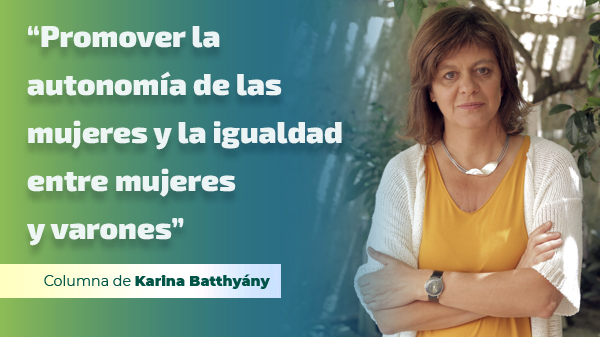
(Transcription of Karina Batthyány's Column)
(In InfoCLACSO – August 10, 2022)
I want to share a report that CLACSO prepared together with researchers from our Network, regarding the progress of the Beijing Platform for Action, that Fourth World Conference on Women which was undoubtedly a watershed moment in the history of International Cooperation. It was held in 95 in Beijing—hence the name—where the plan was agreed upon that is still considered the most progressive and comprehensive for promoting women's rights worldwide.
The Declaration and Platform for Action adopted at that Conference established a series of commitments to promote the physical, economic and political autonomy of women and progress in the field of rights: human rights, educational rights, health rights and also the rights of girls and young women.
This declaration has subsequently been reviewed every five, ten, fifteen, twenty, and twenty-five years. And at CLACSO, we set out to also review this Beijing+25 platform; due to the pandemic, we presented the report in 2022, hence the +27 designation.
The various assessments do indeed show some progress, but also the persistence of discriminatory structures that are long entrenched in different countries worldwide and also, of course, here in our Latin American and Caribbean region.
International organizations, including the United Nations and some civil society organizations, have closely examined the situation regarding gender equality in different regions of the world. In this case, CLACSO collaborated with UN Women and Oxfam to conduct this review, which was carried out by three researchers from our Network: Clyde Soto, Martha Patricia Castañeda, and a team led by Natalia Quiroga, addressing the various topics covered.
In terms of the general conclusions and some proposals and recommendations, firstly, we are experiencing a profound crisis of the economic model that generates the need for more radical and innovative interventions in order to reduce multidimensional social inequalities and gender inequalities.
In this sense, it is urgent that 27 years after the adoption of the Beijing Declaration and Platform for Action, structural horizons be broadened in a comprehensive and intersectional manner, building instruments to promote women's autonomy and equality between women and men.
The need then arises to prioritize the fundamental needs for life, to put life at the center, to put the care of life at the center, thinking about the link between the State, the market, the community and families, and the place that women occupy so that they can fully enjoy all their rights and all their opportunities.
Based on the analysis presented in this report, conducted jointly with CLACSO, UN Women, and Oxfam, several institutional actions are recommended to help fill statistical and information gaps regarding the various objectives and areas of concern. It is essential to always consider disaggregating data by sex, age, place of residence, origin, ethnic self-identification, dimensions of disability, and other variables. Furthermore, a proper analysis should be conducted that incorporates gender, human rights, and intercultural perspectives.
The above are the general recommendations of the report, but it delves deeper into three areas:
Women and the Economy: How to Rethink Women's Economic Autonomy (report prepared by Natalia Quiroga and Marta Sandoval). They will show us the key factors behind the assertion that in recent years the reduction of the gender gap worldwide has reversed; that is, instead of shrinking, it has widened. This is, of course, also due to the impact of the pandemic.
Then there is also a report on care in Latin America and the Hispanic Caribbean prepared by Clyde Soto and his team, where once again the need to take care as a central element in the discussions of current societies is placed and to work towards that care society through the redistribution of care work between the market, the State, families and the community.
There is also a chapter dedicated to gender-based violence against women and girls in Latin America, written by Martha Patricia Castañeda, which outlines the successive revisions of the Beijing Report and the conceptualizations of violence against women, showing how the context in which this violence occurs within the framework of structural inequality in our region has expanded and become more forceful. Violence is undoubtedly a serious concern in Latin America.
We must also mention Indigenous women, because August 9th was the International Day of the World's Indigenous Peoples, and 2022 is dedicated to Indigenous women and their contributions. This is closely related to what has been said about their contributions both within their homes and families and within their communities. And, in many cases, the work of these Indigenous women, who also suffer inequalities and are, of course, statistically invisible, is often overlooked.
-Absolutely, Karina. The invitation to discuss this topic begins next week. There are so many interconnected themes that it's sometimes difficult to condense them all into a single column, but you've managed to do so with the Beijing +27 report. My only thought, as a brief reflection from you as we close this column, is how important the role of organizations like CLACSO is. They enable reports like this, which are produced by civil society and academia, to then connect with public policymakers. Because it's in that triangle that things can truly begin to work more effectively.
Absolutely. It's the triangle we always work within. This Beijing report specifically incorporates a series of recommendations for public policy to promote and advance gender equality, which is still so distant for Latin American and Caribbean women. We undoubtedly believe in this connection between knowledge, public policy, and social organizations. It's what we do every day, and in this specific case, with the Beijing report, we'll take some of the conclusions from each of the chapters and, of course, relate them to the public policy recommendations. In this way, we'll explore the issue of inequalities, which are intertwined and have intersectionality at their core.

SEE The challenges of the Beijing Platform for Action
If you would like to receive more information about CLACSO's training programs:
[widget id=”custom_html-57″]
to our email lists.
If you would like to receive more information about CLACSO's training programs:
[widget id=”custom_html-57″]
to our email lists.

