
Latin American urban processes: (in)justices and (in)equalities
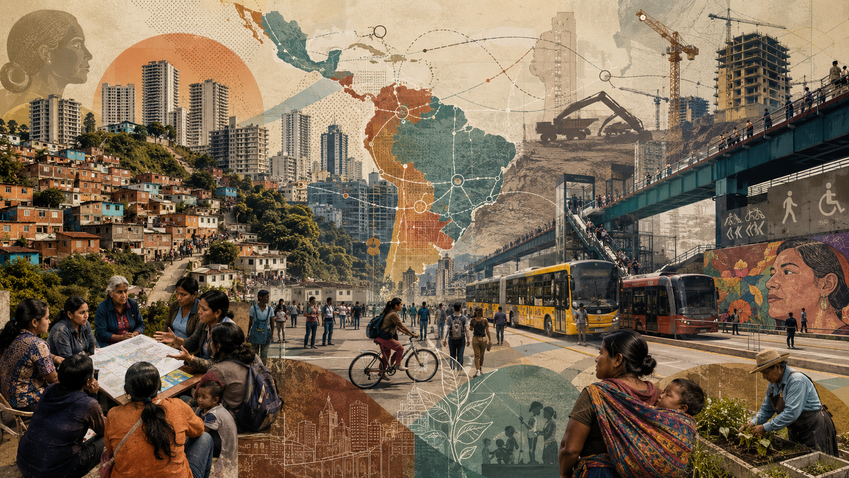
The CLACSO Working Group on Latin American urban processes: (in)justices and (dis)equalities studies contemporary urban transformations in Latin America and the Caribbean as a privileged way to understand the processes through which inequalities and injustices are produced, reproduced, legitimized and also contested.
From a critical and situated perspective, linked to the traditions of Latin American and Global South urban thought, the Working Group seeks to broaden the geographies from which urban theory is constructed. To this end, it recognizes the heterogeneity of the region's cities, their specific historical trajectories, and the profound social, economic, political, and territorial asymmetries that shape them.
The Working Group (GT) starts from a central premise: the relationship between inequality and injustice is neither direct nor automatic. Some inequalities are naturalized, tolerated, or considered legitimate, while others are recognized as unjust and give rise to conflicts, resistance, and forms of collective action. From this perspective, the group analyzes the asymmetrical and interdependent relationships between the state, the market, social organizations, activism, and city dwellers. Its interest lies both in the dynamics of exclusion, expulsion, dispossession, and value capture, and in the practices of self-management, care, community organizing, and collective urban production that contest access to, retention in, and enjoyment of the city.
During the period 2026–2028, collective work will be organized around three interconnected axes:
Urban commodification and extractivism: Financialization and speculation of land, housing, urban services and public space, along with new forms of dispossession, hoarding, exploitation and rent-seeking.
Right to the city: disputes over access to affordable housing, neighborhood permanence, participation in urban decisions, the provision of infrastructure and services, and resistance to evictions, displacements, and rentier dynamics.
Unequal urban mobility: unequal distribution of infrastructure, travel times, risks, accessibility conditions and mobility opportunities, considering their intersections with gender, age, class, embodiment, disability, racialization and territory.
Gender and care constitute a cross-cutting dimension to these three axes.
Through comparative research, training activities, publications, seminars, audiovisual production, and dialogue with public institutions, social organizations, and academic networks, the Working Group seeks to strengthen a Latin American agenda for urban studies. Its purpose is to produce rigorous, context-specific knowledge, contribute to public debate, and promote policies and practices aimed at building more just, equitable, and livable cities.
coordinate
Vicente Moctezuma Mendoza
Center for Sociological Studies
The College of Mexico
Mexico
[email protected]
Loreto Rojas Symmes
Faculty of Social Sciences
Directorate of Research and Postgraduate Studies
Alberto Hurtado University
Chile
[email protected]
Ramiro Segura
Interdisciplinary School of Advanced Social Studies
National University of San Martín (UNSAM)
Argentina
[email protected]

