
Latin American Urban Processes: (In)justices and (In)equalities
The CLACSO Working Group “ Latin American Urban Processes: (in)justices and (dis)equalities ” holds its annual meeting on October 8, 9 and 10 in Paraguay, at the Faculty of Architecture, Design and Art of the National University of Asunción, located on the San Lorenzo Campus.
This meeting constitutes a space for dialogue, debate and regional reflection on contemporary urban transformations in Latin America, understood as prisms from which to analyze the dynamics of social and urban (in)justices and (in)equalities on the continent.
As the closing event of its third year of operation, the GT is organizing the International Seminar “Latin American Urban Processes: (in)justices and (dis)equalities”, conceived both as a space for synthesizing collective work and for projecting towards new lines of research on inequalities and injustices in Latin American cities.
Participate
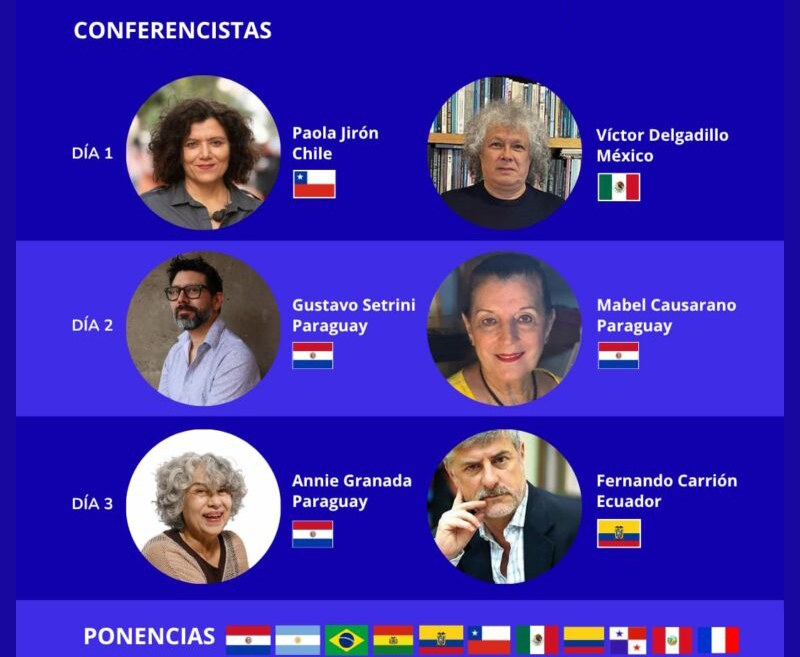
The meeting invites the presentation of proposals and debates around four thematic areas:
Thematic axis 1. Urbanization, commodification and urban extractivism
Coordination:
Loreto Rojas-Symmes (Alberto Hurtado University, Chile)
Mercedes Di Virgilio (UBA-CONICET)
Vicente Moctezuma (UNAM, Mexico)
Manuel Dammert (PUCP, Peru)
The Latin American urbanization model is heterogeneous in its modalities and logics of growth and consolidation. However, increasingly intensive processes of speculation and commodification of land, housing, and services are shared. This occurs in different territorial configurations, including urban-rural transition zones, self-built spaces (categorized as “informal”), and consolidated areas. The logics of financialization and urban extractivism express the struggle for and hoarding of resources, as well as new forms of articulation between the market, the state, and society. In this section, presentations addressing these issues based on empirical research are expected. Some of the subtopics to be discussed include: renting and formal and informal submarkets; forms of appropriation and dispossession of urban and rural land; peri-urban transformations; speculation and commodification of land, housing, and services; crime and territorial governance; among others.
Thematic axis 2. Right to the city: between institutional capacities and resistance movements
Coordination:
Victor Delgadillo (UACM, Mexico)
Magela Cabrera (University of Panama)
María Laura Canestraro (UNMDP-CONICET, Argentina)
Ana Raquel Flores (UNA, Paraguay)
The Right to the City, often understood as a utopia to be built and sometimes as a legal right to be won, has become a platform for struggle in Latin America that encompasses a wide range of citizen demands: access to affordable housing, the defense of neighborhoods against private investments or public policies, halting evictions and displacements due to rising land and housing costs, preventing the exploitation of cities by digital capitalist apps and platforms, and confronting urban waste resulting from the financialization of housing and the transformation of the city into a vehicle for global financial investments, which ultimately dispossesses and displaces residents and traditional neighborhood businesses and services. On the other hand, in recent decades, within the context of shifting power dynamics and institutional capacities, some cities governed by progressive political forces have implemented social programs that have aimed—with varying emphasis and scope—to reduce socio-spatial inequalities and physically and socially integrate informal, low-income neighborhoods into the city. In this thematic area, we hope to receive papers that contribute to enriching the debate on the Right to the City and the struggles of resistance against the excesses of the system, which in some cities and historical contexts have succeeded in winning certain social rights and/or improving the quality of life for people living in low-income neighborhoods. Papers that critically examine the implementation of programs for the improvement of peripheral and central neighborhoods, and for affordable housing, and that highlight the achievements of social movements and resistance, are welcome.
Thematic axis 3: "Unequal Mobilities, Public Space and Care"
Coordination:
Paulette Landon (UAH, Chile)
Alejandro Cortés Salinas (UAH, Chile)
Pablo Vega Centeno (PUCP, Peru)
Hernando Sáenz Acosta (Santo Tomás University, Colombia)
Latin American cities are undergoing profound transformations driven by changes in urban mobility. Aspects related to infrastructure, its production, its unequal distribution across the territory, and the quality of the services it provides reveal historical gaps in access, safety, and the quality of daily commutes. This theme seeks to bring together researchers interested in analyzing how these inequalities are expressed and reproduced in urban contexts marked by stark socio-spatial contrasts. We expect contributions that critically address the relationship between mobility and territorial equity, considering both the material conditions of infrastructure and its implications in terms of gender, age, class, and territory. In particular, we invite papers that explore the interplay between daily mobility, public space, and care practices, paying attention to how these dimensions are configured in specific urban scenarios across the region. We are interested in fostering a broad, interdisciplinary, and situated discussion that considers diverse geographical conditions—such as slopes, climates, and urban scales—as well as public policies, ways of inhabiting, and local resistance movements that shape mobility practices. This call for papers is open to empirical, theoretical, and methodological studies, with a special emphasis on critical and territorial approaches.
Axis 4: “Territorial inequalities: infrastructure, intersectionality and public policies in Latin America”
Coordination:
Paola Jirón (University of Chile)
Tilmann Heil (MECILA/UzK, Brazil/Germany)
Ana Laura Elorza (UNC-CONICET)
Jaime Erazo (CIVITIC Network)
This theme proposes an interdisciplinary debate, bringing into dialogue the multiple territorial inequalities that permeate Latin America, focusing on three key dimensions: infrastructure (care, mobility, urban repair and regeneration, etc.), intersectional differences (gender, class, ethnicity, among others), and the role of public policies. We invite research that critically addresses these complex realities, from the institutional policies and discourses that respond (or fail to respond) to infrastructural challenges and multifaceted inequalities, to the agencies (human and non-human) that establish, adapt, or transform the policies, experiences, and materialities of the city. We encourage submissions from diverse methodological perspectives, including case studies, comparative analyses, and theoretical works.

