
Peace process and implementation of the final agreement in Colombia
Seminar 1965
Chair: CLACSO
Coordination: Jairo Estrada Álvarez and Carolina Jiménez Martín (National University of Colombia)
Teaching team: Carolina Jiménez Martín, Jairo Estrada Álvarez, José Francisco Puello Socarrás, Andrés Felipe Mora Cortés, Víctor Manuel Moncayo, Sergio de Zubiría, Victoria Sandino
Start: 10/10/2019 | Registration: 29/08/2019 to 06/10/2019
Tuition scholarships – Free seminar
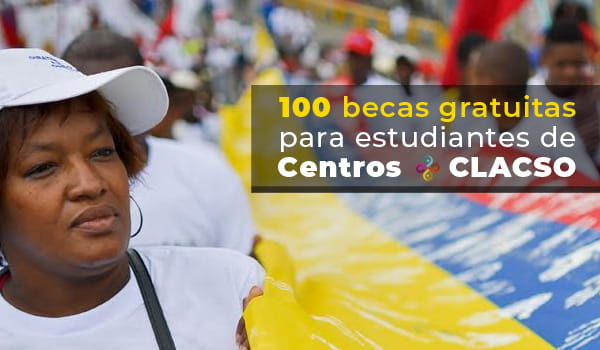
CLACSO is also committed to the Peace Process in Colombia through research and training. We are opening applications for 100 full scholarships for students from CLACSO Centers to attend the seminar “Peace Process and Implementation of the Final Agreement in Colombia.” Today, as always, we reaffirm our commitment to peace. The scholarships cover 100% of tuition fees.
Applications will be submitted through the CLACSO website.
Apply for a scholarship:
Enter here and complete the information requested on the form.
The available scholarships (100) will be assigned to students from CLACSO Centers taking into account gender equity and regional balance.
The application period will be open until October 6, 2019.
Course presentation:
The signing of the Final Peace Agreement between the Revolutionary Armed Forces of Colombia – People's Army (FARC-EP) and the Colombian State on November 24, 2016, is the most important political event in the country's recent history. The Final Agreement signifies, among other things, the end of the use of force in the organization of the social system as a whole and the democratic channeling of the contentious relationship between the State and society. It aims to rebuild a society with a greater capacity to influence the determination of public affairs and to create spaces for autonomy within communities to achieve the well-being of their people. It is, therefore, an opening that fosters transformative conditions not only for Colombia as a country, people, and nation, but also, in geopolitical terms, especially regionally, it is a process that would propel new societal directions, including the imminent demilitarization of territories in Our America.
Contents:
- Peace process in Havana (2012-2016)
- Historical conditions of the peace process
- The comprehensiveness of the peace agreement and the overall state of its implementation
- Between comprehensive rural reform and the expansionist ambitions of the “agribusiness model”
- Between democratic expansion and the persistence of political violence
- The comprehensive system of truth, justice, reparation and non-repetition and the resistance to truth
- Between comprehensive reintegration and the demobilization, disarmament and reintegration model
- The FARC-EP's transition to legal life and the alternative force party
- Revolutionary commons implementation and verification system: between perfidy and transformative power
- Fiscal policy and peacebuilding: reflections from the final agreement and social conflicts
FAQ
The basic requirements for taking a seminar are:
- Availability of at least 4 hours per week to dedicate to the seminar course.
- Internet access.
- Reasonable handling of communication and computer tools.
- Language proficiency in the language in which the course will be taught. The official languages are Spanish and Portuguese.
|
|
Discount for one payment until 16/03 |
In one payment after 16/03 |
|
CM Plenos |
$75 |
$150 |
|
CM Associates |
$95 |
$190 |
|
No link |
$95 |
$190 |

