
Food problems and health crisis in Ecuador
Francisco Hidalgo Flor [1]
The global crisis caused by the Covid-19 pandemic is turning everything upside down; nothing is staying in its place. It began as a health problem, but it is now calling into question the entire civilizational model built up over the last seventy years, from the post-war period of the mid-twentieth century onwards; this is globalized capitalism.
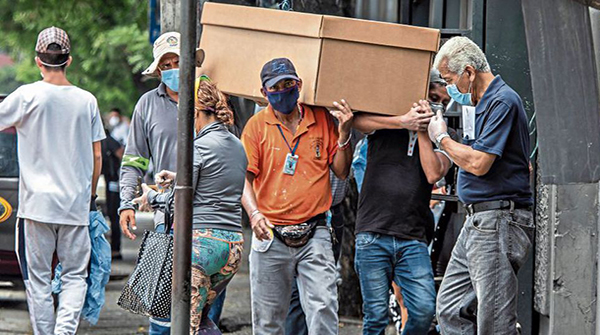
In some regions and countries with greater complexity than in others—and it seems that the situation in Ecuador is among the most dramatic—who wasn't shaken by the images broadcast by national [2] and international media on April 1st: the display of corpses in the streets of Guayaquil and the burning of tires in neighborhoods where bodies had been accumulating for several days? At the time of writing this article, it is officially acknowledged that the data generated is underreported [3].
One of the most serious issues that has emerged is the food crisis: entire countries struggle to access food, and in other countries, areas like impoverished neighborhoods face significant barriers to food access. Furthermore, private retail chains are concentrated in middle- and upper-income areas, neglecting low-income communities. Adding to this, the current health situation demands fresh, healthy food, not just canned or packaged goods, which are often produced with polluting inputs.
It is the consequence of seventy years of a corporate system that built the concentration of food production and trade worldwide, based on an unfair and irrational international division, sustained on the basis of trade agreements, under the auspices of the WTO, which monopolized fertilizers and seeds, forced the best lands in the world to be oriented towards the products demanded by the central countries and the large transnational consumer companies, and made most countries in Africa, Asia and Latin America dependent on food.
What's worse, in recent years, with the promotion of biofuels, production has gone to fuel cars and the monopolistic meat industry.
This is irrational because it diverts food production from the needs of surrounding human populations. Furthermore, it imposes a model that forces farmers to abandon their traditional farming methods while simultaneously increasing the use of fertilizers and seeds from transnational corporations.
An example of this is Ecuador; the best lands in the country, those with the highest soil fertility, with access to irrigation, located in the flatlands and valleys, connected to the main transport routes, with great state support, are oriented towards products that are consumed in Europe, the United States or China: shrimp, bananas, flowers.
Agricultural products for the national market are produced on lands of low fertility, with little or no irrigation, far from the main roads, with little state support, in small or medium production units: soft corn and hard corn, plantain, tomato, bean, melloco, pea, pepper, onion, among others.
Now the warehouses of large companies, in ports and airports, are overflowing with products that can't leave the country and were never intended for domestic consumption. There they sit, stranded and rotting. Ships full of oil have nowhere to go. And companies are laying off workers.
Meanwhile, in the cities, in the working-class neighborhoods with thousands of inhabitants, men and women demand food to sustain their lives: fruits, vegetables, cereals, milk, eggs, meat.
And those who produce these foods, some of which become more in demand for their nutritional value, such as quinoa, or their contribution to fighting respiratory illnesses, such as oranges, lemons, and honey, are the farmers from the coast, highlands, and Amazon, who stubbornly continued producing for national markets.
Evidence of this is that since 2000, the area dedicated to temporary crops in Ecuador, where most of the food for domestic consumption is grown, has decreased by 200,000 hectares. Meanwhile, the area dedicated to permanent crops, where most of the crops for export are grown, has increased by 150,000 hectares. Let's look at the following graph, prepared [4] based on data from the national ESPAC [5].

Another issue to address, at the local level, is the question of the collection and trade of food for urban sectors with fewer economic resources and for marginalized populations, since neoliberalism weakened or eliminated the circuits of municipal or state markets, nor did developmentalism work in that direction.
The five largest private supermarket chains were the companies that generated the most profit in the last decade and a half, after banks and oil companies.
The concentration of the market in large oligopolistic supply chains increases the vulnerability of access to food for peripheral and/or marginalized sectors. This is exacerbated when we consider the need for healthy and fresh food, free of chemicals and preservatives.
It is urgent and essential to work on public marketing lines, through local and/or provincial governments, that bring peasant agricultural production and consumption closer to popular neighborhoods.
It is urgent to strengthen support for local and regional efforts in favor of agroecology.
Finally, it is necessary to demand a strategic perspective that recognizes that this health crisis is not an isolated case, but is framed within a set of global structural conditions; to transform the essential meaning of public policies, proposing to decouple from the global food system, to revert lands dedicated to export crops in favor of crops for the national market, and to recover indigenous and peasant knowledge of harmony between the life of human beings and nature.
We definitely have to turn everything around; we can't go back to normal.
[1] Professor of Agrarian Sociology at the Central University of Ecuador, researcher at Sipae.
[2] The first images of corpses being displayed in public in Guayaquil were broadcast by the news programs of the pro-government private television networks Teleamazonas and Ecuavisa.
[3] As of 06/04/2020, official data recognizes 3.767 confirmed cases of Covid-19, and 109 deaths.
[4] Prepared by: Sipae. I thank Freddy Montenegro and Eliana Anangonó for their support in creating the graphic.
[5] Source: Continuous Agricultural Area and Production Survey - ESPAC, see: https://www.ecuadorencifras.gob.ec/encuesta-de-superficie-y-produccion-agropecuaria-continua-bbd/
If you would like to receive more information about CLACSO's training programs:
[widget id=”custom_html-57″]
to our email lists.

