
Problems and crossroads of democracy and sovereignty in the Latin American insular Caribbean
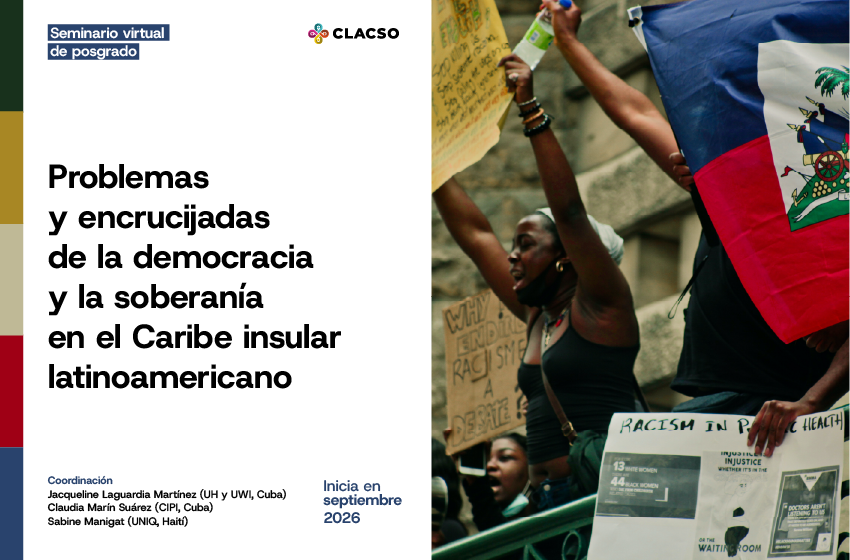
Seminar 2605
Coordination: Jacqueline Laguardia Martínez (Norman Girvan Chair of Caribbean Studies at the University of Havana and Institute of International Relations, UWI), Claudia Marín Suárez (CIPI, Cuba) and Sabine Manigat (Quisqueya University, Haiti)
Teaching team: Matías Bosch Carcuro (APEC, Dominican Republic), Julio Guanche (UNESCO Ecuador), Luis Emilio Aybar (ICIC Juan Marinello, Cuba) and Raymond Laureano (CLACSO Working Group «Crisis, responses and alternatives in the Greater Caribbean»).
Start date : 17/09/2026 | Registration : 03/07/2026 to 16/09/2026
Workload: 10 weeks – 90 hours.
This seminar is organized through a collaborative effort between specialists from several Caribbean countries. From their respective areas of expertise, they will offer a relevant and necessary training program in their modules, connecting participants with concrete realities and challenges.
Thus, the organizational structure of the Seminar is designed to provide theoretical, conceptual and methodological tools, as well as critical approaches, in order to analyze the problems and crossroads of democracy in the countries that make up the Latin American insular Caribbean, conceiving democracy and sovereignty in the capacity to build States and policies that guarantee rights and social, economic, environmental and gender justice, and at the same time to build capacity for self-government and integration in the face of new imperialist and colonial developments.
The course will be organized thematically into two parts: the first, theoretical in nature, will introduce the conceptual and factual history of democracy, the state, and societies in general, and of the Latin American insular Caribbean in particular; the second will present case studies of countries in this region to understand how challenges to democracy manifest themselves there. This will establish the theoretical framework from which to subsequently address specific local democratic issues.
Analyzing the major challenges facing the world today, one could argue that many of them stem from a “hollowing out of democracy.” This process implies that, in an increasingly complex global context marked by economic, political, and social crises, citizens are participating less and less in fundamental decisions affecting collective life, while at the same time freedom is positioned as the dominant political and cultural signifier of our time. This creates a paradox: the more freedom is invoked in public discourse, the less effective societies seem to be at exercising democracy as a collective practice of self-governance.
This apparent contradiction is explained by the consolidation of a political and cultural rationality that promotes aspirations for individual freedom while reducing spaces for democratic participation. This rationality produces subjectivities and common senses that naturalize the reduction of democracy to its procedural dimension, especially to the periodic act of voting. Democratic common sense loses political weight, weakening the idea of popular sovereignty as the foundation of collective life. In this scenario, citizens are progressively stripped of their capacity to influence the structural decisions that shape the social order.
The struggle to expand democratic spaces and build more egalitarian societies has been, however, one of the central axes of modern political conflict over the last two centuries. In the present, marked by the effects of neoliberalism, incomplete democratic transitions, crises of representation, economic blockages, the rise of authoritarian forces, and processes of depoliticization, new threats to the foundations of democracy are emerging. These tensions are particularly relevant in the Latin American Caribbean islands, a region whose political history is deeply intertwined with processes of colonization, dependency, external intervention, and disputes over sovereignty.
In this sense, the study of democracy in the insular Caribbean requires the central incorporation of the problems of colonialism, self-government, international interference, and regional integration. The historical trajectories of Cuba, Puerto Rico, Haiti, and the Dominican Republic reveal distinct but interrelated experiences in the construction of their political systems. The persistence of the colonial condition in Puerto Rico, the impact of revolutionary processes and the economic blockade in Cuba, international interventions and institutional crises in Haiti, and the dynamics of economic and geopolitical dependence in the Dominican Republic constitute indispensable dimensions for understanding the limits and possibilities of democratic practice in the subregion.
Despite the historical and political importance of these processes—many of them with regional and global impact—their joint analysis has been relatively scarce in Latin American academic debates, where they are usually addressed in a fragmented manner or subordinated to other research agendas. The lack of comparative and integrative approaches has limited the understanding of the relationships between democracy, sovereignty, and integration in the insular Caribbean.
This seminar aims to help fill this gap through a multidisciplinary and comparative approach that analyzes the problems and challenges of democracy in Cuba, Haiti, the Dominican Republic, and Puerto Rico. From this perspective, it seeks to understand the relationship between democracy and sovereignty in contexts marked by colonial legacy, structural inequality, economic dependence, and international interference, as well as to reflect on the possibilities for regional integration and the construction of more participatory, autonomous, and inclusive democratic projects.
GENERAL PURPOSE:
To offer rigorous and up-to-date training on the main problems and challenges facing democracy in the Latin American Caribbean islands, incorporating in a cross-cutting manner the analysis of sovereignty, the dynamics of external interference, and the possibilities of regional integration as constitutive dimensions of political life in the subregion. The seminar seeks to facilitate encounter, dialogue, and collective reflection on these historical and contemporary processes, understanding that, in a context of growing threats to democracy and cultural and ideological disputes, it is essential to strengthen the role of academia as an active actor in the critical understanding of reality and in supporting society by generating analytical tools to interpret its complexities.
In this sense, the seminar is part of a broader objective—both academic and political—aimed at contributing to the defense of democracy and the strengthening of popular sovereignty in contexts marked by colonial heritage, structural dependency, and the geopolitical tensions characteristic of the insular Caribbean. It also seeks to contribute to building horizons for regional integration and to developing critical capacities that allow for challenging anti-democratic common sense, promoting the consolidation of frameworks for democratic coexistence and citizen participation that strengthen the political autonomy of the region's societies.
SPECIFIC OBJECTIVES:
- To identify, using updated theoretical and analytical tools, the main problems and challenges of democratic development in the contemporary era, considering especially the relationship between democracy, sovereignty, structural dependence and international interference in the Latin American insular Caribbean.
- To characterize the problems and challenges of democracy in Cuba, Haiti, the Dominican Republic, and Puerto Rico from a historical and comparative perspective, taking into account their state-building trajectories, their experiences of self-government, the colonial or neocolonial persistences, and the tensions between national sovereignty and regional integration.
- To analyze the critical issues, political processes, social disputes and democratic transformation projects present in the subregion, promoting a space for meeting, dialogue and academic integration that contributes to positioning the relationship between democracy, sovereignty and integration as a central axis of reflection for the Latin American insular Caribbean.
- Introduction of the teaching team and the seminar as a whole. Group discussion to learn about participants' backgrounds and expectations.
- Historical problems of insular Caribbean democracy: the difficult democratization in a zone of coloniality and imperial borders
- The Caribbean in the geopolitics of the powers: limits and opportunities for CARICOM members in an international order in transition
- The economies of the insular Caribbean: impacts on politics and society
- Cuba and its democratic development during the Cuban Revolution: A historical approach and current perspectives
- Puerto Rico and its democratic crossroads in times of crisis
- Haiti and its possible democracy in an impoverished and occupied country
- Dominican Republic: From the post-Trujillo democratization experience to today's systematic depoliticization
- Workshop Session: Currents of political, ideological and cultural movements in the context of colonialism, intervention and rightward shift in the Caribbean
- Final activity for collective evaluation and closure
- Bosch, J. (2009). From Christopher Columbus to Fidel Castro. The Caribbean, Imperial Frontier. Mexico: Porrúa.
- Serrano Solares, C. et al. (2021). Thinking about the Caribbean from Juan Bosch and Eric Williams: 50 years after From Christopher Columbus to Fidel Castro. Buenos Aires: CLACSO
- Brown, Wendy (2016) The People Without Attributes. Barcelona: Malpaso.
- Jessop, Bob (2021). The State. Past, present and future. Madrid: Catarata.
- Bishop, M.L., Byron-Reid, J., Corbett, J. et al. (2021) Secession, territorial integrity and (non)-sovereignty: why do some separatist movements in the Caribbean succeed and others fail? Ethnopolitics.
- La légitimité démocratique – impartialité, réflexivité, proximité (Paris: Seuil) (2008)
- Benítez, Antonio (1986) The island that repeats itself: towards a reinterpretation of Caribbean culture. Cuadernos Hispanoamericanos, 429, pp. 115-130.
- Marín Suárez, Claudia and Regueiro Bello, Lourdes María (2024): “Caribbean Community (CARICOM) in the dispute between global powers” in López Bolaños, Alejandro César; Roffinelli, Gabriela; Estay, Jaime and Gambina, Julio (coords.): The disorder of the world economy and its challenges for critical thinking. Working Groups Collection. Buenos Aires, CLACSO. ISBN 978-987-813-949-4.
- Martínez, Laneydi and Cabrera, Maylín (2011): “CARICOM-United States relations in the 21st century: today as yesterday…” in Martínez Alfonso, Laneydi; Peña, Lázaro; and Vázquez, Mariana (coords.): Yearbook of Regional Integration in Latin America and the Caribbean. CRIES. No. 7, Year 2008-2009.
- Regueiro Bello, Lourdes María; Marín Suárez, Claudia; and Fernández Tabío, Luis René (2025): “Caricom in the crossfire of the strategic dispute between China and the United States” in Merino, Gabriel Esteban and Morgenfeld, Leandro (eds.): Our America, the United States and China. Geopolitical transition of the world system. CLACSO/Batalla de Ideas, Buenos Aires. ISBN: 978-987-813-998-2.
- Alberto Abello Vives and Ernesto Bassi Arévalo (2006). “A Caribbean outside the Plantation route”, A Caribbean without plantations Alberto Abello Vives (Comp.), San Andrés: National University of Colombia, pp. 13 – 43.
- Antonio Benítez Rojo (1988). “From the plantation to the Plantation: differences and similarities in the Caribbean”, Cuadernos Hispanoamericanos, no. 451-452 (January-February), Madrid: Instituto de Cooperación Iberoamericana, pp. 217-239.
- Humberto García Muñiz (2005). “The Plantation that does not Repeat itself: The Sugar Histories of the Dominican Republic and Puerto Rico, 1870-19301”, Revista de Indias, vol. LXV, no. 233, pp. 173-192.
- Jesús M. García Molina (2005). The Cuban economy from the 16th to the 20th century: from colonialism to socialism with a market, no. 28, ECLAC - Studies and perspectives series - ECLAC Subregional Headquarters in Mexico.
- Martínez Heredia, Fernando (2018). Thinking in Times of Revolution: An Essential Anthology. Compiled by Magdiel Sánchez Quiroz. - 1st ed. - Autonomous City of Buenos Aires: CLACSO, 2018.
- Valdés Paz, Juan (2019). The evolution of power in the Cuban Revolution. Volumes I and II. Mexico City: Rosa Luxemburg Foundation.
- Berbane, Rafael and Ayala, César J. (Ed.) (2011). Puerto Rico in the American Century: Its History Since 1898. San Juan: Callejón Editions
- González, José Luis (1989). The country of four floors and other essays. San Juan: Huracán.
- Villarini Jusino, Ángel R. and Núñez, A. (Ed.) (2019). New forms of democracy, new forms of citizenship: political culture of young Latin Americans. Editorial SM-OFDP.
- Manigat, Sabine, “Haiti in the Post-Cold War Era: The Changing State/Society Relationship”, in Lozano W., coord. Political Change in the Caribbean, FLACSO RD, ed. Nueva Sociedad, Caracas, 1998
- Pierre-Charles, Gérard, Haiti, despite everything, a utopia, ed., Siglo XXI, Mexico, 1999
- Seitenfus, Ricardo (2016). Reconstruct Haiti: between hope and the imperial trident. Santo Domingo: Juan Bosch Foundation and CLACSO. pp. 88-111. (PDF online)
- Hartlyn, Jonathan (2008). The struggle for political democracy in the Dominican Republic. Santo Domingo: Funglode.
- Ferrán, Fernando (2019). The big bet: a critique of Dominican democracy. Santo Domingo: General Archive of the Nation and PUCMM.
- Bosch, Juan (2016). Dictatorship with popular support. Santo Domingo: Juan Bosch Foundation.
- Ackerman, J. et al (2025). The rise of the right in Latin America and the Caribbean: Theorizing the problem and case studies. Autonomous City of Buenos Aires: CLACSO, UNAM and UASD.
- Prieto, F., Rivara, L. et al (2022). The new Plan Condor. Geopolitics and imperialism in Latin America and the Caribbean. Autonomous City of Buenos Aires: Batalla de Ideas.
| Early registration (until 10/08) | General registration (11/08 to 10/09) | Registration without discount (11/09 to 16/09) | |
| Full or Associate Member Center | $100 | USD 150 | $200 |
| No link | $150 | USD 225 | $300 |
FAQ
The basic requirements for taking a seminar are:
- Availability of at least 4 hours per week to dedicate to the seminar course.
- Internet access.
- Reasonable handling of communication and computer tools.
- Language proficiency in the language in which the course will be taught. The official languages are Spanish and Portuguese.
The seminars last 10 weeks, plus the completion of a final project. A total of 90 hours of dedication will be credited.
A course consists of ten classes, each accompanied by required reading bibliography, supplementary bibliography, discussion forums and training activities proposed by the teaching team, partial deliveries and a final project.
The course is online and asynchronous. Some instructors may propose synchronous activities. In those cases, the time and date will be agreed upon beforehand between the instructors and the students to ensure everyone's participation. Attendance at synchronous sessions is not mandatory.
To pass the seminar, you must participate in at least 80% of the discussion forums and activities proposed by the teachers, have completed the scheduled partial deliveries, and pass the final work.
| Early registration (until 10/08) | General registration (11/08 to 10/09) | Registration without discount (11/09 to 16/09) | |
| Full or Associate Member Center | $100 | USD 150 | $200 |
| No link | $150 | USD 225 | $300 |
The possible payment methods are by credit card or bank transfer.
Inquiries: [email protected]

