
Editing for the First International Colloquium: Dislocation and expansion in a hurry
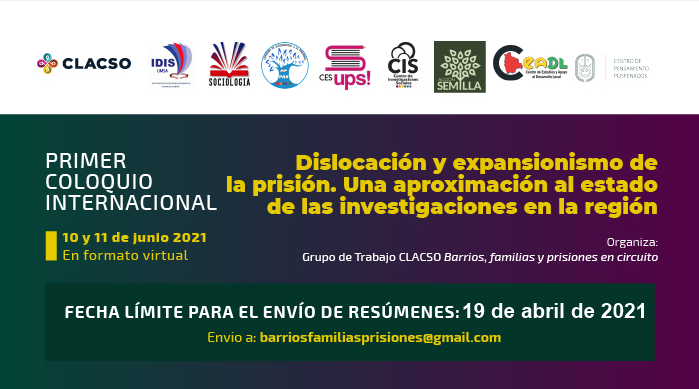
Click here to see the call for applications in Spanish
New date: open call until April 19
Virtual modality – June 10 and 11, 2021
The CLACSO Working Group “Bairros, famílias e prisons em circuit” convenes the First International Colloquium “Dislocation and expansion of prisons: An approximation to the state of research in the region”, which will take place in virtual format on June 10 and 11, organized by the Sociology course of the Institute of Sociological Research (IDIS) of the Universidade Mayor de San Andrés, or Centro de Investigações Sociais (CIS) of the Vice-presidency of the Plurinational State of Bolívia and Centro de Pensamento dos Egressos Prisionais (CPPP) of the Universidade Nacional da Colômbia.
This Colloquium is intended to continue the debate initiated at the last Meeting of Anthropology of Mercosul (XIII RAM, 2019), in which foram presented and disclosed the first works carried out in the perspective of the removal of prison spaces and that was resumed at the last congress of the Latin American Association of Anthropology (VI ALA, 2020), not Which format incorporates the studies of mobility that unfold around the imprisonment. We propose, at this moment, to extend the conversation by searching for a “state of the art” of research on the topic in our region, delving into some of the analysis results that were particularly useful in our previous findings.
We invite researchers from Social and Human Sciences who study the effects of incarceration, in particular from gender perspectives, the geography of prison spaces, the anthropology of violence, urban sociology and carceral studies, to present their research progress, results of ongoing work. already concluded, in order to collaboratively build an overview of the state of research in this broad and, at the same time, particular field, which crosses the studies on prison, urban conflict, social segregation and violence. We consider it necessary to establish two advances in our research to allow the debate of the categories as we work.
For these purposes, we organize five thematic tables:
- Prisons and circuit wards: flows, mobility, dynamics and strategies of prisoners, their families and social organizations. Previous trajectories, intra and extramural and forms of sociability. The concentrated prison experience. Methodological strategies.
- Government of Prisons and Bairros: the governance of separate spaces but in communication: continuities / discontinuities. The seletividade two orgãos penalis e do governo dos territórios. Continuum of criminal and social policy agency.
- Incarceration, territory and drug trafficking: The wars “against drug trafficking”, “against organized crime” and “against poverty” in the region: their consequences within prisons. Police interventions in problematic neighborhoods and incarceration from a gender perspective. Penal reforms, increase in prison population and institutional violence.
- Social organizations and incarceration effects: social reintegration strategies, work with vulnerable populations. Relationships with the State (mutual conditioning, articulations). Work cooperatives. Addiction and recidivism. Families and recidivism. Religious practice and recidivism.
- Methodological aspects of research in the field of incarceration effects: tools to decenter research. The scope of the «field» and its relationship with the native categories. Quem são “relatives of prisoners”? Longitudinal studies and ethnography. Pandemic and access to the countryside: reconfiguration.
Presentation and oil of products:
We summarize that we must refer to the results of specific research processes, either in progress or concluded. Those that refer specifically to Latin America, Central America or the Caribbean and that primarily use elements of empirical research will be prioritized.
These presentations must be framed in two five eixos:
- Prisons and wards in the circuit
- Government of prisons and neighborhoods
- Prison, territory and drug trafficking
- Social organizations and the effects of incarceration
- Methodological aspects of research in the field of incarceration effects.
Complete submission of presentations:
Maximum size of 25 pages (including notes and bibliography), line spacing 1,5, Time New Roman font size 12.
The deadline for submission of the final presentation is May 31, 2021.
Organization:
CLACSO Working Group on Neighborhoods, Families and Circuit Prisons
Sociology Department, UMSA (Bolivia)
Institute of Sociological Research, UMSA (Bolivia)
Center for Social Research, Vice Presidency of the Plurinational State of Bolivia
Center for Post-Convict Studies, UNAL (Colombia)

Support:
Build Foundation
Alternatives to Violence Program (Bolivia)
Center for Studies and Support for Local Development (Bolivia)
Seed Action Foundation (Bolivia)
Support Network for Families of Detainees (Argentina)

