
For a new feminist normal
Isabel Serra1
In Spain, the right wing, in cahoots with the far right, has seized the opportunity to exploit the fear generated by the coronavirus crisis to try to transform it into hatred of feminism, to the point that they attempted to convince the entire country that the origin of the virus's spread lay in the March 8th demonstration. It didn't matter that this virus knows no borders and is present worldwide, that there were hundreds of large events and gatherings that same day, or the usual overcrowding on public transport. The illogical nature of the claim didn't matter, because precisely in this climate of tension that the right wing tries to create, visceral reactions outweigh reason. Reasons don't matter because the goal is to attack feminism.
However, the risk to women and feminism does not lie in yet another attack from an extreme right wing that has been building itself up around the world for years, precisely in opposition to this powerful social movement. We have spent our entire lives making progress in the fight for our rights despite the conservative—and neoliberal—backlash from the right.
The problem we must address is that all crises are a severe blow to women, eroding our rights in particular, and this one is no exception. This is not only due to the devastating effects on our material living conditions—a harm that is rarely a priority to combat, as it wasn't in the management of the 2008 crisis. How many times have we heard these days, "With everything that's going on, and you're talking about feminism!"—with the intention, conscious or not, of deflecting the feminist agenda. Women's rights are also harmed when the differences between the positions we occupy in social life are magnified, and with them, inequalities. The roles of men and women in society, the sexual division of labor, the separation between those who should be in the private sphere and those who have the right to be in the public sphere—all become more pronounced in these times. It also often happens that women are sidelined as agents capable of managing crises and deciding how to address them. Especially in times of uncertainty and democratic exception, when "strongmen" reappear to offer security and protection. And this is even more pronounced when bellicose narratives are used to treat the fight against the virus as a war. Wars have always been waged by men, and in the current globalized context, war is always a war against women, as Rita Segato so aptly explains.
Of course, as long as women—and especially feminists—are always in the minority among those who decide how to respond to the crisis, the response will always be insufficient for us. And the effects on our material living conditions in this crisis are no less than in previous ones; this has been highlighted by international organizations such as the UN, which have called on governments to implement gender policies to address the Covid-19 crisis. They have also commended the Spanish government, recognizing it as the country that is most actively prioritizing policies to protect women's rights.
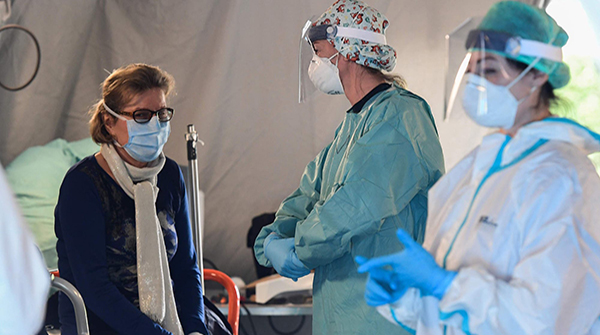
Despite this being a different crisis, primarily a health crisis rather than an economic one, women and their health are once again more vulnerable. The services and jobs that are acting as a barrier against the virus, caring for and protecting the population, are overwhelmingly performed by women. One only needs to look at the percentage of women in the healthcare sector (a report by the Carlos III Health Institute concludes that 76% of infected healthcare professionals are women), among pharmacy staff, in cleaning services, in supermarkets and grocery stores, and in elder care, both in long-term care facilities and nursing homes. Women are the majority in essential activities. We are the ones who care, always.
In economic and social terms, once again, we are the worst off. We have the most precarious jobs, with higher rates of temporary employment and involuntary part-time contracts. We earn lower wages, receive less income of any kind, and have easier access to informal employment. And as always, it is women who bear the burden of care work and social reproduction. The care crisis has been simmering for decades, and in crises like the current one, it resurfaces with greater force. This crisis stems from the State's inadequacy as a guarantor of public care services (primarily childcare and long-term care, but not exclusively) and the transformations of the family in recent decades, linked to the massive incorporation of women into the labor market since the 70s. These transformations have occurred alongside neoliberal advances that have cut back and privatized public services, creating a latent crisis that is now becoming evident.
The lockdown has not been a solution to these inequalities either; on the contrary, it has exacerbated existing inequalities. The closure of preschools (in the Community of Madrid, the Ayuso government has even cut services for the coming months, denying the budget agreed upon with the municipalities), the suspension of the school year, and teleworking (which we have finally learned as a society is not beneficial for either workers or companies) are circumstances that have further intensified gender inequalities. Not to mention single-parent families who have to go to work and have no one to leave their children with, the vast majority of whom are headed by women. And, of course, the quarantine has caused levels of gender-based violence to increase dramatically (up to a 47% increase in calls to the helpline for victims in Spain), generating insecurity for many women who cannot access external support, whether from individuals or institutions, in the same way.
From this crisis, however, arise opportunities connected to the critique that feminism has leveled for decades against our social, political, and economic model, and it is everyone's responsibility to seize them. This standstill sheds a glimmer of light, revealing what was either invisible or deliberately obscured by the powers that maintained—and will do everything possible to maintain—the old normal. While we are all confined to our homes, there are those who have been sustaining life outside our homes as well. It could be said that the question of "what" activity is fundamental to this sustenance and "who" is involved has emerged, revealing the social structure as if it were an X-ray showing the skeleton of our society. This sudden halt has forced us to question which activities are essential and which are not, how an economy and a society that prioritize the care of life and the well-being of people should function, and to grasp and reflect on the contradiction between capital and life when we have made decisions about returning to work and reopening businesses. It has also allowed us to experience that it is possible to drastically reduce consumption and that climate change depends entirely on our way of being in the world. Although, as Daniel Innerarity said in a talk recently, “Nature isn’t going to do our job”In other words, the fact that we have drastically reduced polluting emissions is not, and will not be, positive from a social justice perspective, nor therefore from a social ecology perspective.
We have felt more acutely an “interdependence” that is a prerequisite for our lives, as feminism has long emphasized. We have witnessed networks of mutual support emerging in neighborhoods and among communities, providing psychological, emotional, material, and physical support. Today, the population and society as a whole are more aware of the importance of public services in addressing future risks and enabling us to live in a democratic society where the concept of “freedom” is inseparable from that of “equality.” It depends especially on political forces and social movements that aim to advance social justice to place these lessons learned from the Covid-19 crisis at the heart of political debate, deciding, from a feminist perspective, how to address this new social crisis.
1- Spokesperson for the “Unidas Podemos” Parliamentary Group in the Community of Madrid, Spain.
If you would like to receive more information about CLACSO's training programs:
[widget id=”custom_html-57″]
to our email lists.

