
Why consider distance education?
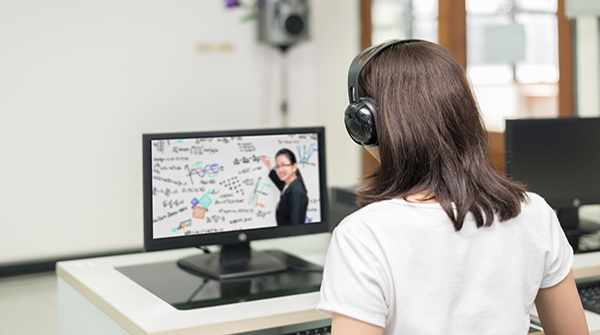
Asian woman student video conference e-learning with teacher on computer in IT room at university. E-learning, online, education concept.
Freddy Javier Álvarez González[1]
- What are the fundamental questions?
What does it mean to educate today, in times of pandemic, on our planet? How can we educate remotely? These two questions propose a state of the art, unthinkable for current governments, lost in their neoliberal ineptitude, which, with its pragmatism, dissolved politics into economics, with the corresponding manipulation and violence for its implementation. Hence, they became effective with lies and propaganda, and ineffective with life, death, and the grief associated with it; it was no surprise to them that they ignored the scientists' warnings about pandemics; on the contrary, they weakened international systems of joint action, public health systems, and education systems. That is why they now speak of the unpredictable, to avoid any responsibility, as will surely be the case with the already present phenomenon of climate change and its catastrophic consequences. Their fascist tendencies distance them from science, and they believe that research is a meaningless privilege and a waste of resources and time; they protect themselves in the conservatism of morality and the churches. Their followers are opportunists, the middle and upwardly mobile classes who don't want to lose their privileges, racists, xenophobes, and nationalists; they get elected through the politics of fear, formerly against communism, now against migrants, always against those who criticize neoliberalism and its profound inequalities, without realizing, as David Harvey points out, that El Capitalism It's a cruise ship adrift.where the few first-class guests continue their bourgeois parties while those below, working in the engine room, know that the engines have broken down; now, they themselves want that Let's continue with distance education, that the economy recovers as soon as possible, that we return to normal, no matter the price.
The two initial questions seep through the window of educational thought and practice and enter the lives of teachers. The globalized school, which had been disciplined by assessments, is now forced to abolish itself. Undoubtedly, digital education will be good news for neoliberals. Their wish will come true. The computer will eliminate future investments in educational infrastructure. The teacher will be nothing more than a tutor, a coach who prepares videos, pdfs, organizes the content with some learning objectives; the virtual platforms will do the rest, and while these improve, the teacher, as we know him now, will gradually disappear. Learn to learn It will have its most sinister side: If you don't learn, it's because you don't want to. Inequalities will not be caused by the market, because technology and the internet will be fundamental factors in the possible way out of the crisis: digital capitalismThe school for the elite will have no more opponents, as the educational and pedagogical act will be reduced to an individualistic action that emphasizes opportunities while leaving inequalities intact. The strongest will survive; the excluded, migrants, the poor, Afro-descendants, and women will fall further down the ladder, through the continuation of the same formula as the 2008 crisis. more austerity, leaving two questions unanswered: what does the pandemic teach us?, and how to educate to guarantee the life of everyone now and in the future?
The question about what or why The inevitable has been postponed ever since capitalism became the only possible economic model after the fall of the Berlin Wall in 1991. On the one hand, right-wing or progressive states and governments either accepted the rules or were condemned to be left out; in fact, there was no need to enter the system, we had always been inside it, which is why we had so much difficulty criticizing it. We were trapped in the fatalism of Laius, brought about by the Oracle of Delphi, with respect to his son Oedipus.
In the 20th century, the most real thing was the economy; the utopia of the 19th century was shelved, there was no way out, everyone should try to progress, with the same formula, as if it only will lead us dialectically to the other, and not to the implosion of the selfFaced with numerous failures, the 21st century has witnessed the disappearance of politics, a profound economic crisis, and the consequent rise of populist and fascist decadence exemplified by figures like Trump, Bolsonaro, Vox, Marine Le Pen, Salvini, Orbán, and others. Furthermore, free and visionary men and women have been persecuted under the false narrative of corruption, as socialist experiences have been stigmatized, hence the fear of becoming “Venezuela,” “Nicaragua,” or “Cuba,” promoted by the international right. At the same time, leaders of social movements committed to various forms of emancipation are being assassinated, as in the case of Colombia, or succumbing to a pessimism that leads to inaction.
The global crisis has forced capitalism to increasingly distance itself from democracy, even representative democracy; consequently, it will only win elections through virtual manipulation, vote buying, and fraud. Democracy will no longer be merely a failed endeavor of progressive governments, as portrayed by the media that serves capital. With capitalism fracturing, North American hegemony is dissolving, now more than ever because the humanism they demonstrated in World War II has been replaced by the face of... I'm only thinking about saving myself. America First. Now there are three global systems vying for global hegemony: the nationalist isolationism of Boris Johnson and Donald Trump (which will surely gain some followers after the pandemic); the almost extinct welfare state of the European Union, which is likely to enter intensive care; and the emerging Asian authoritarianism, with state capitalism and effective control systems for a new phase of... biopolitics and the bio-power in the style of Michel Foucault.
We cannot forget that the models of Finland, Shanghai, and Singapore are central to the contemporary educational landscape. North America lacks an educational model to export or impose, as privatization is not a viable path for Latin America and the Caribbean, and educational innovation already faces stronger competition. Nevertheless, its universities remain attractive for postgraduate studies. For how long? We don't know. What we do know is that China surpasses China in patents worldwide, and consequently, in scientific publications. So, who will sell the electronic devices for distance learning, which has become the only solution—previously driven by the democratizing narrative, and now necessary to prevent potential contagion? Undoubtedly, a broad Asian technological, techno-scientific, and bio-technological response already exists in the fields of nanotechnology, artificial intelligence, robotics, and Big Data—disciplines that are integral to 21st-century governance. Therefore, some issues will not even be up for debate. The decline of North America and the failure of Europe are undeniable.
What can we educators do? A key challenge is to educate in a way that doesn't make us dependent on a great OtherEducation fosters autonomy, and this objective does not contradict the construction of the common good. We educate ourselves with and through others; education is not an isolated act, as some would have us believe. digital totalitarianismEducation is a political act insofar as it combats the politics of Big Other which makes us believe it is indispensable for our lives. Emancipation is not about moving from Western to Asian domination. Walter Benjamin always thought that politics was profoundly a theological matter, because we detach ourselves from God to embrace the cult of charismatic leaders. Žižek rightly says that The emancipatory philosophical and political project is to achieve the removal of the Big Other. Having good teachers means learning to live independently, because they help us become ourselves. We only truly learn when we separate ourselves from those who taught us. However, the educational process, like politics, falls into the trap of omnipotence. The Great Other believes that the student becomes someone through them, which justifies something central to education: that education must allow for resistance to being educated as part of the educational process itself, without ever abandoning the duty to educate.
The task of teaching and learning to think is becoming increasingly important in our society and is becoming a central objective in our schools. Thinking attempts to fill the void of being, in Descartes' words. cogito ergo sum. That void will never be filled, and perhaps the proliferation of mathematics is meant to make us believe it's already filled, when in reality what exists is a vast hole. We mathematize what we cannot understand, just as we did during the pandemic, pretending to have a control we don't have.
Thinking is not a matter of democratic procedure. On the contrary, we must distrust majorities without abandoning democratic principles, since learning is learning with others and starting from others. However, we cannot fall into the trap of democracy as self-sufficiency that leads us to conform to mass behavior. A true democrat constantly experiences the absence of the Big Other, and therefore knows that revolution is justified by itself and not by majorities. Although Claude Lefort locates the void in democracy and not in being, he was right to say that democracy is necessary because There is no certainty, While Power, knowledge, and law are not coagulated.Democracy is learning to live with uncertainty because the king is dead, and what remains is an empty space that no one can fill. But one of its greatest dangers is that in catastrophes and moments of transgressive violence, it seeks a scapegoat in order to achieve catharsis, thereby attempting a return to normalcy.
Teachers are there to teach us how to emancipate ourselves from the Big Other—from family, religion, economics, politics, and culture. Therefore, plurality must be reduced to antagonism; otherwise, we fall into a tolerance equivalent to hypocrisy. Subtraction, not saturation by excess, is what places us in the tension underlying every act of emancipation, for it allows us to take part, for those who have no partAs Rancière would say, for the women who struggle to avoid being raped or murdered within still patriarchal societies; for the migrants who live dying at sea or at borders; for the Afro-descendants who die in the peripheries next to polluting factories or in prisons built so that whites can live peacefully exploiting blacks; for the children and adolescents who lack internet access, but above all, for those who lack the conditions for education; for the elderly who die alone and abandoned within an infantilized society that seeks to eternalize youth through the worship of the good life; for the billions of people who live in slums, shantytowns, favelas, and informal settlements, outside of capitalism and in the hands of mafias and evangelical churches; and for the Indigenous peoples and nationalities condemned to elimination since the conquest and now by extractive capitalism that displaces and kills them. They are, as Badiou says, the living dead generated by global capitalism, before the pandemic arrived.
The question, "What kind of education do we want?", arises from pure powerlessness. A delirious machine, without control or regulation, created by the large corporations that gave rise to globalization, has imposed itself on almost the entire planet, robbing us of the infinite with its logic of monopoly, limitless expansion, and usurious financing model—like the worst of crimes—through the allure of neon signs, music, and famous personalities in Times Square, Tokyo, Moscow, Beijing, Hong Kong, London, Paris, Buenos Aires, Mexico City, Bogotá, and São Paulo. This fantasy wasn't external; it belonged to the imaginaries that inhabit us, those of us who consider ourselves citizens of the North and South, urban and rural, rich and poor. Then, we don't forget the question of being, as Heidegger intended; we fall into oblivion of the question...What is life?At the same time, nature became an object that we experience through tourism, or need only to do sports, to get out with our children and pets from the modern prison that urbanism builds, to de-stress thanks to one of the last gestures of charity of capitalist modernity.
In this condition of sleepwalking citizens, frenetic consumers, and bored and guilt-ridden individuals caught in the immediacy of the act and the impulse, within late capitalism as the sole and unsurpassable model of life, despite its eternal crisis and annulment of the future, and with the seductive aspect of a impulse capitalismAs Bernard Stiegler points out, human rights are chained to remaining hidden within the system; therefore, the human right to education is not questioned. What kind of education is that? This gesture is repeated in the mandatory requirement of distance education, just as the rights of minorities are reduced to inclusion within a system that inertia-drivenly excludes them, as also happens with the added respect for nature, without losing sight of the brutality with which capitalism expands, destroying it, and weak and complicit states experience it as inevitable even though they enshrine the rights of nature in their constitutions or proclaim them in their policies. Something entirely different is found in the claim of affection for nature, of the indigenous peoples of the world.
The right to life must be accompanied by simple, feasible, and community-based responses, starting from our understanding of life; without this, we will continue to educate for selection and competition in a world that not only kills others, but now we know also It kills us, Because from the beginning, life has been reduced to a transaction between use value and exchange value. Vital needs are traded, speculated upon. Lives are not equal; life itself is subject to the value assigned to it by capital, a value that corresponds to the stock exchanges of New York, London, and Paris, which operate within the framework of mathematical acceleration and calculation that govern us but are ungovernable.
Proposing distance education as an immediate solution raises two fundamental questions: What does what we are experiencing mean? What is distance education? Is it like keeping the car at high speed, heading straight for the abyss in front of us, or drowning in it? the icy waters of calculus, As Marx said, resorting to previous solutions is all we have when science is as perplexed and distressed as we are; thus, soap and water and responsible, mandatory distancing are sensible solutions. But trying to play magician, pulling a rabbit out of a hat when it was already there, in the face of the braking —an expression used by Walter Benjamin—, is to believe that, in the catastrophe, even the right to think has been closed.
Distance learning will deepen the gaps, because they existed before the pandemic, and because education is increasingly being designed for topIt is disciplined by evaluations, besieged by the loss of free education and privatization, and relentlessly commodified by capitalism and its technologies, consequently becoming a destiny, even by the anti-pedagogical narrative of neuroscience and artificial intelligence that tries to make us believe that we no longer need to think, when it fundamentally forgets that intelligence is a biological matter as Markus Gabriel points out.
- What do we mean when we talk about moving to distance education?
The “cancellation” of school and formal education in general due to confinement and mandatory social distancing has placed us in a digital world that has become unique and necessary; virtuality is not strange to us because its presence has been around for decades, though not as long as the State of Emergency. So far, we are witnessing virtual education systems that are becoming commonplace in the market and, consequently, with the almost nonexistent democracy, deepening individualization, even though they are justified by majority access. The equation, access-democracy, is not real, but what is undeniable is that it is good news for the market and for the democracy of numbers. In any case, it would seem that we have no choice, the so-called “presence"It must be suspended, it will probably be extended; before, the outside world was already unsafe, now it is threatening, terrifying; we even have to prevent others from coming to infect us, the State of Exception seems to say, finally, there is a "good reason" to kill migrants, the fascist dream is being fulfilled under the guise that distance is a matter of "health", "prudence", and better, of "survival"; thus, "blessed be" virtuality.
The virtual world has been shaped by the shift from analog to digital. The famous and oft-repeated question in every colloquium and seminar on education:Should we turn off cell phones in the classroom or not? It already indicated that we weren't alone in the classroom, that someone had entered uninvited, and we began to question ourselves: if communication wasn't so kind to education, was clinging to the presence Is it accompanied by our digital ignorance? Or, what is there in education that cannot be virtualized?
Existence is real: we eat, work, sleep, love, have sex—all these aspects form a spectrum we can call real. However, each of them is permeated by the fantasy within which virtuality is inscribed. In other words, our psychic apparatus—real, symbolic, and imaginary—following Lacan, is clothed by the experience of the virtual. Creating distance between teacher and student, between boss and employee, carries an ambivalent charge. Virtual distance is positive because it avoids contact, guaranteeing continuity. Virtual distance is negative because it is not real. However, the previous answers are simplistic. We have no doubt that it avoids contact, but what continuity does it prolong? From an educational and pedagogical perspective, what does virtuality allow us to do, and what does it not allow us to do? How can we make the virtual connection educational? Finally, is there education in the exclusivity of virtuality?
There is a consensus among educators and pedagogues that Education is a relationship. Consequently, the question is whether distance education can be considered a relationship. Undoubtedly, yes. So, what kind of relationship does distance education guarantee? Here, a discussion opens up, first because of the digital divide, then because of the limited or almost nonexistent training of teachers for this modality, and then because of some critical aspects that pedagogy brings to light. Some of these include the elimination of the school, which has many other meanings beyond learning, and others, as Meirieu pointed out, such as the elimination of context, the body, and institutional structures by centralizing something that was inherently random. Therefore, the question of relationship would force us to define: what kind of relationship is needed for virtual learning to occur? Then, how can we learn with others, and how can we ensure the continuity of the future, the care of life, and the institution of humanity?
La education as a relationship Distance education fails to recognize the diversity of contexts, precisely because of the denial inherent in virtual learning. Educating a middle-class family is not the same as educating a working-class family where cell phone data is a costly expense. It disregards the diversity of learning styles. Being a primary school teacher is not the same as being a special education or early childhood education teacher.
By eliminating the body, the importance of motivation, approachability, follow-up, and listening is also eliminated, precisely because the individuality of the market is multiplied for massification. Results guide its way of operating. An education without the body makes Descartes' dream a reality. the cogito determines beingIt is not surprising that, the more we study remotely, the more inequalities inside and outside are reproduced due to the degree of abstraction we are experiencing.
Distance learning is disrupting institutional structures. Most online, on-the-fly projects don't require a physical location; the location can be anywhere, and the time can be anywhere. Now, in lockdown, work, married life, leisure, and education are vying for space, time, and the affirmation of individuality, precisely because the non-institutional fails to recognize that life is institutionalized and that pedagogy itself has a significant institutional component.
Beyond the obstacles we've presented, we also encounter some underlying ones that stem from the virtual environment itself, since it's precisely because it's virtual that we can operate remotely. Let's examine these aspects that are at play and that we often overlook because they're so captivating. (To be continued…)
[1] Philosopher. Former rector of UNAE, Ecuador. Current researcher at UNAM, Mexico.
[+] Thinking about the pandemic

If you would like to receive more information about CLACSO's training programs:
[widget id=”custom_html-57″]
to our email lists.

