
For the full exercise of the right to popular demonstration
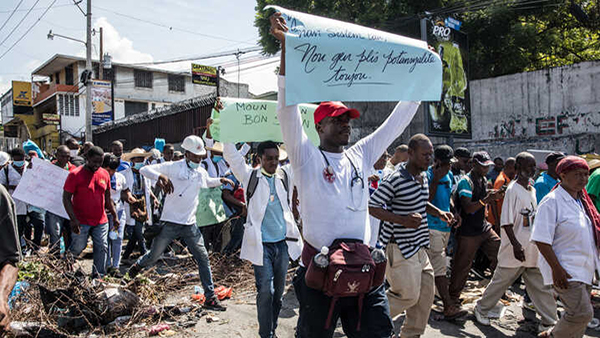
Protesters, medical professionals, and political opponents demonstrate during a demonstration demanding the resignation of President Jovenel Moise in the Haitian capital in Port-au-Prince on October 30, 2019. – Over the past year, Haiti has sunk deeper into political crisis amid anti-corruption protests demanding President Jovenel Moise's resignation. (Photo by Valerie Baeriswyl / AFP)
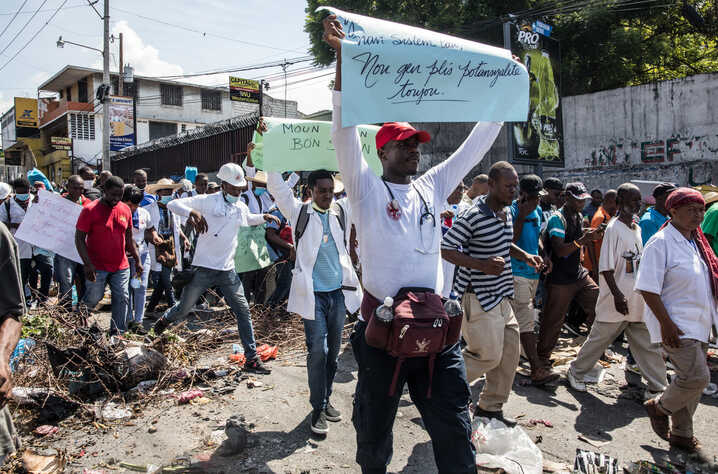
The Steering Committee of the Latin American Council of Social Sciences and the Working Group “Crisis, Responses and Alternatives in the Greater Caribbean” express their concern regarding the current situation of the Haitian people, specifically:
- A fractured democracy. Legislative and local elections were due in 2019, but they have not taken place due to government inaction. Since January 2020, parliament has ceased to convene, allowing the President to issue more than 40 decrees that undermine the country's institutional legality and nullify the mechanisms for controlling the Executive branch.
- The lack of guarantees for citizens' rights. Over the past three years, waves of violence perpetrated by armed paramilitary groups have been staged, particularly against residents of working-class neighborhoods. In response to citizens exercising their right to protest, these groups have used excessive violence, resulting in the deaths of young people, students, intellectuals, workers, and activists. A prime example was the assassination, on August 28, 2020, of Monferrier Dorval, President of the Port-au-Prince Bar Association, a prominent intellectual, and professor at the State University of Haiti. In addition to these deaths, numerous kidnappings occur daily.
- Deepening inequality. A catastrophic assessment of the last 10 years reveals that more than two million Haitians are suffering from hunger. An estimated six million are in a state of emergency and require humanitarian aid. The national currency devalued by 147% between 2009 and 2020, causing a collapse in the purchasing power of wages, a phenomenon exacerbated by the currency crisis and soaring inflation, which reached 25% in 2020.
Given this context and heeding the call from organized groups in various sectors for a general strike to express their outrage at the kidnappings and insecurity, and at the same time to assert that the Haitian Constitution, which establishes the end of Jovenel Moïse's term on February 7, 2021, must be respected, the CLACSO Working Group "Crisis, Responses and Alternatives in the Greater Caribbean" calls on the Haitian authorities to guarantee the safety of citizens in their exercise of the right to popular demonstration.
We call upon the international community, and specifically the Caribbean peoples, for their support and solidarity with the Haitian people in their call for demonstrations demanding respect for their right to self-determination and to live under constitutional law. We support the Haitian people in their demand for a political transition beginning February 7th, aimed at restoring democracy, institutions, and a government that works for the benefit of all Haitian society.
CLACSO Steering Committee
Working Group “Crisis, Responses and Alternatives in the Greater Caribbean”
February 2021
If you would like to receive more information about CLACSO's training programs:
[widget id=”custom_html-57″]
to our email lists.

