
Let's put an end to the neoliberal experiment in education
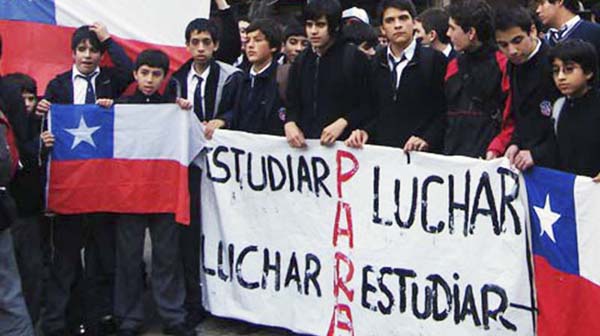
The current context of social mobilization, unprecedented in Chile, opens a favorable scenario for making the structural changes that the education system requires: the same changes that the political class declared unfeasible or “inadmissible” are now imperative, as educational stakeholders' organizations have been pointing out for decades. These organizations have put forward numerous proposals throughout these years of struggle for education, which are an important basis to consider in this moment of mobilizations. [1]
What is the origin of the problems in Chilean education?
The Chilean educational model is considered worldwide as a unique experiment in market forces, competition, and privatization. It is time we put an end to it. This model had two phases of implementation, and understanding them is fundamental to getting to the root of the educational problems we face today. The first phase occurred in the early 80s when the civic-military dictatorship led by Pinochet radically transformed the main pillars of the educational system. These transformations were threefold:
1) A new definition of educational rights and the role of the State in the 1980 Constitution: it establishes that the role of the State is not to guarantee the right to education, but rather to limit itself to providing subsidies to public and private educational entities (what is known as the subsidiary State and equal treatment for State and private institutions). Likewise, it establishes that the most legally important educational right in Chile (because it is constitutionally guaranteed) is the so-called right to “freedom of teaching,” which is defined as the “right to open, organize, and maintain educational establishments” (Article 19, paragraph 11).
2) A new legal entity is created to manage schools: the "sponsors." Chilean schools are no longer under the direct control of the State, but are instead administered by these sponsors, which can be public (municipalities or local education services) or private (subsidized private schools). These sponsors hold central authority over the educational process: they manage the financial resources provided by the State, administer the hiring of teaching and non-teaching staff, establish regulations for students, and define potential curriculum adjustments. They can even close schools for the academic year without consulting the communities, as the mayor of Santiago has done with the Instituto Nacional and the INBA.
3) A financing system called demand subsidy or vouchersThis system stipulates that the State does not directly fund public schools to cover their minimum needs (basic funding), but rather provides a subsidy to the school administrators (not the school communities) based on enrollment and average student attendance over the past few months. This funding model fosters competition between public and private schools for the subsidy and has led to the closure of nearly a thousand public schools due to declining enrollment.
The second phase of the market-based education model took place during the post-dictatorship civilian governments. This second phase is characterized by the refinement of the market model, the massive incorporation of members of the Concertación and Right-wing parties into the education sector through private universities and as owners of subsidized private schools, and the implementation of processes of covert or outright privatization. This latter process not only seeks to transfer ownership of schools to private owners, but essentially consists of forcing public institutions to operate like private businesses. To ensure that the entire education system functions according to the logic of a private enterprise, one of the main tools used was educational standardization: primarily through the intensified application of SIMCE tests, the increased consequences for schools, and the implementation of individual teacher evaluations for teachers in Chile. [2]
Essential and urgent measures to dismantle the market-driven education model
At this historic moment of popular mobilizations in Chile, we cannot repeat the same mistakes made over the last 30 years, during which reforms were implemented that ultimately strengthened the market-driven model of competition and privatization. The proposals developed by educational organizations over these years hold the key to building a new educational model that is not based on the market, profit, and competition, but rather on the well-being of the majority of the population. To contribute to the numerous debates taking place in the country, we want to propose essential and urgent measures to dismantle the market-based educational model, based on the following proposals:
1. Construction of a public education system that is articulated, democratic, non-sexist, inclusive, with quality infrastructure and community control from early childhood education to higher education. Today, public education is severely diminished; only 32% of primary school students (the most vulnerable) attend public schools, and less than 15% of higher education students attend public institutions. Furthermore, its infrastructure falls far short of the dignity required by the children and young people who need it most—an unacceptable situation, given that public education is responsible for building a more humane, equitable society that respects the rights of all.
The public education system must be the best and guaranteed by the State. It must be diverse and democratically managed, with decisive and binding school councils, and with mechanisms that promote the participation of the organized community, which will ensure the relevance of the curriculum and the transparent use of resources. The public education curriculum must, at a minimum, promote a democratic, inclusive, and non-sexist society. [3]
In the immediate future It is urgent to stop the closure of public schools. It is imperative to eliminate the current system of educational providers, both through municipalities and local education services. It is necessary to correct the serious deficiencies and privatizing tendencies within local education services. Likewise, it is urgent to establish a public education repair fund to rebuild the damage already inflicted by the neoliberal earthquake.
2. Build a new financing system for public educationThis funding should be preferential, of a basic nature [4], and its amount should be established by the needs of the communities [5]. Likewise, State Universities should be preferentially funded, which must guarantee mass access for popular sectors, be free of charge, and be at the service of national and local needs, contributing to the cultural, economic, and social development of the territories [6].
In the immediate future It is urgent to end the private sector business in educationIt is necessary to end the multiple forms of hidden profiteering permitted by the so-called "inclusion law." It is necessary to freeze and begin reducing the allocation of resources to private educational institutions. It is necessary to halt the system of concessions in the various public education services (JUNAEB, MINEDUC, ATEs, etc.). Finally, it is essential to forgive all educational debts, including student loans (CAE); studying cannot be a sentence.
3. End the SIMCE and all types of standardization. The SIMCE test is not an educational tool, but rather a tool for promoting the market and competition among schools. Students' results on the SIMCE depend primarily on their background (basic living conditions, access to healthcare and nutrition in early childhood, etc.) and very little on the school's practices. For this reason, these types of tests are not used to measure school quality under any circumstances worldwide. Many countries recognized for their good education systems do not administer these tests, and those that do only administer them to a representative sample, not to all students.
In the immediate futureIt is urgent to eliminate the universal (census-based) application of the six SIMCE tests (which is a lucrative business for the private institutions that administer them). Any standardized test administered must be sample-based, providing general information while eliminating competition between schools. Likewise, it is necessary to eliminate individualized teacher evaluations. It is now known that there is no clear correlation between being a good teacher and obtaining high scores on teacher evaluations. Professions like teaching cannot be measured through a standardized test. The only real objective of this evaluation is to destroy educational communities and foster competition and individualism among teachers.
4. To create suitable working conditions for education workers. Teachers and education assistants know that their working conditions have progressively deteriorated in recent years. This includes a decline in salaries and material resources (many educators pay out of their own pockets for basic classroom materials such as paper, markers, and photocopies). But it also includes a deterioration in the psychosocial aspects of their work: excessive workload, lack of support, pressure and control, meaningless tasks, lack of autonomy, and so on.
In the immediate futureIt is necessary to end the arbitrary dismissal of education workers at the end of each year. It is essential to eliminate individualized teacher evaluations and build a teaching career path that fosters collaborative work, not competition, and that guarantees sufficient non-teaching time. Likewise, it is essential to improve the salaries of education support staff.
5. Stop the criminalization of the student movement. It is obvious that the participation of young people should be promoted in schools, not persecuted, but facilitated, as it is the engine of transformation of our society (as has become clear in recent weeks).
In the immediate futureThe Safe Classroom Law and the Juvenile Criminal Responsibility Law must be repealed, and the School Violence Law must be reviewed, as these are instruments that penalize school life and the participation of young people. The use of internal regulations or coexistence manuals must be rethought; these should be developed from a civic and pedagogical perspective, and never again from a punitive one.
6. Stop the bills privatizing early childhood education that are currently in parliament and that the Piñera government intends to passCurrently, the government is promoting two legal initiatives in Parliament, in a clear attempt to extend the commodification of education to early childhood education. The first is the school subsidy for middle school levels, which means the entry of new private actors into early childhood education through a payment-for-attendance system—a scheme analogous to the one that fueled widespread privatization in primary education and has caused so much harm by promoting commodification and competition. The second, which the Executive Branch has expedited, is the universal childcare project, which seeks to have workers finance their children's attendance at preschool through their unemployment insurance. This project excludes the children of self-employed workers and public sector employees. Furthermore, it jeopardizes the care and stimulation of infants, as the centers will be limited to 42 infants with three adults in charge. The only ones who win with these projects are the companies, which will no longer have to finance the kindergartens of their employees' children, and the education entrepreneurs who will once again profit from public resources.
A new Constitution for a new public education
For these changes to the market-based educational model to be viable and sustainable over time, it is necessary to change the political Constitution that currently establishes that the most important educational right in Chile is the right to the misnamed “freedom of teaching” (Article 19, paragraph 11).
It is urgent to draft a new Constitution that establishes a State guaranteeing educational and social rights in general, defining lifelong learning as a guaranteed right, without any kind of discrimination. The right to education enables the exercise of other rights; therefore, it should not be limited by any type of individual, corporate, or business freedom.
As social organizations and the mobilized people in general have pointed out, this constitution must be drafted through a national process of a Plurinational Constituent People's Assembly, with broad participation at the neighborhood, local, provincial, regional, and national levels. The people are already debating this through town hall meetings and territorial assemblies; their voices must be given weight and validity.
CHILEAN OBSERVATORY OF EDUCATIONAL POLICIES
UNIVERSITY OF CHILE
November 8, 2019
[1] See publication Forum for the Right to Public Education “A decade of struggles and proposals for the right to education”. A summary of proposals from educational stakeholders from 2005 to 2015
[2] See more about this in Juan González and Diego Parra (2016): Commodification of Education. Comments on the Educational Reform in Chile 2015. Revista Enfoques Educacionales 13(1), 71-89.
[3] ACES (2011): “Proposal for the Education We Want”.
[4] It is worth remembering that when the New Public Education bill was debated (2016), the Chamber of Deputies agreed that public education should not be financed through competition for subsidies, but rather should have a base funding structure. Unfortunately, as so often happens in the Senate, the right wing and the mercantilist sectors of the new majority cooked up something else entirely.
[5] See Forum for the Right to Public Education (2014): How Much Does the School We Want Cost?; ANDIME (2015): Proposal for the Return of Schools and High Schools to the Administration of the Ministry of Education; Fundación Sol (2019): Indebting to Govern and Commodify. The Case of the CAE (2019 Update). Fundación Sol and Educational Debt Movement (2017): Letter for the Abolition of Educational Debt. These proposals share the common feature of a preferential financing system for public education, with a variable amount according to the needs of the communities.
[6] See CONFECH proposal (2017): Fundamental principles for a New Public Education.
If you would like to receive more information about CLACSO's training programs:
[widget id=”custom_html-57″]
to our email lists.

