
Public policies and gender justice
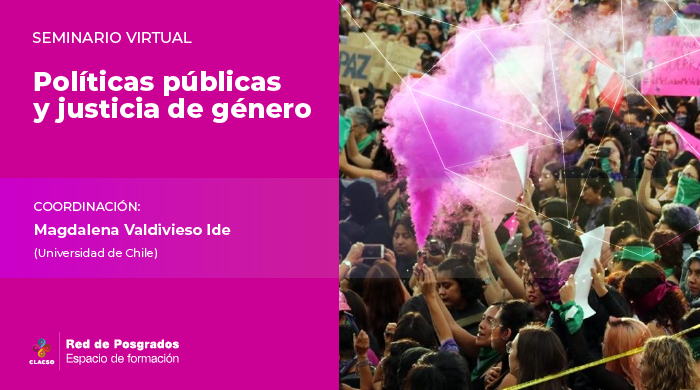
Seminar 2309
Chair : CLACSO
Coordination : Magdalena Valdivieso Ide (UCh, Chile)
Teaching team: Karin Bock Gálvez (UCh, Chile), Eliana Cherubini Sánchez (UNES, Venezuela), Mitzy Flores Sequera (University of Carabobo, Venezuela) and Sofía Schuster Ubilla (UCh, Chile)
Home: 25/04/2023 | Registration: 20/12/2022 to 24/04/2023
Workload: 12 weeks – 90 hours.
The seminar analyzes public policies as instruments of state action to advance gender justice in complex social contexts. Conceived as a space for the theoretical and practical training of professionals from various disciplines, the seminar develops its program through presentations, guided readings, discussion forums, group work, and report writing, among other activities.
The program begins with a review of the current socio-political context and the main public issues in our region, from a gender perspective. It analyzes and evaluates the role of the State as an agent of gender equality, examining the state of gender institutions and public policies for gender equality in different countries. The theoretical and conceptual framework is based on feminist theories; the principles and concepts related to gender justice are studied, various approaches to addressing gender inequalities are reviewed, and public policies with a gender perspective are evaluated.
Developing this seminar at this time presents several challenges. On the one hand, the pandemic and its differentiated effects on men and women exposed the weaknesses of the social organization of care, the institutions responsible for providing it, and public policies, highlighting the unjust distribution of caregiving tasks. On the other hand, it revealed the weaknesses of public policies and gender-related institutions in our countries. These situations and their consequences are occurring within a broader context of crisis in global models and ways of life, and these issues will be the subject of analysis and reflection at the seminar.
Gender justice has become a fundamental element of social equity, a challenge to democratic coexistence, and a prerequisite for sustainable development. The State, as guarantor of social equity, has a responsibility to undertake initiatives to correct gender inequalities and inequities and to restructure itself in order to prevent the perpetuation of the system of gender restrictions inherited from patriarchal culture.
Addressing and overcoming inequalities is one of the most urgent challenges facing Latin American societies in order to sustain democratic coexistence and advance sustainable development processes. This will hardly be possible without public policies that address gender inequalities and inequities, which are linked, intersected, and reinforced by ethnic and racial inequalities, inequalities related to the life cycle, and territorial inequalities.
Public policies are a fundamental tool for driving the economic, political, social, and cultural transformations essential for advancing gender justice. Most states in Latin America and the Caribbean have implemented public agendas in recent decades to address the main gender gaps and barriers; however, progress is slow, and significant discrimination and problems persist, such as gender-based violence, political underrepresentation, overrepresentation in poverty, the disproportionate burden of caregiving responsibilities on women, and the lack of recognition of a range of economic, social, and cultural rights that limit women's decision-making capacity and autonomy. All of this demonstrates that power structures have not been substantially modified and that structural gender distinctions remain in the region's societies.
GENERAL PURPOSE
The main purpose of the Seminar is to deepen the analysis and debates related to gender inequalities in the region and the actions of States as guarantors of social equity, as well as to provide conceptual, methodological and instrumental frameworks that allow them to understand the formulation process and the importance of public policies as tools to correct gender inequalities and advance gender justice.
SPECIFIC OBJECTIVES
That the students
- Identify and analyze the main political, social, economic, and cultural trends present in the global, regional, and national context and explain
how they affect situations of equality and gender equity and the generation and management of public policies.
- Learn about and be able to apply different theoretical and methodological approaches to address situations of inequality and gender exclusion.
- Explain the content and scope of the concept of gender justice and establish its relationship with public policies.
- Describe and explain the role of the State and especially public policies as agents of gender equality.
- Analyze the public policy generation cycle from a critical gender perspective.
- Learn about and use methodologies for evaluating public policies for gender equality and equity.
- Value gender justice as a condition for coexistence, democracy and sustainable development.
- A look at the regional socio-political context and main public problems from a gender perspective
- A systemic look at gender gaps, barriers and restrictions, theories and approaches for addressing them
- Gender Justice and the Role of the State
- Public policies, public decisions and gender equality
- Gender-focused public policy analysis
- Aguirre Rosario, García Sainz Cristina and Carrasco Cristina (2005) Time, the times, a yardstick of inequality. Women and Development Series No. 65. ECLAC, Santiago, Chile.
- Benavente Riquelme María Cristina and Alejandra Valdés Barrientos, (2014) “Public policies for gender equality: a contribution to the autonomy of women”, ECLAC Books, No. 130 (LC/G.2620-P), Santiago de Chile, (ECLAC),
- Carrasco, Cristina (2016) Times in conflict, unsustainable societies, necessary dialogues. Journal of Critical Economics, Association of Critical Economics, vol. 22.
- Cliche, G., Ranaboldo, C., Serrano, C. (2015) “Territorial approach for the empowerment of rural women. In Latin America and the Caribbean”. Lima, IEP; Nuevas Trenzas.
- Diez, María Laura (2004). Reflections on interculturality. Anthropology Notebooks
- Oszlak, Oscar and Guillermo O'Donnell (1982), “State and state policies in Latin America: towards a research strategy”, Venezuelan Journal of Administrative Development, No. 1, Caracas
- Pérez Orozco, Amaia. "Multidimensional Crisis and Sustainability of Life." Feminist Research, vol. 2, 2011.
- Zapata Martha, Galindo Sabina García Peter Jennifer Chan de Avila Editors (2012) Intersectionality in Debate. Institute of Latin American Studies Freie Universität Berlin
|
|
Discount for one payment until 17/04 |
In one payment after 17/04 |
|
CM Plenos |
$75 |
$150 |
|
CM Associates |
$95 |
$190 |
|
No link |
$95 |
$190 |
FAQ
The basic requirements for taking a seminar are:
- Availability of at least 4 hours per week to dedicate to the seminar course.
- Internet access.
- Reasonable handling of communication and computer tools.
- Language proficiency in the language in which the course will be taught. The official languages are Spanish and Portuguese.
|
|
Discount for one payment until 17/04 |
In one payment after 17/04 |
|
CM Plenos |
$75 |
$150 |
|
CM Associates |
$95 |
$190 |
|
No link |
$95 |
$190 |
More information: [email protected]

