
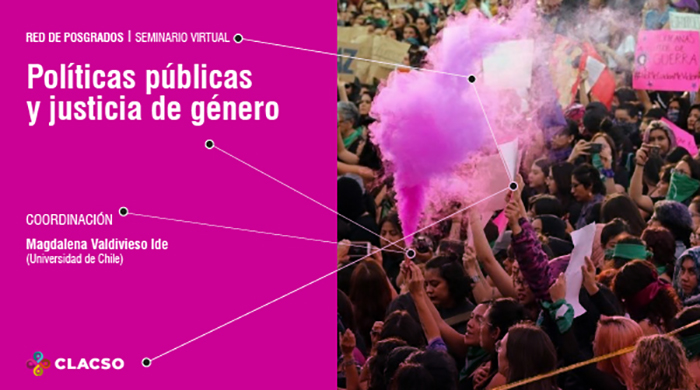
Public policies and gender justice
Seminar 2118
ChairCLACSO
Coordination: Magdalena Valdivieso Ide (UCh, Chile)
Teaching team: Karin Bock Gálvez (UCh, Chile), Eliana Cherubini Sánchez (UNES, Venezuela), Mitzy Flores Sequera (University of Carabobo, Venezuela) and Sofía Schuster Ubilla (UCh, Chile)
HomeApril 22, 2021 Registration: 17/12/2020 to 20/04/2021
Workload: 12 weeks – 90 hours.
This seminar aims to study and evaluate how Latin American and Caribbean states use public policies to advance gender justice. To this end, it identifies the complex situations of gender inequality present in our region and analyzes the various approaches used to design public policies aimed at addressing these inequities.
Relating public policies to gender justice requires a deeper analysis of public policies as instruments of state action and reflection on how we understand gender justice.
In recent years, gender justice has become a fundamental element of social equity, a challenge to democratic coexistence, and a prerequisite for sustainable development. The State, as the guarantor of social equity, has a responsibility to undertake initiatives to correct gender inequalities and restructure itself to prevent the perpetuation of the system of gender restrictions inherited from patriarchal culture.
Furthermore, a gender perspective in public policy design recognizes that the roles, rights, obligations, resources, and interests of women and men are culturally and socially determined in an unequal and hierarchical manner. This means that requirements, priorities, needs, and interests must be considered differently in the formulation of policies, programs, and projects, as well as in the design of management, evaluation, and monitoring systems. However, a gender perspective alone is insufficient to address situations of inequality. Therefore, the Seminar reviews other approaches that are used in conjunction with gender to understand the complexity of intersecting inequalities that affect women's quality of life.
Developing this seminar during this pandemic presents several challenges. On the one hand, the pandemic, which has undoubtedly had different effects on men and women, exposed the weaknesses of the social organization of care, the institutions responsible for providing it, and public policies, and highlighted the unjust distribution of caregiving responsibilities. On the other hand, it revealed the utter weakness of public policies and gender-related institutions in our countries, so these are issues we must address and reflect upon.
We cordially invite you to be part of this space for the exchange and production of knowledge, in which we highly value the contributions of those who participate, who enrich the exchanges with the diversity of experiences, due to their professions and nationalities.
Regional political context, gender inequality and public policies.
Restrictions, barriers and gender gaps; theories and approachesfor its treatment Restrictions, barriers and gender gaps; theories and approaches to addressing them Role of the State, Public Policies and Gender Justice Analysis of public policies with a gender focus.
Dallanegra Pedraza, Luis, The Latin American Political System. Political Reflection [online] 2003, 5 (June)
OECD: Regional Report Social Institutions and Gender Index.
AWID “Intersectionality: A Tool for Economic Justice.” In Women’s Rights and Economic Change No. 9, August 2004
Cliche, G., Ranaboldo, C., Serrano, C. (2015) “Territorial approach for the empowerment of rural women in Latin America and the Caribbean”. Lima, IEP; Nuevas Trenzas.
Cristhian Aid (2017) The scandal of inequalities. Project Documents, No. 436 (LC/W.436), Santiago de Chile.
Gómez E. Gender analysis: Conceptual and methodological bases. PAHO. WDC. [internet] 2011
Kabeer, Naila (2012) Women's economic empowerment and inclusive growth: labor markets and enterprise development, IRC, SIG WorkingPaper 2012/1, DFID, Ottawa.
Kabeer, Naila (2008) Paidwork, women's empowerment and genderjustice: critical pathways of social change Pathways Working Paper 3. Brighton: IDS England.
Longwe C. The conceptual framework of equality and empowerment of women. In: León M (Comp.), Power and empowerment of women. TM Editores [internet] 1997.
Rimisp (2016). “Latin American Report on Poverty and Inequality – 2015: Gender and Territory”. Santiago, Chile. IDRC – IFAD.
Aguilar Astorga and Lima Facio: What are Public Policies and what are they for?, in Contributions to Social Sciences, September 2009.
Borelli, Andrea (2008): “Gender and Citizenship. Some reflections on the debate in developed countries”, Contributions to the State and Government Administration, publication of the Association of Government Administrators, 14 (25): 71-82.
ECLAC(2010c), What State for what equality? (LC/G.2450(CRM.11/3), Santiago de Chile, June.
Garretón, Manuel A. (2001). “Equality, citizenship and actors in social policies” in Sociology of development, social policies and democracy. Rolando Franco, coordinator. ECLAC and Siglo XXI Editores. Mexico
Goetz, Anne (2007), “Gender Justice, Citizenship and Rights. Fundamental Concepts, Central Debates and New Directions for Research”, Gender Justice, Citizenship and Development, Maitrayee Mukhopadhyay and Navsharan Singh (eds.), (CIID)/Mayol Ediciones
Lahera, Eugenio (2002), Introduction to Public Policies, Santiago de Chile, Fondo de Cultura Económica
León Magdalena (2016) “Gender in Latin American public policy: neutrality and détente”. Revised version of the paper presented at the XIX Latin American Congress of Sociology, Caracas, May 30 to June 4, 1993.
Molyneux, Maxine (2007), “Reconfiguring Citizenship. Perspectives on Gender Justice Research in the Latin America and Caribbean Region”, Gender Justice, Citizenship and Development, Maitrayee Mukhopadhyay and Navsharan Singh (eds.), International Development Research Centre (IDRC)/Mayol Ediciones
Benavente Riquelme María Cristina and Alejandra Valdés Barrientos,
(2014) “Public policies for gender equality: a contribution to women's autonomy”, ECLAC Books, No. 130 (LC/G.2620-P), Santiago, Chile, (ECLAC),
Guzmán Barcos, Virginia and Sonia Montaño Virreira (2012), “Public policies and gender institutionality in Latin America (1985-2010)”, Women and Development series, No. 118 (LC/L.3531) Santiago de Chile, Economic Commission for Latin America and the Caribbean (ECLAC).
Oszlak, Oscar and Guillermo O'Donnell (1982), “State and state policies in Latin America: towards a research strategy”, Venezuelan Journal of Administrative Development, No. 1, Caracas.
Valle Rodríguez, Gloria M.Bueno Sánchez, Eramis (2006)Public Policies from a gender perspective.
If you have a link with a CLACSO Associated Center:
- Paying in one payment: USD 95 (includes issuance and shipping costs of the digital certificate).
- Paying in one payment: USD 140 (includes issuance and shipping costs of the digital certificate).
- Paying in one payment BEFORE 06/04/2020: USD 150 (includes issuance and shipping costs of the digital certificate).
- Paying in one payment: USD 190 (includes issuance and shipping costs of the digital certificate).
More information: [email protected]

