
Educational Policies and the Right to Education
Presentation
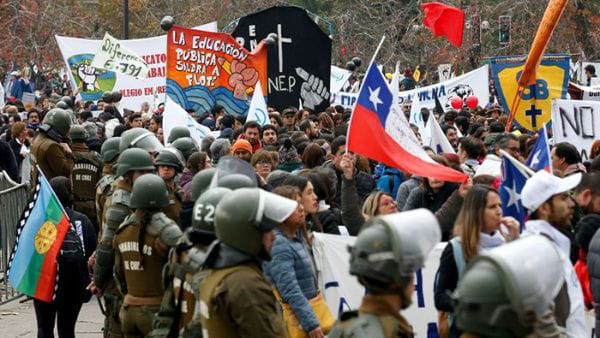
A month has passed since the popular mobilization that many called “Chile woke up.” But Chile was not asleep. Mobilizations, primarily by students, that have systematically challenged the commodification of life have been occurring with varying degrees of intensity and popular support for almost two decades in the country.
In the last month, this situation was neither repressed—as is usually the case—nor contained by a political class detached from the interests of the people. Overcoming the terror of the brutal repression that attempts to blind protesters by shooting them in the eyes, the population is putting a stop to the agenda of those in power.
The persistence of the mobilization makes it clear that a “National Historical Agreement” is far from being signed, since what remains pending is to what extent the political class recognizes and expresses something of what the popular deliberation that took place in the streets and is not yet willing to leave them, expresses and represents.
El GT Educational Policies and the Right to Education He shares the reflections that colleagues from that country have developed in these turbulent and hopeful times of change.
Foreword[1]
Jesús Redondo – University of Chile
They say that the water in a river never flows through the same place twice. Today's circumstances in Chile place us before a "historic moment" in which the concrete results of the so-called "neoliberal experiment" on the daily lives of the majority of the Chilean population have been questioned "socially" in diverse and complex ways.
Extreme inequalities, laden with false expectations and constant promises of "better times," have buried the supposed Latin American oasis in the seemingly dormant human sands of history, past and recent, left under the rug of one's own house: awakened in an impetuous citizen movement.
It is therefore a time for transformations, for qualitative and not merely quantitative advances (unworthy bonuses).
The democratic break with the "transition pact" is an unavoidable process; since it has been shattered by a right wing and an elite who, unable to govern with their own rules of "tutelage democracy", have decided to return the military to the streets and allow, through action and omission, the massive violation of citizens' human rights, violating "never again".
A genuine constituent process has been initiated in recent days by the people of Chile, and a new constitution is now an urgent and essential social and historical necessity. Citizens are demanding of themselves not only a legal and constitutional change, but also a cultural shift in the very soul of Chile to strengthen trust, bonds, and fraternal and supportive relationships—the antithesis of the imposed neoliberal experiment based on individualism, competition, and mutual distrust, which has ultimately benefited less than 5% of the population disproportionately over the past 50 years.
As citizens and as education professionals, we cannot remain passive in this social, political, and intersubjective context. To confront fear, mistrust, and blind violence, we must strengthen and enhance welcoming spaces and relationships that foster connections and trust—a task that cannot be delegated.
We invite the entire academic community of the region to commit to this task with all the diversity and creativity that characterizes us; “…history is ours and it is made by the people…”.
Back to October: On the Chilean situation in October 2019
Chilean Observatory of Educational Policies (OPECH)
University of Chile, 22th October 2019
In a month steeped in political history, unprecedented demonstrations are unfolding in the streets of Chile. What began as mass fare evasion by high school students on the capital's Metro has transformed into a popular rebellion, met with a repressive response that has deployed the military to the streets for the first time since the end of the dictatorship. Lacking a clear political path forward, unlike the recent uprising in Ecuador, the movement's trajectory remains uncertain. The following lines offer a partial and fragmented overview of the situation unfolding in the country, aiming to systematize some of the key features that characterize this juncture.
Act #1: “Evade, don’t pay / another way to fight"
Almost all the major social uprisings following the dictatorship have been triggered by the secondary school student movement. It is no coincidence that the current government and the municipality of Santiago (the capital's center) have been waging a war against young people, subjecting them to a state of war, with militarized police guarding/provoking high schools, following the implementation of the Safe Classroom Law to facilitate the expulsion of students without due process. Under this military-institutional siege of several weeks, young people began to promote "mass fare evasions": the simultaneous entry of dozens of them into a subway station to overwhelm the guards and avoid paying the fare (incidentally, the reduced student fare demonstrated that the problem was not paying, but a reflection of something deeper).
October 7th marked the final straw: the "panel of experts" appointed by the capital's transportation system to set fares decided to raise them to 830 pesos (US$1.15). The minimum wage is 301.000 pesos (US$418), meaning that commuting to work can represent more than 12% of a person's monthly family income. For a population drowning in debt and subjected to a high cost of living, with all basic services commodified, yet another fare hike was like another slap in the face, one that this time would not be tolerated.
The hitherto pristine Santiago Metro began to see dozens of adults joining the students in fare evasion. In an unprecedented escalation, "fare-free zones" emerged where hundreds of passengers passed through without paying, even resorting to more violent acts such as breaking turnstiles and electronic payment devices. In response, the uniformed police (Carabineros, or "pacos") began guarding the entrances to prevent the mass entry of high school students; as these students moved to other stations, the police successively increased the number of closed stations, and thus, suddenly, on Friday, October 18, the capital was paralyzed. The cry "enough of the abuses" began to dominate the media, and soon a call came for a "cacerolazo" at 20:00 p.m., a form of protest typical of the dictatorship that the student movement revived in 2011.
On Friday night, the largest pot-banging protests seen in the last four decades took place. Without a centralized call to action or a visible leader, we simply went out to our street corners as neighbors to bang our pots and pans in repudiation of the mass repression that was unfolding and in support of the social protest. The scale of the mobilization reached such proportions that the Executive Branch declared a State of Emergency at midnight. The military would take charge of public order (Agamben was right).
Interlude: “It’s not about 30 pesos, it’s about 30 years”
While it is undeniable that discontent over the increase in public transportation fares in the capital was the spark that ignited the flame, the search for explanations quickly led to the issue of inequality and abuses. The characteristics of present-day Chile are typical of a neoliberal capitalism that has been implemented for almost 40 uninterrupted years. Unlike the rest of Latin America, which saw it coming, especially in the 1990s, the dictatorship began applying the neoliberal playbook early on, around 1974, giving rise to what would later be known as the “shock doctrine.”
From then on, and also unlike the rest of the region, which experienced several episodes of neo-developmentalism, the dictatorship itself and the seven successive government periods—five social democratic (Concertación and Nueva Mayoría) and two right-wing—continued the same policies. Here, the situation has always oscillated between two ironies: either the right governed with the ideas of the Concertación, or the Concertación with the ideas of the right. The collusion between the two main political blocs has been intense in implementing a neoliberal deepening agenda. This agenda constructs “neoliberal solutions,” meaning that, faced with constant and increasingly frequent displays of discontent, it has recycled the demands of these movements into measures that have ultimately deepened the model, based on bonds, subsidies to the private sector, greater deregulation, and, of course, privatization. A short-term fix that will lead to long-term problems.
The Pension Fund Administrators (AFPs) are the best example: despite popular demand to end this private pension capitalization system, which brought a million people to the streets in protest, the two-party coalition has closed ranks to maintain the AFPs and sustain the current system. They've even floated the idea of returning part of the funds in exceptional cases (such as illness), thus strengthening the ideological foundation of the model.
A similar situation exists in education. Reforms aimed at greater access and coverage have given way to the profound privatization and standardization of the education system. Healthcare reforms have led to the proliferation of private healthcare providers and an accelerated deterioration of the public system. The same occurred with public transportation, which, under the guise of modernization, even infiltrated banks to speculate with fare revenue. The businesspeople in pensions, education, healthcare, and transportation are all the same: profit-driven, white-collar criminals. They are the architects of popular outrage.
Despite this situation, there is widespread recognition of the inability to foresee the explosion. Nobody expected it. The metaphor of the pressure cooker that suddenly explodes and overflows everything is apt for the current situation. Although several authors have acknowledged the existence of "cracks" in this neoliberalism—that is, an exhaustion of the model that manifests itself in multiple crises and their respective social demands—the counterpoint was the anomic and apathetic nature of the Chilean population, their accustomedness to this state of affairs, their willingness to resolve it individually through the credit system. Except for the youth, especially those who are not necessarily part of the renewal of the political class and who had been able to channel various demands, the image of Chileans was one of being asleep, incapable of reacting. It is no coincidence that just a few days ago, Piñera had dared to claim that Chile was an "oasis" in Latin America, in comparison to the Ecuadorian crisis. The boasting exploded in his face like a grenade.
That is why, as we titled it, we say "30 years", although we should say 40: from 1980 inclusive to the present, a feeling of sustained abuse has been established in various aspects of life, from some more felt and related to subsistence, such as salary, the cost of housing or access to health, to luxury issues such as the conditions of indebtedness or the entrance to see a football match.
Act #2: “We are at war”
As we mentioned, on the night of Friday, October 18, Piñera declared a Constitutional State of Emergency. This had only been established after the dictatorship in the context of the supply chaos experienced in the south of the country following the 2010 earthquake and tsunami. In other words, this was the first time in the “democracy” that he invoked a state of emergency to control social protest. This measure meant that control of public order was placed in the hands of the military, through the appointment of a “national defense chief.”
On the afternoon of Saturday, October 19, the government, after nearly 24 hours of focusing its statements on criticizing the "vandalous" actions of the protesters, delivered a national address in which the president stated that he had "heard the voice of the people" and would send an urgent bill to freeze the Metro fare increase. Thus, the only visible demand of the social discontent was quickly addressed. This was followed by irrelevant measures, such as opening a dialogue with "citizens," without defining who or how. However, immediately afterward, the general in charge decreed a 10:00 PM curfew in the capital, a measure that began to spread like dominoes throughout the rest of the country; today, it is in effect in 22 of the country's 15 regions. The first images of soldiers pointing their weapons and making brutal arrests came from the indomitable port city of Valparaíso, and were even shown on television.
Despite the movement restrictions, people were not intimidated. On the contrary, they were prepared to confront the police and armed forces and defy the curfew by taking to the streets. At the same time, from the banging of pots and pans and gatherings in public spaces, looting emerged, primarily targeting supermarkets (belonging to three business groups: the Chilean-regional powerhouse Cencosud, the American Walmart, and the Chilean company owned by businessman Saieh) and other retail stores, just as happened in the south in 2010 after the earthquake and tsunami. The mobs removing the goods did so without police presence, sometimes taking them away in cars. (What is happening that the looting is being carried out with impunity? people are asking.)
During Sunday, October 20, the protests continued with unexpected massiveness, as did the looting, which took place in broad daylight. That night, Piñera, surrounded by military personnel, declared: “We are at war against a powerful enemy, one that is prepared to use violence without any limits.” The communication strategy began: the good guys and the bad guys, the innocent and the villains, the citizens and the vandals. The same theory of the internal enemy with which the Chilean armed forces had been trained since the 1950s and applied from 1973 onward; the same theory that justified the militarization of Mapuche territory and the repression of the student movement, was now being used to justify the police and military deployment in the country's cities. The media, primarily television, played a fundamental role by relentlessly showcasing anything that appeared to be violence, disorder, chaos, or vandalism. The journalistic handbook dictates that everything extreme, controversial, and scandalous deserves maximum attention, above any in-depth explanations of social unrest or denunciations of police violence, and Chilean television applied this to the letter.
Over the weekend, calls for a national strike on Monday, October 21st, spread rapidly. With the transportation system operating at reduced capacity and all school and university classes suspended, that day was the closest thing to a national strike in decades, driven less by a worker boycott than by the sheer impossibility of getting to work. The clanging of pots and pans continued unabated, looting persisted, and the paranoia of shortages intensified, leading thousands to crowd into the network of small stores and open-air markets that have sprung up throughout the cities to buy food beyond their immediate needs. Soon, shopkeepers and vendors called for calm: "There are no shortages, we have merchandise, relax." Ironically, the population recalled the myth that circulated during the presidential elections, in which the right wing claimed that if Piñera wasn't elected, Chile would become the new Venezuela: "Chilezuela." On the contrary, chaos arrived with the right wing in power.
Act #3: A new social order?
The president's declaration of war has given rise to a powerful thesis circulating among Chileans: that the chaos is being deliberately fomented. In short, this view posits that the government encouraged looting and the unrest of the lumpenproletariat in order to later justify the militarization of public spaces. For example, it is mentioned that the Metro stations that were set on fire on Friday and Saturday lacked police protection, even though this was foreseeable. Even more serious, videos are circulating showing police or military personnel starting fires, stealing merchandise, or infiltrating and instigating unrest, as a way of inciting violence. The thesis continues that the emergence of the lumpenproletariat fosters the notion of "unity among Chileans" against a common enemy, crime, and deliberately obscures and renders invisible the multifaceted expressions of popular organization. Thus, police-military repression could act even with the support of the population, who see their actions, the curfew, and similar measures as a "necessity."
Whatever the most accurate hypothesis may be, the development of the demonstrations has shown a high level of confrontational willingness among a sector of the Chilean population against the police and even the military. It is understood that we are not at risk of a military coup and a murderous escalation like the one the country experienced 46 years ago, so people, especially young people, are emboldened to defy the curfew, to mobilize in city centers, and to confront—even violently—the uniformed officers. This does not negate the fact that the result has been fierce repression: a report from the National Institute for Human Rights issued on Tuesday the 21st indicated more than 1.600 people detained for the riots and 123 wounded by firearms, with the figure of 18 killed by armed forces or police being cited. It is clear that all the numbers are underestimates of what is actually happening, while reports of shootings by the military and armed civilians are multiplying. The true face of uniformed violence is only just beginning to emerge.
Another distinctive feature of the uprising is the absence of political parties and social organizations. In general, the movement has been primarily territorial, a collection of individuals with little connection to one another beyond their place of residence. While several social organizations have called for continued demonstrations, they were not the ones who convened the initial mobilizations, and their continuation does not depend on their calls. Rejection of traditional politics is widespread, though it is not yet reflected in community or grassroots organizing; at least not before this began, although it is expected that this will be a result of this volatile situation.
For now, a group of welfare-oriented NGOs are calling for a “new social order”; a kind of reaffirmation of the supposed social contract that governs the country. In contrast to this nostalgia for transitional pacts, another conglomerate of social organizations, the Social Unity Roundtable, formed to unite the opposition to the Piñera government, is calling for a general strike this Wednesday, October 23, if the state of emergency and the military presence in the streets continue. The Port Workers' Union, one of the country's strongest unions, had called for a strike on Monday the 21st and issued the same call. Both groups agree on the need for a Constituent Assembly. Meanwhile, the parliamentary political opposition has confirmed the leadership incapacity already evident during the Piñera administration. Furthermore, lacking unity, some parties have met with Piñera, others have gone to the presidential palace to deliver letters, and still others have withdrawn their support.
As can be seen, there is a lack of political leadership in the social uprising, as well as a lack of clear demands that would enable a solution, although numerous statements from social organizations allude to fundamental issues: a different pension system, reduced transportation costs, rebuilding public health and education, nationalizing natural resources, ending water theft, ending the theft of land from Indigenous peoples, halting the ecological destruction evident in sacrifice zones, freezing all tariffs for basic necessities, regulating the prices of basic goods and services (including medicines), freezing interest rates on debt and the financial system (including housing), calling for a constituent social process for a new Constitution, repealing the fishing law, etc. In short, changing the model.
The repressive response and escalation of the state of emergency, coupled with the fear of shortages, leave the future of the mobilization uncertain. However, there's a feeling in the air stronger than tear gas: people want some basic demands: the military off the streets, answers about the deaths, justice for the killers, and clarification regarding the involvement of police and military in looting and arson. Once this is done, Piñera must go! Down with neoliberalism! Nothing can stay the same!
Chile: The Streets Against the Precariousness of Life[2]
By Vicente Sisto
Today, November 12th, we will begin a Great General Strike called by the largest labor and social organizations in Chile, as part of the massive mobilization that began three weeks ago. As Karol Morales stated in La Nación Trabajadora, what ignited was not merely a protest against a fare increase on the Santiago metro, but rather a widespread outcry from all quarters against the precariousness of life that has become our new normal.
While from the 30s to the early 70s Chile was moving, with some continuity, towards a growing welfare state, even under both right-wing and left-wing governments, the military coup and Pinochet's dictatorship marked a violent break in this process. Indeed, as sociologist Tomás Moulian (1996) has pointed out, although initially a counter-revolutionary dictatorship, Pinochet's dictatorship quickly established itself as a revolutionary dictatorship, embodying what would become a "neoliberal revolution." Milton Friedman himself even advised the dictator in 1975. Thus, through various reforms, Pinochet sought to transform the economy, the state, and society according to the neoliberal principles proposed by Hayek, Friedman, and Buchanan, among others (see Fisher, 2009; Oliva, 2008; Pitton, 2007, among others). These reforms involved various measures, all marked by the privatization of public services and the individualization and precarization of social rights.
Thus, on the one hand, the aim was to transform the entirety of public action, promoting the private provision of public services, especially in the areas of health, education, social security, and social policies, relegating the State to a subsidiary role. On the other hand, labor rights were profoundly weakened, promoting labor deregulation and radically undermining forms of collective organization. This 'modernization' was characterized by placing the State, public services, labor, and even natural resources at the service of 'private initiative,' under the assurance that these measures would stimulate the economy, generate economic growth, and therefore benefit the entire country.
In Chile today, job insecurity is the norm. More than 78% of the workforce can be moved, voluntarily or involuntarily, within just 18 months (Henríquez and Uribe-Echeverría, 2004). Most of the new jobs created in the last eight years (60,2%) have been self-employment or external salaried positions, meaning through subcontracting, temporary staffing, and/or recruitment (Fundación Sol, 2018; INE, 2017). Furthermore, 40,5% of all currently employed individuals are linked to employment through contractual arrangements not associated with any labor legislation (service contracts and others), leaving them without legal protection (Fundación Sol, 2018; INE, 2018). It should be noted that, although permanent workers can form unions, the legislation weakens their bargaining capabilities and does not allow sectoral bargaining.
The precariousness of life is expressed and sustained not only by instability and lack of labor protection, but also by the privatization and individualization of social security.
By law, salaried workers are required to save for their pensions through AFPs (Pension Fund Administrators), which not only mismanage individual savings by using them for stock market speculation and other investments, but also charge a substantial commission exceeding 1% of each worker's salary. These commissions are supposedly to cover the administrator's operating costs; however, in reality, they have ensured continuous profit increases for these companies. Thus, in just the first three months of 2019, their profits reached $196 million, a 100% increase compared to the same period of the previous year. This substantial increase in profits has been a constant feature of the system—the same system that generates poverty-level pensions.
More than half of the pensions granted by the AFPs (Pension Fund Administrators) in February 2019 to workers with more than 20 years of uninterrupted contributions were $243.603 (approximately US$300), in a country with a high cost of living (Fundación Sol, 2019). Considering that the poverty line for a family of two is $268.692 (Ministry of Social Development, 2019), we can see that more than half of those who have had uninterrupted contributions for more than 20 years have poverty pensionsEven those belonging to the segment of the population with the greatest job stability and security, reflected in their uninterrupted contributions, face this situation. If we consider the entire population, the situation is even more dramatic: 50% of the 125 people who retired in 2018 received a self-funded pension of less than $48.000 (approximately US$67), according to data from Fundación Sol. The State then provides a supplemental transfer to reach the minimum pension ($122.000), which is paid through the same AFP (Pension Fund Administrator). Today in Chile, the highest suicide rate is precisely among those over 80 years old. The precariousness and shame of having worked a lifetime and being unable to support oneself are behind this.[3].
The right to health has also become another individualized service, heavily privatized and transformed into individual health insurance through the so-called Isapres (Private Health Insurance Institutions). This system, operating as insurance, generates profits from those who do not require healthcare (young workers), while making access more difficult and expensive even for the same workers when they do need it (older workers and their families). Although a state-run alternative exists (FONASA), it maintains the logic of a private insurance that subsidizes the services received by the 'client,' who chooses between private and public providers according to their purchasing power. This occurs within the context of the constant impoverishment and precariousness of the public healthcare network itself. For this reason, Rotarou & Sakellariou (2017) have identified the Chilean healthcare system, as a whole, as one that produces inequality by creating structural disadvantages precisely for those who need it most.
All of this is compounded by a series of other elements that have become part of our normality. Among these are a heavily privatized education system, with private providers of educational services funded by the state (Budnik, Chávez, López, Rojo, Edmonson & Morales, 2011). This system is characterized by segregation and a focus on generating results in standardized learning tests rather than on the development of children (López, González, Manghi, Ascorra, Oyanedel, Redón, Leal & Salgado, 2018). It is also authoritarian in its own organization (Sisto, 2018) and highly punitive (López, Ramírez, Valdés, Ascorra, & Carrasco-Aguilar, 2018), a situation that has intensified during the last administration. Similarly, all basic services are privatized under concession systems that guarantee significant profits for the owners, resulting in high prices relative to wages.[4].
In addition to the above, large companies have consistently colluded to fix prices on essential products in order to increase their profits (for example: collusion among pharmacies).[5]collusion of toilet paper manufacturing companies[6]of diapers[7]collusion between chicken producers and supermarkets[8]among others); collusions that, although classified as a crime, are punished with meager fines compared to the profits generated by said collusions[9]Alongside this, the privatization of natural resources under conditions that are highly beneficial to private companies has also been a constant (see, for example, the case of lithium).[10] or fishing[11]), privatization of water at the expense of rural communities and human consumption[12], declaration of sacrifice zones inhabited by communities for the installation of highly polluting companies[13]among so many other situations.
The perception that Chile is a country for businesspeople is reinforced by the constant forgiveness of multimillion-dollar tax debts for large companies, while for the average citizen even minor tax evasion can lead to jail time.[14]This also applies to business owners, including the President himself, who for 30 years paid no taxes on one of his most prized properties, which could have resulted in seizure, but in his case, it was instead a significant tax break. These state benefits go precisely to business owners who tend to devise complex strategies to evade taxes, as the President himself has done.[15].
All of this has occurred within the framework of the establishment of political financing practices by large companies, whether through campaign sponsorship or even through monthly payments to parliamentarians under the guise of 'professional advice', in exchange for favoring them in the drafting and voting of laws[16]This has not only been public knowledge, but it was also protected by the prosecuting bodies, thanks to an agreement between political power and the prosecution.[17]as recently denounced by the prosecutor who was in charge of the investigation at the time.[18].
These are just a few examples that illustrate a context in which we, as inhabitants of contemporary Chile, experience the increasing precarity of our lives. This precarity is actively fostered not only by a series of legal mechanisms, but also by institutionally protected and sustained practices geared toward the benefit of big capital at the expense of our lives.
That this occurs is intrinsically linked to and supported by the current Constitution of the Republic of Chile.
The Precariousness of Life as a Constitutional Issue
Indeed, the constitution approved in 1980 by the Dictator, although amended by various legislatures from 1989 to the present, has never touched the fundamental elements of the social organization and the conception of the State that it establishes. In fact, Chapter III, concerning Constitutional Rights and Duties, notably demonstrates the establishment of a subsidiary State, in which the initiative for the 'provision' of social rights resides with the private sector, with the State acting primarily as a financing and regulatory entity, and the citizen as the individual responsible for exercising or not exercising their 'right,' which literally translates as "freedom to choose" (see Articles 10 et seq. of said chapter). Likewise, the State is prohibited from engaging in any business activity or providing any service, unless a law passed by a qualified majority stipulates otherwise. This same Constitution severely limits the right to strike, as well as collective bargaining, weakening the possibility for the workforce to achieve a better position vis-à-vis capital. On the other hand, it guarantees freedom of enterprise, even allowing private companies the lucrative business of providing state-funded public services. Accordingly, the right to property takes precedence, with the State acting as a defender of private property and private enterprise. This is taken to the extreme of guaranteeing private ownership of water (see Article 24), among other things. The so-called "Fundamental Charter" also establishes an entity, the Constitutional Court, which ensures that all actions within the country comply with it. It can rule on individual and/or collective actions, legislative initiatives (even those with a majority in Congress), and even presidential initiatives, ultimately establishing itself as the highest court in the country. The possibility of amending this constitution is also safeguarded by the requirement of a 3/5 or 2/3 quorum in Parliament, which necessitates a cross-party agreement that significantly exceeds the congressional majority. This has made structural reforms impossible, sustaining a social order and a form of State that effectively prioritizes large private companies over the citizen, who in turn is reduced to a consumer, precarious, with limited rights, but "free to choose" among the options proposed by the business sector, a business sector colluding with each other, as well as with political power.
Today, according to data from the National Institute of Statistics (INE)[19] Most Chileans who are fortunate enough to have formal employment earn less than 400.000 pesos (less than US$560) per month. The poverty line for an average family of four is 430.763 pesos, or approximately US$600 (Fundación Sol, 2018). This means that most Chilean workers with formal employment do not earn enough to support a family above the poverty line. Therefore, the high level of debt among the Chilean population is understandable. Healthcare requires payment, even within the public system. Education, especially at the tertiary level, also requires payment, in addition to expenses for housing, transportation, and food. Consequently, it is common for people to pay for groceries, bread, and vegetables in 10 monthly installments or more. 11.3 million people are in debt and 4.6 million are in default. Indeed, wages are insufficient to cover the cost of living, and therefore, endless work, with jobs and overtime, and debt, are the only way to make ends meet for more than half the population. It is therefore not surprising that, according to the Multidimensional Poverty Index, more than 20% of the population lives in poverty (Ministry of Social Development, 2018), contradicting the narrative of the World Bank and other promoters of the Chilean model, who claim that Chile has eradicated poverty. According to a report recently published by ECLAC (Economic Commission for Latin America and the Caribbean), Chile has become one of the most unequal countries in the region: “while the poorest 50% of households held only 2,1% of the country’s net wealth in 2017, the richest 10% held two-thirds (66,5%) and the richest 1% held 26,5%” (ECLAC, 2019; p. 62).
This is the context in which the Santiago metro fare hike became the final straw. It's no surprise that high school students started it all. The "Safe Classroom" Law, designed to reinforce authoritarianism within educational communities by expelling students who didn't meet the principal's expectations, with no recourse other than to the principal, fueled student discontent throughout the year. It was these students who jumped the metro turnstiles, rejecting the authoritarianism that imposes a privatizing and precarious social order. The repression that day against the students ignited a spark that continues to burn brightly, a spark of a people fighting against the precariousness of life, a right guaranteed by the constitution, and the collusion of business and political elites.
Strike, Street Mobilization, Town Hall Meetings:
The rhizomatic intelligence of the Constituent Chile
I close this column in the second person singular, addressing the President of the Republic.
During these three weeks, you first declared war on us, stating that your enemy—us—was a great and powerful enemyIndeed, you were right. You sent the military into the streets, gassed and shot at our children, our elderly, more than 20 dead, 2000 wounded, 200 people blinded by your bullets to the eyes, more than 250 tortured, including sexual abuse… and despite all of it, here we are. It's been three weeks… And we continue… marching, meeting in assemblies… creating something new that even we didn't suspect.
Your response was, first, a false social agenda, in which, faced with the precariousness of life, you proposed more individualization and privatization of social rights, and we told you NO. We took to the streets again, and more than a million and a half people told you that your social agenda was not the answer. And you turned a deaf ear, and, on the contrary, ridiculously claimed that the march demanded the implementation of your social agenda. The people took to the streets again. And you increased your repression. Until just a few days ago, you proclaimed a security agenda that would give greater powers to the police who violate human rights. And the people took to the streets again. In reality, we never stopped taking to the streets during these three weeks.
The mobilization has no clear leaders or organizers. At one point we thought that was a problem… today I don't think so. Your enemy is large and powerful… And today it has acquired a certain rhizomatic intelligence that includes the construction of forms of mobilization and deliberation that have emerged in every corner of our society during these thirty years of post-dictatorship. The organizations of subcontracted and paid workers have already taught us that it is possible to organize from precarity and from prescribed forms of organization of an individualized nature. We saw deliberative assemblies in the secondary school movements of the so-called Penguin Revolution of 2006, when in the poorest schools and high schools throughout Chile, our secondary students began not only to discuss their most urgent needs, but even went so far as to challenge the very constitution of the republic as the body responsible for social and educational order, generating, 13 years ago, from the poorest schools in the country, constitutional proposals. The workers' collectives that have gradually formed, establishing the assembly space as the ultimate authority, have also shown us possible political designs.
Today, town hall meetings are being held all over Chile. The voices and opinions flowing in this more rational and argumentative space recognize the mobilization in all its forms, from peaceful demonstrations to masked protesters, because the latter are capable of keeping the repressive forces at bay so that we can march. And in this deliberative space, the principles of the new constitution and how it should be drafted are being discussed. There are thousands of town hall meetings scattered throughout Chile, organized in plazas, sports clubs, and neighborhood associations. No one keeps count, as they are self-organized.
And once again you're late, Sebastian Piñera, President of the Republic. On Sunday, November 10th, late at night, your Minister of the Interior, Gonzalo Blumel, announced that the governing coalition supporting you has agreed to convene a Constituent Congress that will propose a new Constitution to be put to a plebiscite.[20]You didn't explain it very well. At this point, it's unclear whether the current members of parliament will draft a new constitution or if it will be a new parliament. However, you received an immediate response on social media. #ConstituentAssemblyorNOTHING!
Today we will be on General Strike. And it is a strike that demands a Constituent Assembly. Workers' organizations and other social organizations, for the first time in 30 years, have managed to coordinate enough to carry out a major general strike for a new Chile.
Perhaps you believed, like some politicians and social researchers, that the precariousness of life, coupled with a strong individualistic narrative oriented towards glorifying consumption and individual entrepreneurship, had dismantled us. More than one researcher indicated that this Chile was characterized by a asocial individualizationAnd that this wouldn't allow for any kind of collective articulation with a societal horizon. But they were wrong. Here we are… and this has been building from the ground up for a long time… through sheer effort… and today we have indeed become, and in this you were right, a great and powerful enemy.
Vicente Sisto. Social Psychologist. Professor at the Pontifical Catholic University of Valparaíso. Principal Investigator at the Research Center for Inclusive Education (CONICYT PIA/CIE Project 160009) and Adjunct Investigator at the Millennium Nucleus Center for Authority and Power Asymmetries.
Highlighted
Budnik, JA, Chávez, RC, López, JG, Rojo, JR, Edmonson, RS, & Morales, MS (2011). The Chilean educational enterprise. Education & Society, 32
ECLAC (2019). Social Panorama of Latin America 2018. Santiago: Economic Commission for Latin America and the Caribbean (ECLAC)
UN Committee on the Rights of the Child (2018). Report of the related investigation in Chile pursuant to Article 13 of the Optional Protocol to the Convention on the Rights of the Child on a communications procedure. Available http://www.minjusticia.gob.cl/media/2018/07/Informe_del_Comit%C3%A9_de_la_Ni%C3%B1ez_de_ONU.pdf
Fischer, K. (2009). The influence of neoliberals in Chile before, during, and after Pinochet. In P. Mirowski, & D. Plehwe (eds.). The road from Mont Pelerin. The making of the neoliberal thought collective (pp. 305-346). Cambridge, MA: Harvard University Press.
Sol Foundation (2018). Monthly Job Quality Report April 2018Santiago Sol Foundation.
Sol Foundation (2019). Pensions for new retirees in February 2019. Available http://www.fundacionsol.cl/graficos/pension-promedio-mediana-febrero-2019/
Sol Foundation (2019). The real salaries in Chile. Santiago: Sol Foundation.
INE (2017) New National Employment SurveySantiago: INE.
INE (2018) New National Employment SurveySantiago: INE.
INE (2018). 2018 Supplementary Income SurveySantiago: INE (National Institute of Statistics).
López, V., González, P., Manghi, D., Ascorra, P., Oyanedel, JC, Redón, S., …& Salgado, M. (2018). Educational Inclusion Policies in Chile: Three Critical Issues. EducationPolicyAnalysis Archives, 26, 157.
López, V., Ramírez, L., Valdés, R., Ascorra, P., & Carrasco-Aguilar, C. (2018). Tensions and critical issues in the implementation of the school coexistence policy(ies) in Chile. Quality in Education, (48), 96-129.
Oliva, MA (2008). Educational policy and the deepening of inequality in Chile. EstudiosPedagógicos (Valdivia), 34(2), 207-226.
Paley, J. (2001). The Paradox of Participation: Civil Society and Democracy in Chile. Political and Legal Anthropology Review, 24(1), 1-12.
Pitton, V. (2007). Disentangling Chile's authoritarian neoliberalism and its effects: the downfall of public higher education and its implications for equitable access. Critical Studies in Education, 48(2), 249–267. http://doi.org/10.1080/17508480701494267
Sisto, V., Fardella, C., Montecinos, C., Ahumada, L., Leiva, P., Jaramillo, M., & Fuentes, R. (2008, March). Findings From a Qualitative Evaluation of the Impact of the Implementation of the System for Quality Assurance of School Management in Chile's Municipal Schools. in Annual Meeting American Educational Research Association (AERA). March. Chicago.
The essential and the urgent. Let's put an end to the neoliberal experiment in education.
Chilean Observatory of Educational Policies
University of Chile, November 8, 2019
The current context of social mobilization, unprecedented in our country, opens a favorable scenario for making the structural changes that the education system requires: the same changes that the political class declared unfeasible or “inadmissible” are now imperative, as educational stakeholders' organizations have been pointing out for decades. These organizations have put forward numerous proposals throughout these years of struggle for education, which are an important basis to consider at this moment of mobilizations.[1]
What is the origin of the problems in Chilean education?
The Chilean educational model is considered worldwide as a unique experiment in market forces, competition, and privatization. It is time we put an end to it. This model had two phases of implementation, and understanding them is fundamental to getting to the root of the educational problems we face today. The first phase occurred in the early 80s when the civic-military dictatorship led by Pinochet radically transformed the main pillars of the educational system. These transformations were threefold: 1) A new definition of educational rights and the role of the state in the 1980 Constitution: it establishes that the role of the state is not to guarantee the right to education, but rather to limit itself to providing subsidies to public and private educational entities (what is known as the subsidiary state and equal treatment for state and private institutions). Likewise, it establishes that the most legally important educational right in Chile (because it is constitutionally guaranteed) is the so-called right to “freedom of teaching,” which is defined as the “right to open, organize, and maintain educational establishments” (Article 19, paragraph 11). 2) A new legal entity is created to manage schools: the "sponsors." Chilean schools are no longer state-run, but are instead managed by these sponsors, which can be public (municipalities or local education services) or private (subsidized private schools). These sponsors hold central powers in the educational process: they manage the financial resources provided by the state, administer the hiring of teaching and non-teaching staff, approve regulations for students, and define possible adjustments to the curriculum. They can even close schools for the academic year without consulting the communities, as the mayor of Santiago has done with the Instituto Nacional and the INBA. 3) A financing system called demand subsidy or vouchersThis system stipulates that the state does not directly fund public schools to cover their minimum needs (basic funding), but rather provides a subsidy to the school administrators (not the school communities) based on enrollment and average student attendance over the past few months. This funding model fosters competition between public and private schools for the subsidy and has led to the closure of nearly a thousand public schools due to declining enrollment.
The second phase of the market-based education model took place during the post-dictatorship civilian governments. This second phase is characterized by the refinement of the market model, the massive incorporation of members of the Concertación and Right-wing parties into the education sector through private universities and as owners of subsidized private schools, and the implementation of processes of covert privatization or endo-privatization. The latter not only seeks to transfer ownership of schools to private owners, but essentially consists of forcing public institutions to operate like private businesses. To ensure that the entire education system functioned according to the logic of a private enterprise, one of the main tools used was educational standardization: primarily through the intensification of SIMCE testing, the increased consequences for schools, and the implementation of individual teacher evaluations for teachers in Chile. [2]
Essential and urgent measures to dismantle the market-driven education model
At this historic moment of popular mobilizations in Chile, we cannot repeat the same mistakes made over the last 30 years, during which reforms were implemented that ultimately strengthened the market-driven model of competition and privatization. The proposals developed by educational organizations over these years hold the key to building a new educational model that is not based on the market, profit, and competition, but rather on the well-being of the majority of the population. To contribute to the numerous debates taking place in the country, we want to propose essential and urgent measures to dismantle the market-based educational model, based on the following proposals:
1. Construction of a public education system that is articulated, democratic, non-sexist, inclusive, with quality infrastructure and community control from early childhood education to higher education. Today, public education is severely diminished; only 32% of primary school students (the most vulnerable) attend public schools, and less than 15% of higher education students attend public institutions. Furthermore, its infrastructure falls far short of the dignity required by the children and young people who need it most—an unacceptable situation, given that public education is responsible for building a more humane, equitable society that respects the rights of all.
The public education system must be the best and guaranteed by the State. It must be diverse and democratically managed, with decisive and binding school councils, and with mechanisms that promote the participation of the organized community, which will ensure the relevance of the curriculum and the transparent use of resources. The public education curriculum must, at a minimum, promote a democratic, inclusive, and non-sexist society.[3]
In the immediate future It is urgent to stop the closure of public schools. It is imperative to eliminate the current system of educational providers, both through municipalities and local education services. It is necessary to correct the serious deficiencies and privatizing tendencies within local education services. Likewise, it is urgent to establish a public education repair fund to rebuild the damage already inflicted by the neoliberal earthquake.
2. Build a new financing system for public educationThis should be preferential, of a basal nature.[21]and its amount should be determined by the needs of the communities [4]. Likewise, preferential funding should be given to state universities, which must guarantee mass access for popular sectors, be free of charge, and serve national and local needs, contributing to the cultural, economic, and social development of the territories [5].
In the immediate future It is urgent to end the private sector business in educationIt is necessary to end the multiple forms of hidden profiteering permitted by the so-called "inclusion law." It is necessary to freeze and begin reducing the allocation of resources to private educational institutions. It is necessary to halt the system of concessions in the various public education services (JUNAEB, MINEDUC, ATEs, etc.). Finally, it is essential to forgive all educational debts, including student loans (CAE); studying cannot be a sentence.
3. End the SIMCE and all types of standardization. The SIMCE test is not an educational tool, but rather a tool for promoting the market and competition among schools. Students' results on the SIMCE depend primarily on their background (basic living conditions, access to healthcare and nutrition in early childhood, etc.) and very little on the school's practices. For this reason, these types of tests are not used to measure school quality under any circumstances worldwide. Many countries recognized for their good education systems do not administer these tests, and those that do only test a representative sample, not all students.
In the immediate futureIt is urgent to eliminate the universal (census-based) application of the six SIMCE tests (which is a lucrative business for the private institutions that administer them). Any standardized test administered must be sample-based, providing general information while eliminating competition between schools. Likewise, it is necessary to eliminate individualized teacher evaluations. It is now known that there is no clear correlation between being a good teacher and obtaining high scores on teacher evaluations. Professions like teaching cannot be measured through a standardized test. The only real objective of this evaluation is to destroy educational communities and foster competition and individualism among teachers.
4. To create suitable working conditions for education workers. Teachers and education assistants know that their working conditions have progressively deteriorated in recent years. This includes a decline in salaries and material resources (many educators pay out of their own pockets for basic classroom materials such as paper, markers, and photocopies). But it also includes a deterioration in the psychosocial aspects of their work: excessive workload, lack of support, pressure and control, meaningless tasks, lack of autonomy, and so on.
In the immediate futureIt is necessary to end the arbitrary dismissal of education workers at the end of each year. It is essential to eliminate individualized teacher evaluations and build a teaching career path that fosters collaborative work, not competition, and that guarantees sufficient non-teaching time. Likewise, it is essential to improve the salaries of education support staff.
5. Stop the criminalization of the student movement. It is obvious that the participation of young people should be promoted in schools, not persecuted, but facilitated, as this is the engine of transformation of our society (as has become clear in recent weeks).
In the immediate futureThe Safe Classroom Law and the Juvenile Criminal Responsibility Law must be repealed, and the School Violence Law must be reviewed, as these are instruments that penalize school life and the participation of young people. The use of internal regulations or coexistence manuals must be rethought; these should be developed from a civic and pedagogical perspective, and never again from a punitive one.
6. Stop the bills privatizing early childhood education that are currently in parliament and that the Piñera government intends to approveCurrently, the government is promoting two legislative initiatives in parliament, in a clear attempt to extend the commodification of education to early childhood education. The first is the school subsidy for middle school levels, which means the entry of new private actors into early childhood education through a payment-for-attendance system—a scheme analogous to the one that fueled widespread privatization in primary education and has caused so much harm by promoting commodification and competition. The second, which the Executive Branch has expedited, is the universal childcare project, which seeks to have workers finance their children's attendance at preschool through their unemployment insurance. This project excludes the children of self-employed workers and public sector employees. Furthermore, it jeopardizes the care and stimulation of infants, as the rooms will be limited to 42 infants with three adults in charge. The only ones who win with these projects are the companies, which will no longer have to finance the kindergartens of their employees' children, and the education entrepreneurs who will once again profit from public resources.
A new Constitution for a new public education
For these changes to the market-based educational model to be viable and sustainable over time, it is necessary to change the political Constitution, which currently establishes that the most important educational right in Chile is the right to the misnamed “freedom of teaching” (Article 19, paragraph 11).
It is urgent to draft a new Constitution that establishes a state guaranteeing educational and social rights in general, defining lifelong learning as a guaranteed right, without any kind of discrimination. The right to education enables the exercise of other rights; therefore, it should not be limited by any type of individual, corporate, or business freedom.
As social organizations and the mobilized people in general have pointed out, this constitution must be drafted through a national process of a Plurinational Constituent People's Assembly, with broad participation at the neighborhood, local, provincial, regional, and national levels. The people are already debating this through town hall meetings and territorial assemblies; their voices must be given weight and validity.
[1] See publication Forum for the Right to Public Education “A decade of struggles and proposals for the right to education.” A summary of proposals from educational stakeholders from 2005 to 2015
[2] See more about this in Juan González and Diego Parra (2016): The Commodification of Education: Comments on the 2015 Educational Reform in ChileEducational Approaches Journal 13(1), 71-89.
[3] ACES (2011): “A Proposal for the Education We Want”.
[4] See Forum for the Right to Public Education (2014): How much does the school we want cost?; ANDIME (2015): Proposal for the return of schools and high schools to the administration of the Ministry of Education; Sol Foundation (2019): Indebtedness for governance and commodification. The case of the CAE (2019 update). Sol Foundation and Educational Debt Movement (2017): Letter for the abolition of student debtThese proposals have in common the presence of a preferential financing system for public education, with a variable amount according to the needs of the communities.
[5] See CONFECH proposal (2017):
Fundamental Principles for a New Public Education.
[1]Text originally published in the newsletter of the Psychology Department of the University of Chile, October 2019
[2]Originally published in La Nación Trabajadora, November 12, 2019.
http://lanaciontrabajadora.com.ar/
[3]https://www.publimetro.cl/cl/noticias/2019/02/05/suicidio-adultos-mayores-chile-pensiones.html
[4]https://ciperchile.cl/2019/11/01/luz-agua-ges-metro-tag-arriendos-y-contribuciones-el-tren-de-alzas-que-asfixio-a-los-chilenos/
[5]http://www.poderjudicialtv.cl/programas/expediente-judicial/noticiero-judicial-expediente-judicial-colusion-de-las-farmacias/
[6]https://www.camara.cl/pdf.aspx?prmTIPO=DOCUMENTOCOMUNICACIONCUENTA&prmID=15090
[7]https://www.elmostrador.cl/noticias/pais/2016/12/20/papelera-de-eliodoro-matte-se-coludio-tambien-en-el-mercado-de-los-panales/
[8]https://ciperchile.cl/2016/01/06/nueva-colusion-por-el-precio-del-pollo-acusan-a-las-tres-principales-cadenas-de-supermercados/
[9]https://ciperchile.cl/2019/03/06/chile-lindo-pais-coludido-con-vista-al-mar/
[10]https://ciperchile.cl/2015/06/26/el-dia-en-que-el-estado-le-entrego-el-control-del-salar-de-atacama-a-ponce-lerou/
[11]https://ciperchile.cl/2015/04/22/financiamiento-ilegal-de-la-politica-los-pagos-de-las-pesqueras/
[12]https://ciperchile.cl/2012/02/17/la-privatizacion-de-las-aguas-en-chile-viola-los-derechos-humanos/
[13]http://www.chilesustentable.net/la-crisis-social-es-tambien-una-crisis-ambiental/
[14]https://www.elmostrador.cl/mercados/2018/11/08/sii-condono-deudas-por-32-mil-millones-de-pesos-a-grandes-empresas-en-el-primer-trimestre/
[15]https://ciperchile.cl/2017/03/17/las-empresas-zombis-que-compro-pinera-para-ahorrar-millones-en-impuestos/
[16]https://ciperchile.cl/especiales/financiamiento-irregular-politica/
[17]https://ciperchile.cl/2018/04/16/el-entierro-del-caso-sqm-asi-se-fraguo-la-impunidad-para-el-financiamiento-politico-ilegal/
[18]Words from former prosecutor Carlos Gajardo, who as prosecutor was responsible for prosecuting these crimes, but who resigned from the prosecutor's office after the agreement mentioned here: https://www.youtube.com/watch?v=hgdPILxfsH4
[19]https://www.ine.cl/docs/default-source/ingresos-y-gastos/esi/ingreso-de-hogares-y-personas/resultados/2018/esi-sintesis-2018-nacional.pdf
[20]https://www.elmostrador.cl/noticias/pais/2019/11/11/gobierno-anuncia-congreso-constituyente-para-avanzar-hacia-una-nueva-constitucion/
[21] It's worth remembering that when the New Public Education bill was debated (2016), the Chamber of Deputies agreed that public education should not be financed through competition for subsidies, but rather through a base funding mechanism. Unfortunately, as has so often happened in the Senate, the right wing and the profit-driven sectors of the new majority cooked up something else entirely.
If you would like to receive more information about CLACSO's training programs:
[widget id=”custom_html-57″]
to our email lists.

