
Podcast “Against time, out of time”
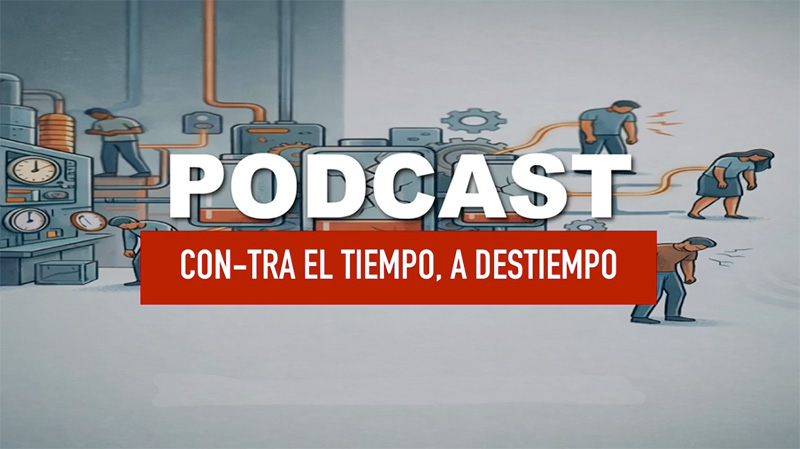
We're not here to make a podcast. We're here to take apart a clock. They stole our time and gave us noise. Haste condemned us to blinking. We choose the refuge of the voice and the weight of the word.
Every Sunday, a space to reflect on life when time is running out. A podcast based on the reflections of an Ecuadorian academic. René Ramírez Gallegos in the keynote address presented at the round table “Caring for life as a path towards an alternative future,” delivered at the Development Studies Unit of the Autonomous University of Zacatecas, Mexico, on August 26, 2024.
René Ramírez Gallegos is Coordinator of the CLACSO Working Group “Studies on time and temporalities”.
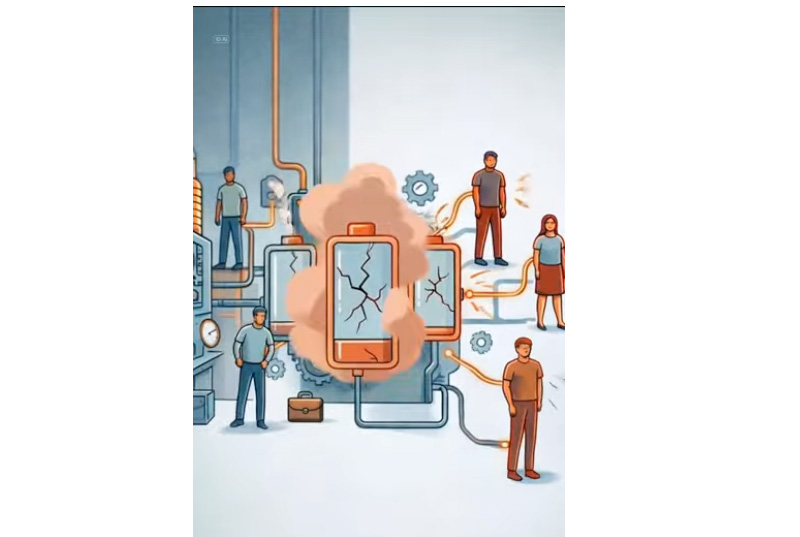
Episode 1: Why redistribute clocks if they stole our time?
The first episode is based on the article «Redistribution cannot be the goal. By René Ramírez Gallegos. “The old reflex of the left (more State, more redistribution) returns with the dignity of what is necessary but with the inadequacy of what is repeated. Redistribution cannot continue to be the radical, the full name of the horizon or the end of the program. We must go further,” he says in his introduction.

Episode 2: Who Owns Your Day?
What happens when time no longer belongs to us? What happens when the days pass without us in them? Not because we have died, but because we have been evicted from our own time…
In this second podcast, you will recognize the alienation of time as the silent way in which we are expelled from our own daily lives… The voice fades, but the wound remains. If you seek the essence of these words, you will find it in this episode.
Source of episode 2: Ramírez Gallegos, R. (2026) Time and space: between alienation (of lost time) and ideology, in Ramírez, R (Coord). Goodbye neoliberalism, welcome fascism? From material redistribution to the ideological battle. INE: Mexico City.
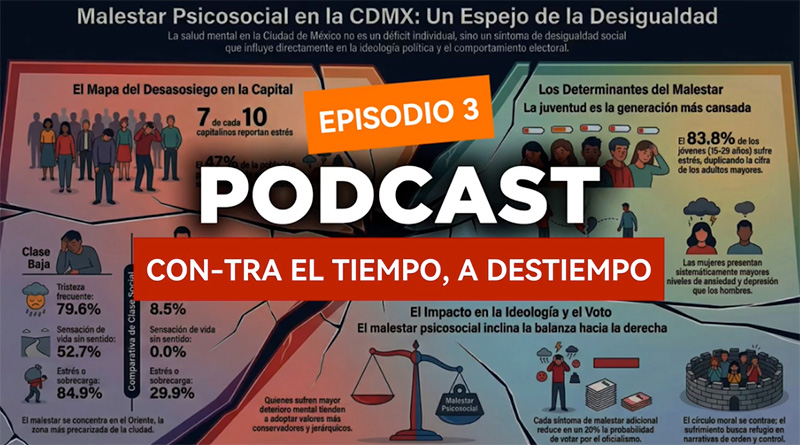
Episode 3: Insomnia as a political problem
What does insomnia have to do with politics? And loneliness with ideology? And technology with sexual abstinence? Screens on. Bodies without embrace. Accumulated stress. Suspended desire. When we can't sleep, is it just individual anxiety or is it the city throbbing inside our bodies? Some nights aren't private. They're political.
Based on the article written by René Ramírez y Sandra Hoffman Martins: “Psychosocial malaise, desire and ideology in Mexico City.”
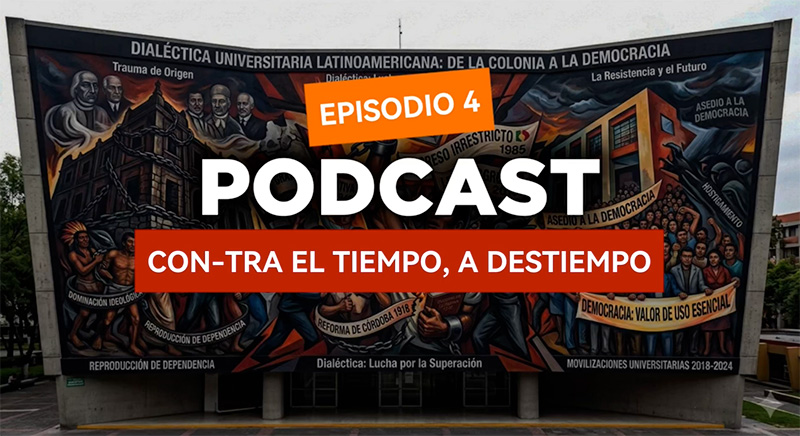
Episode 4: The university as a battleground: democracy or internal colonialism
What does it mean for a university to have original sin? Can an institution be born colonial and become democratic?
Full classrooms. Inherited curricula. Imported knowledge. Disputed autonomy. Frozen budgets. Ridiculed truths.
The university wasn't born free. It was born royal and clerical. It was born to evangelize, to domesticate, to reproduce an already ordered world. But something happened. Córdoba cried out for autonomy. Free tuition opened the doors. Unrestricted admission broke the barrier. The university ceased to be elite and began to become for the people…
Full text that inspired this episode: Ramírez Gallegos & Zaruma Flores (2025).Democracy as a use value of the peripheral university".
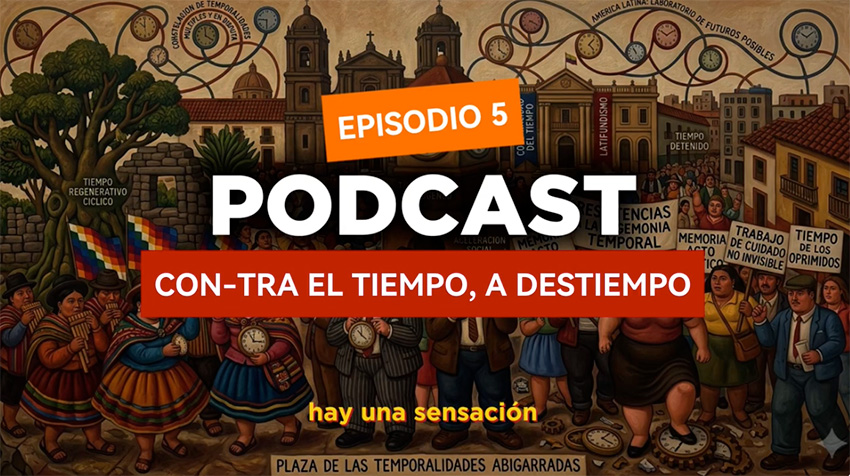
Episode 5: Times that don't fit on a clock
What if the problem wasn't a lack of time... but believing that there is only one?
In Latin America, time has never been linear. It is variegated: many stories unfolding simultaneously. It is baroque: a mixture, excess, resistance. It is suspended: peoples trapped in colonial structures that never seem to end. Here, the past does not disappear. The future does not arrive on its own. Times overlap. They clash. They resist. Because the history of Latin America does not run in a straight line. It moves forward… like a tapestry of time.
Base text: Ramírez Gallegos & Valencia García (2025). Disputes over the future: presentism, acceleration of time and other temporalities, article presented at the CALAS International Congress “Facing crises. Perspectives from Latin America”, Kassel-Germany, February 10-12, 2025.
"Against time, out of time" on YouTube
Redistribution cannot be the horizon
René Ramírez Gallegos
The old reflex of the left (more state, more redistribution) returns with the dignity of necessity but with the inadequacy of repetition. Redistribution cannot continue to be the radical element, the full name of the horizon, or the end goal of the program. We must go further.
There are times that don't die: they run out of future. They don't explode; they drip. Wages drip, trust drips, the future drips. And in that drip, capitalism achieves a sinister-domestic perfection: it doesn't become solemn, it becomes cunning. It learns to rule without epic, without promise, without a flag. When tomorrow ceases to convince, calculation appears: performance, score, ranking. One begins to live like someone taking an exam, like someone justifying themselves. The whip no longer needs a hand: it programs itself. It's in the spreadsheet, in the algorithm, in the self-imposed demands one mistakes for character. And above all, it's in the clock: it doesn't mark hours. It marks what it takes from you. Wrinkles tell what the clock has stolen: sleep, rest, calm. And when time is stolen, it ceases to be an idea and becomes a body.
We are not tired: we are expropriated.
The current crisis has a familiar feel: a certain aura of the interwar period, when long waves of change run out, short-lived upheavals erupt—the much-discussed 30s—and hegemonies are fought over like furniture in a burning house. But it introduces a difference that shatters the analogy. We are not going through a recession: we are experiencing a collapse of meaning.
Today the crisis is not limited to the reproduction of capital; it compromises the reproduction of life; the lives. And this isn't just another "green" metaphor to embellish speeches: it's pure political economy. Energy, water, territories, bodies, emotions; social metabolism on the brink. Capitalist modernity, conceived as infinite expansion, finds its limit in the living matter it devours. When the material base trembles, consciousness doesn't "make a mistake": it defends itself. Sometimes with lucidity, sometimes with fear, sometimes with resentment. But it defends itself.
Redistribution is not a moral whim or a nostalgic notion of the 1970s: it is a minimum obligation in the most obscenely unequal continent on the planet when it comes to measuring wealth. We are talking about a region where 1% concentrates almost sixteen times more wealth than 50% of the population, and yet we are asked for moderation, patience, and education regarding the plunderers. As if the obscenity needed translating. As if it were radical—and not merely decent—to assert that no democratic pact should tolerate a microscopic minority accumulating more than half of the living population, as happens in every country in the region. True extremism lies not in wanting to narrow this gap, but in normalizing it; not in addressing wealth, but in sanctifying it.
In Latin America, (re)distribution is not the goal: it's the minimum. Anything that falls short of this is mere accounting theater, PowerPoint-driven progressivism, or guilt-ridden charity. Because when capital concentrates to the point of suffocating time, labor, and life itself, neutrality ceases to be prudence and becomes complicity. And no: this isn't hatred of the rich. It's historical memory. It's political economy. It's the cold rage of knowing that no society can call itself democratic when the spoils—the socially produced and expropriated wealth—weigh more than the lives of the people.
That's why the old reflex of the left—more state, more (re)distribution—returns with the dignity of necessity but with the inadequacy of repetition. It was the solution of the 20th century, and that's no small feat. But repeating a solution when the nature of the problem has changed is the most elegant way to lose: not through excessive justice, but through a lack of evolution. Not because (re)distribution is wrong, but because it can no longer be the radical stance, the full name of the horizon, the religion of the program. Radicalism isn't measured by the volume of the same thing: it's measured by the capacity to change what causes the same thing to re-emerge.
The postwar period was an engineering of fear. Capital agreed to compromise to avoid being engulfed in flames. There were conditions: a Fordist system capable of absorbing labor and generating massive wages, nation-states with monetary leeway, production pacts, and, above all, a collective trauma with blood still visible. That "more government" approach worked because the capitalism of that era could still expand its legitimacy by distributing growth. It was a machine with room for its own anesthesia. Social peace could be bought with employment, consumption, and stability. Even the bourgeoisie, for a moment, knew how to fear the conflagration.
Without a State, no (but with this State, neither)
Today, however, capitalism no longer buys social peace with the same instrument because its accumulation regime has changed its organ. It's not that the State "doesn't work"; it's that capital has learned to govern even when the State (re)distributes. It has learned to govern the form of desire, the grammar of merit, status as a comparative religion, and fear as domestic pedagogy. (Re)distribution can coexist with a subjectivity trained to look upward, to compare itself, to feel that the justice of others is a loss for itself. (Re)distribution can coexist with a symbolic order that turns equality into a threat and solidarity into suspicion. And there the left discovers, too late, that it is not enough to administer goods if the sense of value remains intact. Capital can tolerate redistribution if its liturgy is left undisturbed.
Herein lies a poisonous knot: the left defends the State with the fidelity of a religion—as if simply uttering its name were enough to make it the people again—and fails to recognize that this devotion is, at the same time, the most useful material for the right. Because the right doesn't debate redistribution: it distorts it. It doesn't dispute taxes; it disputes fear. It transforms the State into Big Brother, who watches, regulates, and "limits freedom" (and all the while, the eye smart (it blinks in your pocket), and in the name of a freedom reduced to the size of consumption, it manages to make vulnerability seem like emancipation.
Meanwhile, capitalism is no longer a capitalism of states: it is a capitalism of large corporations, global chains, platforms, mobile finance, and tax havens; it operates on a global scale. And that's where the short circuit occurs: the right speaks the language of global unity—planetary competitiveness, capital flight, capital mobility—and the left entrenches itself in the defense of the nation-state as if borders could contain the algorithm and as if the tax authorities could pursue with paperwork a power that has become cloud-like.
It's not about renouncing the state: without the state, no; with this state, no either. A state that administers the same liturgy of value (growth, performance, productivity) is insufficient, even if it distributes its crumbs more equitably. What's needed is a state integrated into regional blocs, but reoriented by a different compass: one capable of contesting what counts as wealth and what counts as life. At the rate things are going, the 20th-century state that the left still defends will end up being, even with good intentions, the local office of an order that no longer has a fixed address.
Here it is appropriate to return to Marx without nostalgia. Marx is not a grandfather to be quoted: he is a method for seeing. His core is not a sermon on exploitation, but an analysis of the social form that makes life a means and the commodity an end. When the commodity occupies the place of the sacred, everything else is degraded to an instrument: the forest to a "resource," the body to "human capital," care to "inactivity," time to a "cost." Value is not a number; it is a regime of perception. It decides what counts, what is made invisible, what is sacrificed, and in whose name.
Benjamin put it with ruthless cruelty: history doesn't advance as progress; it advances as managed catastrophe. What we call "development" is usually the orderly accumulation of ruins. And there is one particularly contemporary ruin: that of time. Not the clock. Experience. Time for care, for community, for rest, for presence; time without accounting. Capitalist modernity doesn't just expropriate labor: it expropriates life; it expropriates the world. Its most refined spoils are the interval where a life might not be a function. What is stolen is not merely the hour, but the possibility that an hour could truly be habitable.
In Latin America, we know this through experience, not from literature. Dussel forced us to begin with the exterior: that which the order produces as remainder, periphery, backwardness. Echeverría insisted that capitalism is not a homogeneous bloc: it is embodied in ethosWays of life, ways of inhabiting contradictions. Rivera Cusicanqui shattered the fantasy of peaceful synthesis: ch'ixi It does not reconcile, it coexists in tension, it cannot be tamed by purity. Translated into political economy: our modernity is not that of the center, and therefore its solutions cannot be mere copies. Here, value has always come with coloniality: first as dispossession, then as "progress," now as extractivism with an adjective. The "future" usually arrives as a closed package: it comes with a contract, with debt, with compromised territory.
But this wound is not only colonial. It is also patriarchal, not as an identity marker but as a mechanism of accumulation. Peripheral modernity was sustained—and continues to be sustained—by a silent expropriation: the time dedicated to the reproduction of life, appropriated as if it were natural. Caregiving, raising children, cooking, daily health care, emotional support, the endless logistics of the home: work that doesn't appear in the GDP but without which the GDP cannot breathe. This "outside" of the economy is, in reality, its basement. And when the crisis hits, the adjustment doesn't fall first on the profit rate: it falls on feminized bodies that stretch their hours, multiply tasks, and absorb the blow so that the machine keeps running.
That's why the struggle over value can't remain confined to the factory or the mine: it must enter the home, caregiving, the stolen time that capital calls "love" when it suits its purposes. In Latin America, coloniality and patriarchy are not two parallel histories: they are intertwined in the same fabric that transforms territory and life—jungle and body—into cheap or free commodities.
That's why there's something insidious about the trend of "green industrialization" when the adjective is meant to solve the underlying problem. Painting the machinery green doesn't change the logic of appropriation. The question isn't whether we produce batteries or panels: the question is who controls the income, who controls the technology, who controls the value chain, who captures the surplus, and where does it disappear to? Regional history knows this scene by heart: national accumulation followed by disaccumulation in tax havens. The elite learns the language of the future and stores their money in a place where the future has no citizenship. "Green," in this way, can be just another excuse for the same sacrifice: territories transformed into extraction zones, lives turned into inputs, ecosystems converted into "compensation."
The redistribution trap as a horizon
And what does this have to do with the left and its commitment to (re)distribution? Everything. Because even when (re)distribution works, it can still be (re)distributing within a society organized for attrition. (Re)distributing time in an alienated order is not about giving back life: it's about distributing lack more equitably. It's about democratizing exhaustion, alienation, exploitation; making them more equitable, yes, but without changing the machine that produces them. Radicalism, in that case, risks becoming a bitter perfection: a democratically exhausted, democratically anxious, democratically expropriated society. Less unjust, certainly—and that matters—but unjust nonetheless: because the principle that produces the expropriation of time remains intact.
That's why (re)distribution isn't enough: we need to create a different kind of time, a time that isn't just time for productivity, but time for a good life. That's where the revaluation of value begins: when wealth ceases to be a thing and becomes livable life again; a full life, a dignified life.
If life is the ultimate goal, then political action cannot be evaluated solely by how much it redistributes, but rather by how much time it restores. Not all redistributive policies are emancipatory: only those that decommodify time and return it as livable life truly are. When time continues to be organized as cost, yield, or sacrifice, even justice becomes merely the management of attrition. Revaluing value, therefore, implies that every programmatic decision—fiscal, productive, social, or environmental—should be measured by its capacity to expand the time available for a good life, and not just by increasing income, goods, or consumption. Where money gains but time is lost, there is no transformation: there is alienated accounting.
And that's where the knot appears: Redistributing without disputing the meaning of value can end up redistributing under the hegemony of value.And this produces a paradox that shouldn't be dismissed with cheap psychology, but neither should it be denied: objective improvement can coexist with subjective unease, and this coexistence can be politically lethal. Because subjectivity doesn't float: it's manufactured. And it's manufactured in material and temporal relationships: in how we work, wait, rest, and compare ourselves. Common sense has a basis: time and bodies (human and non-human). When the value system continues to dictate perception, redistribution isn't experienced as justice but as a threat to status; it isn't experienced as an expansion of the world but as a "loss" of symbolic hierarchy. Consciousness doesn't err: it responds to the field of forces that shaped it. Hegemony works like a silent pedagogue: it teaches what to fear, what to desire, and whom to blame.
That's the painful dialectical point: in several progressive processes, material (re)distribution was real, and yet a significant portion of the middle classes—especially the upper-middle strata—retreated into reactionary options. Not because it's always economically "convenient" for them (in fact, it's detrimental to their well-being).[1]But the system of value whispers a promise deeper than income: distinction, order, moral superiority, a simplistic explanation of the world: "they took what was yours." Here, capital doesn't just buy votes: it buys identities. And a bought identity is an obedience that feels like freedom.
But if we use the image of "Stockholm syndrome," let's do so with caution: not as a psychological diagnosis, but as the name of a historical mechanism. Some of those who benefited from redistribution end up supporting those who will discipline and harm them, because discipline is presented as a restoration of lost value. This is not a psychological mystery: it is a historical outcome. Uncontested redistribution of hegemonic value can generate a subjectivity that tolerates justice as long as it doesn't affect its place on the symbolic ladder. When it does, resentment emerges as a defense. And there the final temptation appears: to kick down the ladder so that no one else can climb it.
Because the mechanism doesn't originate in the mind: it originates in reproduction. If the material logic of production and social life doesn't change—if success remains a mark of distinction, if competition remains the law, if time remains a commodity—common sense is reborn in the same way, even if the distribution of resources improves. The same system manufactures, time and again, the same pedagogy: compare, fear, defend one's place.
And here we see the second blind spot of progressive movements: they failed to consider the historical role of the middle and upper classes in the struggle for transformation. They were treated as noise, as a betrayal foretold, as "damned middle classes"; it was assumed that the maximalist-minimal approach—"those at the bottom first"—was sufficient, without realizing that if the horizon at the center of the pyramid is not contested, and even more so, if the pyramidal structure itself is not challenged, material success can become political impossibility. Because a transformation that does not win over, challenge, and re-educate the common sense of these strata remains merely an episode: it improves lives, yes, but it leaves intact the pendulum's engine that will later reverse it.
And then the left is outraged, as if politics were merely about the distribution of goods. But hegemony has never been just about economics: it's about meaning. What is measured, what is celebrated, what is designated as success, organizes social desire more effectively than any decree. And here the irony turns bitter: the left believes that radicalization means increasing the dose—more spending, more taxes, more transfers—while capital also knows how to say "more" (more productivity, more extraction, more growth, more speed). In the race for "more," capital always has the advantage: it's its native language. Radicalism today isn't about shouting "more" in its language. It's about changing the language. Changing the value.
Why redistribute clocks if they stole our time?
Herein lies the core of the proposal—and it's best to state it calmly, so it cuts through like a knife rather than a banner—: the transformation agenda cannot be reduced to more government and more (re)distribution (with more industry) as the ultimate goal. That was a response to a world that is no longer ours. Not because the government and (re)distribution (and industry) don't matter, but because their meaning is emptied if the core doesn't shift. The radicalism of the 21st century lies in revaluing value: in challenging the theology that defines what counts as wealth.
Because the hegemonic value remains, essentially, the value of things and exchange value. As long as that is the altar, even life becomes a means to an end. Capitalism can tolerate redistribution if its theology remains untouched. It can tolerate the State if the State administers the same sacramental principles: growth, competitiveness, performance, productivity. Always time as the denominator: more goods, more foreign currency, more natural resources in the same hour, minute, nanosecond. What it cannot tolerate is questioning what counts as wealth. What it cannot tolerate is the assertion that wealth is not the accumulation of goods, but the conditions for a dignified life; not money, but time well lived; not just production, but the reproduction of life itself.
Revaluing value means opening a crack in that theology: affirming that there is value that does not derive from price; that the center cannot be the commodity; that life—lives—has intrinsic value. And here, “life” is not a slogan on a poster: it is a material category, autopoiesis: the capacity of the living to produce and reproduce itself, to sustain its organization, to rebuild its fabric, to persist by creating conditions of possibility. Life is not valuable because it is sold. Nor is it valuable because it “serves” something external. It is valuable because it is the ground, the very heart of the world: without it there is no exchange, no State, no economy, no history. For this reason, even the primacy of use value reveals itself to be dependent on something prior: use value matters because it satisfies needs, but needs are always needs of lives.
And if we ever speak of the "use value" of life, it can only be in a limiting sense: life "serves" only insofar as it unfolds as a dignified life that reproduces more life (not just any "more life," but life goodLife as an end, not as a means. That is the central heresy. And it is, precisely, the dispute over value.
That's why simply proclaiming the "right to time" as if it were the final destination isn't enough. It can be a threshold—an indispensable transitional right—but not a utopia. If life is an end, and that end includes its autopoietic potential (the capacity to produce and sustain life, to create a world), then the problem isn't solved merely by taking hours away from capital, but by restoring meaning to what we do with those hours.
The reduction of working hours is a central tenet of capitalism because here, work steals life's time, alienates, and exploits; we must fight for it without shame. But it cannot be the ultimate goal, as if work were, by its very nature, a sentence from which we must escape. The challenge is more difficult: that every human being can find fulfillment in their life's time, including at work. That work ceases to be the place where one loses oneself and becomes, also, a way of living well. It's not about choosing between free time and work: it's about breaking the historical structure that has turned work into the enemy of living. Because when the "right to time" becomes the end goal, we accept—without saying so—that work will continue to be what it is today: a necessary evil, managed. And that resignation is another way of leaving the system of value intact.
The problem is that capital can applaud life in speeches while continuing to collect its dues in installments. It can grant rights while still confiscating the very condition that makes them livable. That condition is time: without time, rights are mere paperwork; redistribution, statistics; and dignity, a promise. Without biogeochemical time (time for regeneration, for cycles, for rest), nature is reduced to... stockTime is extracted faster than it can be replenished. Therefore, revaluing time cannot be limited to distributing goods; it must also address the social system that distributes—and steals—time.
When we shift the focus to the living, (re)distribution is repositioned. It ceases to be a myth and becomes a condition: ground, not heaven; a tool, not a religion. Important, urgent, but not sufficient. And then the question changes texture. It is no longer just "how much do we redistribute?", but "what kind of world does the redistributed produce?" What subjectivities does an economy produce where success remains distinction and wealth remains extraction? What kind of time are we distributing, if time is colonized? Because time is the place where the economy becomes life. And that is why all economics is the politics of time.
Here, the metaphor of "redistributing clocks" becomes literal in what matters: what is redistributed, often, is already alienated time; time governed by a corporation that decides in advance who will have your day. (Re)distributing within a time-consuming regime can end up being redistributing exhaustion, exploitation, and alienation in the name of justice. It saves lives—the justice of exhaustion saves lives—but it doesn't offer the civilizational way out that is needed. It's an emergency brake on a machine that keeps running. We don't need the redistribution or democratization of injustice: we need to change the principle that organizes it.
And at this point, it's wise to be wary of facile enthusiasm—even from progressives—that idolizes "models" as if they were historical shortcuts. China is invoked as a miracle, but the underlying logic is rarely examined: not only planning and state capacity, but also a time economy pushed to its limits. This is where the 996 emblem (9 to 21, six days) emerges as the popular name for the normalization of long workdays, even though courts and authorities have declared them illegal. And beyond the myth, there are the averages: the Chinese state itself reports that in 2024, company employees worked an average of 49,0 hours per week, and recent reports place an increase from around 46,2 (April 2022) to 49,1 (January 2025).[2].
It's not about denying the reduction of monetary/material poverty—that would be indecent—but about questioning the civilizational cost: what does it mean to defeat one form of poverty only to create another? Because a life without time is a poor life, even if it possesses material goods; a life deprived of rest, care, community, and presence is a disciplined life. If development is bought with temporary poverty, the "miracle" looks far too much like what we've been criticizing: growth as a ritual, life as a means, the clock as a control.
Revalue the value
But the times we live in are more complicated. Today, capital doesn't compete solely for the workday; it competes for attention, for emotion, for sleep, for the future. It captures not only objective hours, but the capacity to be in the world without becoming a function. It captures the very possibility of "timeless time": those moments that cannot be saved, that cannot be broken down, that cannot be accounted for without killing them. Without those moments, life becomes pure administration. And an administered life is the executioner's most silent victory.
That's why even the theory of surplus value—if taken as a complete map—falls short. Not because it's false, but because capital has learned to steal outside the factory while still wielding power as a factory. It no longer expropriates only labor time: it expropriates life time. It captures you awake (attention), it captures you sensitive (emotion), it captures you asleep (sleep), and now it captures you before you even arrive: it colonizes the future. It's not just the exploitation of present hours; it's the indebtedness of future hours, mortgaging the imagination, programming anxiety. Capital doesn't just want your labor power: it wants your availability, your expectation, your silence. And when it achieves that, the workday becomes just one scene among others: the gateway to a regime that continues to control you even when you think you've finally stopped producing.
And for this theft to be stable, for it not to appear as theft, something more than coercion is needed: an epistemology is needed. The regime of value doesn't rule solely through wages and prices; it rules through categories masquerading as common sense. The dominant economics achieved this with an elegant operation: the dominant microeconomics disguises scarcity by calling it "preference," combs submission as "self-determination," perfumes consumption with the name of "well-being," and, to top it all off, seals conformity as "happiness." "Revealed preferences" don't reveal a soul: they reveal the framework that decides which options exist and which remain unthinkable. And above all, they reveal that freedom is mistaken for a choice restricted to baskets of goods, not for freedoms of life. It's not objectivity: it's politics that has learned to speak as if it were describing the world when, in reality, it manufactures it.
That's why the methodological dispute isn't a whim: it's hard politics. Neoliberalism also governs with its measuring devices: at the top, national accounts that enshrine GDP as the state's guiding principle; at the bottom, household surveys that reduce life to income and consumption, as if existence could be contained in two boxes. Thus, care, community, rest, celebration, illness, and solitude become invisible—by definition, not through oversight: everything that sustains life but cannot be easily translated into a price.
Revaluing what is truly important also means revaluing what is measurable; that is, challenging the established diagnoses and social interventions: placing life at the center of analysis and using well-lived time as the methodological compass. Hence the power of an alternative to GDP such as Good Life Expectancy.[3]Not because it is "pretty" or finished, but because it shifts the criterion of social success towards concrete life, towards time to live well and not just to produce/consume.
And it bears repeating: this isn't theory; it's political history. Every era has had its own way of naming wealth, and in naming it, it created it: land, gold, and trade; labor, factories, and productivity… today it's data, platforms, and attention: wealth as the capture of behavior; theory providing the alibi ("preferences"), the algorithm providing the chain. Different names for the same operation: deciding what counts and what is sacrificed. That's why the dispute over value/wealth isn't an academic debate: it's a fight for the horizon. Changing its meaning—and its measurement—is changing the world that this measurement legitimizes. And when measurement governs perception, what seems like "mental health" is also political economy.
Defend what is alive without turning it into merchandise.
As a case in point, it's worth recalling that in our region there have already been times when the core of value was seriously debated, not as theory but as living history. Yasuní-ITT was one such example: a proposal originating in Ecuador to leave the oil underground in Yasuní National Park, one of the most biodiverse areas on the planet, in exchange for recognizing—internationally as well—that there was wealth in not extracting it, value in not turning everything into a commodity. History was neither linear nor straightforward: the country ended up authorizing the exploitation, as if fiscal urgency always had the final say. But precisely for that reason, the decisive moment came later, when society, in a popular referendum, reopened the question in the only language that the State and politics cannot pretend not to understand: the vote.
There, something more important than a simple "yes" or "no" to an economic activity occurred: for a fleeting moment, a shift in perspective became visible. Revaluing worth ceased to be a slogan and became democracy, politics, and collective sentiment. A community was able to choose life—the Amazonian biodiversity and the culture of uncontacted peoples—over the petrodollars lying dormant underground. That gesture wasn't just a poem (though it was that too): it was a reversal of the accounting. It was saying that price doesn't diminish value; that there is a future that cannot be bought by selling off territory.
And it was also a lesson for the left, a harsh one because it's temporary: the condition for the possibility of structural transformation is its political sustainability, and political sustainability hinges on an intergenerational shift in the meaning of wealth. If wealth remains, at its core, extraction with adjectives, each crisis will bring back the same "realism": we must drill, we must dig, we must grow. The right thrives on this scenario: it pays in foreign currency for what it presents as equivalent, as if every dollar per barrel or ton had its fair counterpart in polluted rivers, sick bodies, and dead forests. But this equivalence is a sham: "externalities" are not just another cost; they are lost life, interrupted biological time, a truncated future. Therefore, without a change in meaning, political sustainability is wounded—because transformation becomes merely an episode—and ecological sustainability is also wounded, because the short-term material focus ends up negating the only sustainability that truly matters: long-term, material, and living sustainability.
Self-criticism on the left cannot fall into superficial moralizing (“we were wrong,” “we didn’t understand”); it must be dialectical. The first wave believed that the enemy was only neoliberalism as an economic policy; but the deeper enemy was—and still is—the system of value that makes life a means to an end. You can defeat a policy and leave the underlying ideology intact. You can redistribute wealth and continue worshipping commodities. You can expand rights and continue measuring success with the same metronome that destroys. And when that happens, resentment finds its political form: reaction. History returns, not as tragedy or farce, but as a warning: “the executioner has won.”
I know what you're going to say (with some justification): the enemy is neoliberalism. Yes, it is, both as a form of government and as a "every man for himself" pedagogy. But therein lies the trap: neoliberalism cannot be defeated simply by changing policies because its power doesn't reside solely in government ministries; it resides in how society learns to perceive things, a product of how it has become accustomed to resolving the material problems that distress it.
His checkmate doesn't happen in Congress; it happens in common sense: in what is considered success, what is called freedom, what is mistaken for progress, what is tolerated as "realism." That's why he can lose an election and still remain in control of the era: he returns with a different name, a different coalition, a different aesthetic, but with the same compass. The decisive battle, then, is not just against a package of measures, but against the criteria that decide which measures seem "sensible" and which "impossible." That criteria is value: what is placed at the center, what is sacrificed without it seeming like a sacrifice, what is measured until it becomes destiny.
There's no need to be blunt; it's enough to see it clearly: if value remains a commodity and an exchange value, life will continue to be a means and time, plunder. Redistributing clocks will still be necessary—because there are urgent needs that can't wait—but it won't be the solution. The solution lies elsewhere: to revalue what truly matters so that wealth becomes time for a good life. Time not as a clock, but as a livable life: so we don't become migrants of our own bodies. Time to care without disappearing. Time to rest without guilt. Time for community without surveillance. Time for a world without price.
History has already shown this movement: one can redistribute without transforming, govern without challenging value, and improve conditions without altering the system that undermines them. Every time this has happened, reaction has found its opportunity. Not because justice fails, but because it arrives too late, when time has already been colonized and ultimately usurped.
The question, then, is not whether the left or populist governments want to win elections again, but whether they are willing to change the principle that organizes social life. Because as long as success remains a distinction, wealth remains a means of extraction, and time remains a commodity, politics will continue to manage ruins with better manners. Revaluing worth is not a moral imperative: it is the minimum condition for transformation to be more than just an isolated event. Without this shift, the future is not lost: it is repeated. What is at stake is not only the direction of the left, but something more vital: whether we will continue living against the clock or whether, at last, we begin to live in time.
We must learn to defend life without turning it into a commodity. We must learn to measure without humiliating. We must learn to do politics without making progress an elegant form of devastation. And we must do it quickly, but not hastily: with the slow urgency of one who writes from the ruins. Because the body is the archive. And the archive bleeds.
Notas
[*] This text derives from the Master Conference presented at the round table "The care of life as a path towards an alternative future", given at the Development Studies Unit of the Autonomous University of Zacatecas, on August 26, 2024, and is based on the manuscript of the book: Ramirez, R. (2026). Goodbye economics? From the value of things to the value of a good life, currently under editorial review.
[1] For evidence demonstrating the harm to the well-being of the middle classes under right-wing, neoliberal, or conservative governments, see: Ramírez Gallegos, René (2024). Whoever cuts the pie and divides it, does he get the best part? The right and the left in the distribution of the pie in Latin America, 2000–2020Buenos Aires / Seville / Madrid: Mármol/Izquierdo Editores – Latin American Strategic Center for Geopolitics (CELAG) – Tarahumara Libros.
[2] View National Economy Witnessed Steady Progress amidst Stability with Major Development Targets Achieved Successfully in 2024.
[3] The methodological calculation proposal that supports this approach can be reviewed in the document published by CLACSO: https://libreria.clacso.org/publicacion.php?p=2742&c=37

