
Thinking about the pandemic from the perspective of the social sciences and humanities
RESEARCH GRANT FOR TEAMS
Registration closing: December 18th 2020
This year the world has experienced profound upheaval in the face of what is shaping up to be the worst pandemic in a century. Since the emergence and spread of COVID-19 and the subsequent isolation measures implemented across much of the globe, the dynamics of various societies, countries, and regions have been tangibly disrupted. Furthermore, the pandemic has acted as a powerful catalyst, amplifying and deepening pre-existing social dynamics. Among these, social inequalities have emerged as the most prominent, but they are not the only ones.
In the political arena, 2019 was marked by crises, instability, and mobilizations across various regions and with diverse motivations. The limitations imposed by lockdowns were followed by social mobilizations in several countries. In many Latin American countries, these collective actions can be seen as a continuation of the social rebellions that occurred in 2019 and previous years. In other cases, these were demonstrations reacting to quarantines and isolation measures, including the so-called anti-quarantine marches, which challenged collective or social care measures under the argument of individual responsibility, as well as the anti-vaccine movements. This reflects the re-emergence of marginal trends that already existed in societies, but which strain the State's capacity to manage public affairs, challenge democratic institutions, and undermine social cohesion by promoting violent, rights-denying, conservative, and regressive actions.
At the economic level, the worst downturn since World War II has been experienced, which many authors interpret as a setback or limitation of the globalization process. This situation led to a re-evaluation of the role of the state and the market as regulators and drivers of the economy. On the one hand, public policies were implemented to stimulate recovery and address the needs of the economic sectors most affected by the crisis. On the other hand, public policies were designed to provide direct assistance to businesses, workers, and citizens, leading to renewed debates on basic income or universal basic income, wealth taxes, and other measures of economic compensation and redistribution. This is compounded by trends toward an increasingly concentrated global economy, with greater conflict and competition during crises, and with rising levels of inequality.
Furthermore, the differences between societies and their institutional frameworks for addressing the pandemic, as well as the problems arising from it, have stimulated diverse interpretations of issues such as labor relations, care policies and economics, the situation of young people, intergenerational relationships, the rights to connectivity and disconnection, the stigmatization of different social groups, the social mechanisms of fear, skepticism, and denial, human displacement and migration, and the environmental crisis, among others. Even the handling of the pandemic and the resulting outcomes have led to interpretations that have reverted to a polarization between East and West based on how different societies address collective problems, the role of the state, and the dynamics of coexistence and social responsibility.
The different dimensions of the global pandemic and its diverse impacts invite us to investigate the current situation in its political, economic, social, environmental, and cultural dimensions, as well as to explore trends that will guide our understanding of future dynamics. As part of these efforts, CLACSO created the Social Observatory "Thinking about the Pandemic," which constitutes a collaborative space for sharing reflections, interpretations, and research on the current situation.
Based on these analyses, CLACSO is launching the Research Grant for teams "Thinking about the pandemic from the Social Sciences and Humanities." This call for proposals encourages applications from research teams comprised of researchers from diverse disciplines, backgrounds, and experiences who address the problems outlined here or others they deem relevant, and who propose rigorous and contextualized analyses, as well as proposals for interpreting and acting in the world to come.
Applicant profile.
-
Applicants must be researchers with accredited ties to CLACSO Member Centers, which they will demonstrate with a sworn statement. If awarded the scholarship, they must submit a letter of support signed by the highest authority of the center.
-
Submissions by collective authors of up to 4 (four) members will be accepted.
-
The formation of the teams must respect gender parity (at least 50% women) and must select one of the members as responsible for the registration of the project.
-
Each team must be made up of trained researchers, that is, those who hold a master's degree, doctorate or equivalent and have a proven academic track record, and researchers in training, that is, those who are pursuing master's or doctoral studies or are up to 35 years of age, in this case with a degree.
-
Each researcher or research team may only participate with one proposal in this call.
-
If the scholarship is awarded and travel is necessary, the winners will be responsible for covering the costs of medical insurance or similar expenses.
Support to be granted
Up to 6 group scholarships will be awarded.
The amount of the scholarships awarded will consist of:
-
$16.000 for each research team.
The proposed research will be carried out over a maximum period of eight (8) months. The grants will be paid in installments via bank transfers made to the principal investigator. It is expected that at least 60% of the grant funds will be used for activities related to gathering and processing the information necessary for the research, which must be reported to CLACSO with supporting documentation.
The winners will work with the support of tutors assigned by CLACSO who will follow the process of their research and results.
CLACSO will publish the final products in print and/or digital media, giving them wide publicity and dissemination through the means it deems appropriate.
The authors will transfer the original publication rights of their works, given that CLACSO adheres to and defends the principles of open science and open access to knowledge, so that the resulting work is easy to find, accessible, interoperable, and reusable. Subsequently, these works may be published in any other medium, always citing the grant received. Grant recipients must inform CLACSO of the subsequent publication of works resulting from the grant work.
Characteristics of the proposals
-
The member centers to which the applicants are linked must not have any outstanding debts in the payment of membership fees corresponding to the year 2019, due on June 30 of the same year.
-
Completed research projects will not be accepted. Proposals may be linked to ongoing research processes, but the final works must be original and unpublished products and developed within the period established by the call for proposals.
-
Members of the Steering Committee or officials of the CLACSO Executive Secretariat may not participate.
-
Proposals from researchers who are currently recipients of research grants, fellowships, or research projects organized by CLACSO will not be accepted. Applications from researchers who have previously received a CLACSO research grant will be accepted, provided that the recipient has fulfilled all obligations in a timely manner.
-
Texts written in the four languages commonly used in Latin America and the Caribbean (Spanish, English, Portuguese and French) will be accepted, depending on the country of origin of the proposal.
Selection criteria for proposals
-
In the first stage, the submitted proposals will be reviewed for their formal and administrative aspects to ensure their compliance with the competition rules. Proposals that do not meet the established requirements will be rejected.
-
Applications that pass to the next stage will be evaluated by an International Committee composed of experts who will assess the quality and relevance of the proposals, which will be submitted under a pseudonym.
-
The Call may be declared void or a smaller number of scholarship recipients may be selected, if the proposals submitted do not meet the required quality and consistency.
-
Situations not covered in this document will be resolved by the convening institution.
-
The ruling will be final.
Characteristics of research papers
-
The research projects will develop their work plan between March and October 2021. This plan will be implemented under the facilitation of tutors assigned by CLACSO.
-
The progress and final reports submitted by the scholarship recipients will be reviewed by the tutors.
-
In their final version, the research papers submitted as a result should be between 12.000 and 15.000 words in length (excluding appendices and bibliography), written in Times New Roman 12-point font, single-spaced. This is an approximate guideline, and CLACSO reserves the right to make adjustments or exceptions if deemed necessary.
-
The structure of the text will be free, respecting the conventions of presentation of an academic text and the editorial standards of CLACSO, in addition to APA + GENRE.
-
In addition, each team must submit a Proposal and Guidelines for Action Document (PLA), containing inputs and recommendations for public policies and social intervention on the topics investigated.
-
Texts written in the four languages commonly used in Latin America and the Caribbean (Spanish, English, Portuguese and French) will be accepted, depending on the country of origin of the proposal.
It is mandatory that the submission be made through the online registration system provided by CLACSO. Printed submissions and submissions sent by email will not be accepted. It is recommended to access the online system to review the registration form.
-
Access the CLACSO website clacso.orgThe online registration system will be available from day XXX.
-
Register in the CLACSO Single Registration System (SUIC). The generated username and password will be required each time you wish to access the system to consult, modify, add, or submit information for this or any other CLACSO activity. Applicants submitting collective proposals must designate one of the authors as responsible for registration. This same person will receive the corresponding monetary award if the proposal is selected by the Jury.
-
Identify the proposal by indicating its title and the pseudonym of the applicant(s). Applications with pseudonyms that correspond to the applicant's first and/or last name will not be accepted. Once the corresponding fields are completed, the system will enable the uploading of the following data.
-
They must complete the registration form sworn declaration indicating the applicants' affiliation with a Member Center belonging to the CLACSO network. Consult the database of member centers at: www.clacso.org.ar/clacso/centros_miembros_clacso/inicio.php.
-
Complete the form personal and academic data and attach the curriculum vitae in free format; the digital copy of the identity document, passport or ID card; the digital copy of the highest academic degree obtained (or proof of degree in process) and the photograph.
-
The proposal must be uploaded to the form that appears once the personal and academic data has been completed.
-
Once registration is closed, the system will produce an electronic certificate of receipt that will serve as proof.
Registration closes: December 18th at 23:59 PM (Argentina)
Winners will be announced in February 2021.
Project completion: March-October 2021
Final report due: November 2021
The results will be published on the CLACSO website. The winners will be contacted by email.
Queries: [email protected]
If you would like to receive more information about CLACSO's training programs:
[widget id=”custom_html-57″]
to our email lists.
Results
OPINION
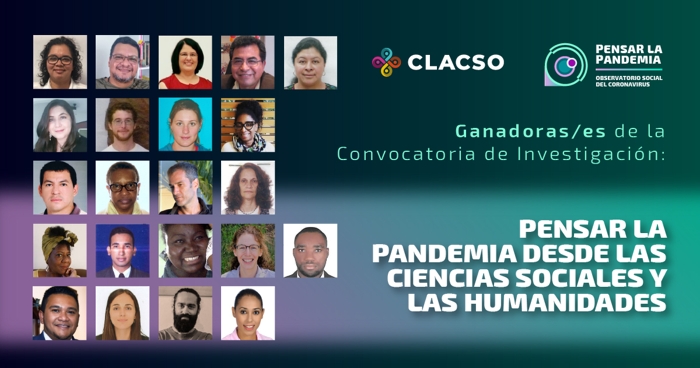
The Latin American Council of Social Sciences (CLACSO) announces the results of the Call for Research for Teams "Thinking about the pandemic from the perspective of the Social Sciences and Humanities”, which focuses on the different dimensions of the global pandemic and its various impacts that invite us to investigate the current situation in the political, economic, social, environmental and cultural dimensions; as well as to explore trends that guide the understanding of future dynamics.
They were received 217 applications, of which, after technical and formal review, 214 They were in a position to be qualitatively evaluated by the International Committee to consider the quality, relevance and coherence of the proposals according to the Call.
The evaluation process was carried out by an International Committee composed of 33 experts 13 Countries: Denisse Roca-Servat (Peru), Felipe Milanez (Brazil), Narciso Barrera Bassols (Mexico), Nora Estela Fernandez Mora (Ecuador), Urphy Vazquez Baca (Peru), Marcos Todt (Brazil), Juan Wahren (Argentina), Hugo Damian Del Valle (Argentina), Ramiro Noriega Fernández (Ecuador), Andrés Gómez Seguel (Chile), Verónica Moreira (Argentina), Antonio Aravena (Chile), Gonzalo Basile (Dominican Republic), Lia Gómez (Argentina), Amparo Marroquin (El Salvador), Angélica De Sena (Argentina), Jeanie Maritza Herrera Nájera (Guatemala), Rebeca Peralta (Bolivia), Consuelo Paz Silva Flores (Chile), Freddy Alvarez (Ecuador), Breno Bringel (Brazil), Julián Rebón (Argentina), Nelsy Lizarazo (Colombia), Carmen Ledo (Bolivia), Jaime Estay (Mexico), Mariana Maneiro (Argentina), Aimee Gross (Cuba), Patricia Rodríguez López (Mexico), Lia Gómez (Argentina), Ana Rivoir (Uruguay), Jorge Rojas (Chile), Ezequiel Saferstein (Argentina), Gabriela Martínez (Mexico).
Following the evaluation, which recognized the excellent quality, relevance, and rigor of most of the applications, Six proposals were selected.
The list of winning proposals from the Call for Proposals is as follows:
|
Winning Proposals |
|||
|
Authors |
Member Center or Institution |
Country |
Title of the proposal |
|
Maria Antonieta Antonacci, Nirlene Nepomuceno, Hiram de Moura Possas, Bernardo Tomchinsky |
Center for African Cultural and Diaspora Studies – CECAFRO |
Brazil |
Community sense and communication networks between Afro and indigenous people in favelas and southeastern regions of Pará: thinking about the pandemic in Brazil |
|
Delfino Vargas-Chanes, Pierre Antoine Delice |
University Program of Development Studies – PUED/UNAM |
Mexico |
Effects of SARS-CoV-2 post-viral syndrome in Mexico, from a syndemic perspective |
|
Marysabel Zelaya Ochoa, César Armando Batres Alvarado, Arlen Mercedes Soto Vanegas, Liliana Isabel Hernández Estrada |
Latin American Postgraduate Program in Social Work – PLATS/UNAH |
Honduras |
Vulnerability of the population at the territorial and social level to the COVID-19 pandemic in four Central American countries |
|
Darling Ayala Freites, Cindy Margarita Arenas Ballestas, Milder Constancio Lara Marriaga, Carla Carolina Bonell Pagano |
Colombian Association of Urban and Regional Researchers – ACIUR |
Colombia |
Study of the correlation between the care economy, work and violence experienced by women in five Colombian cities during the Covid-19 pandemic in 2020-2021 |
|
Rosa Campoalegre Septien, Claudia Miranda, Luis Oswaldo Martelo Ortiz, Anny Ocoró Loango |
Center for Psychological and Sociological Research – CIPS |
Cuba |
The impact of the pandemic on the situation of Afro-descendant women in Brazil, Colombia, and Cuba: An intersectional study |
|
Gabriel Kessler, Gonzalo Assusa, Martina Moriconi, Daiana Ailén Monti |
Interdisciplinary School of Advanced Social Studies – IDAES/UNSAM School |
Argentina |
Disputes over Equality following the Covid-19 Crisis in Argentina |
This ruling is irrevocable and cannot be appealed.
Buenos Aires, March 19, 2021

