
“Thinking about the Caribbean from the perspective of Juan Bosch and Eric Williams”
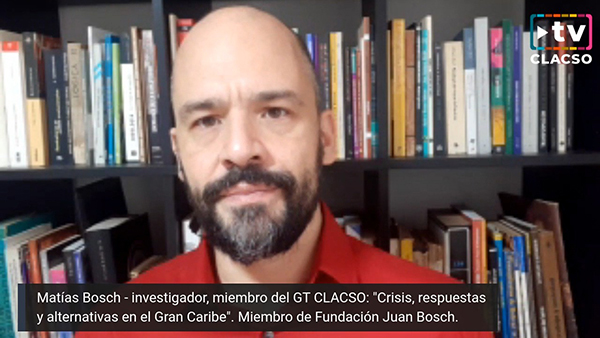
In dialogue with CLACSO.tv, Matías Bosch, researcher, member of the GT “Crisis, responses and alternatives in the Greater Caribbean” and member of the Juan Bosch Foundation, Clacso Member Center in the Dominican Republic, presented the Call for “Essays Thinking about the Caribbean from Juan Bosch and Eric Williams”.
Interviewed by Gustavo Lema
Matía Bosch stated that, “we, between the CLACSO Executive Secretariat, the Working Group on Crisis, Responses, and Alternatives in the Greater Caribbean, and the Juan Bosch Foundation, ensured that a very important date was not overlooked: half a century since two prominent Caribbean figures, Eric Williams and Juan Bosch, each wrote a book, both on Caribbean history. And the titles were practically the same: in Williams' case, 'From Columbus to Castro,' a history from the arrival of the conquistadors to the 60s; and in Juan Bosch's case, 'From Christopher Columbus to Fidel Castro: The Caribbean, Imperial Frontier,' which also covers the period from the conquest to 1961. Each book has its own particular focus. Williams already had a tradition of studying slavery, the relationship between slavery and capitalism, and the plantation economy; Juan Bosch, on the other hand, was very interested in the geopolitical perspective of the Caribbean, and that is why 'The Caribbean, Imperial Frontier,' from the conquest to the hegemony of the United States, is so important. And for him, 61, from That blurring of focus when he writes it is the turning point because the confrontation at Playa Girón in Cuba occurs, and the defeat inflicted on this plan originating from the United States is, for the author, the first defeat suffered by an empire on Caribbean soil. Both books were published in 1970, the first edition of Williams' book and the first edition of Juan Bosch's, one in English, the other in Spanish. Furthermore, both are connected by their prominent intellectual positions in their respective countries, one in Trinidad and Tobago, the other in the Dominican Republic. Consider also the context of the Caribbean at that time: the Cuban Revolution, the 1965 invasion of the Dominican Republic, the struggles for independence in the Caribbean colonies (which still exist). Juan Bosch, as a political leader, was president of the Dominican Republic in 1963, overthrown in a coup d'état. As a result of that coup and the revolution that occurred in 65, came the American invasion. At that time, he was in self-imposed exile. He wrote that book in self-imposed exile where... Furthermore, it has an encounter with Marxism and delves deeper into Marxism, and this is a key book to explain historically how the relationship of Caribbean peoples with imperial powers occurs and how that determines what happens in each country.”
If you would like to receive more information about CLACSO's training programs:
[widget id=”custom_html-57″]
to our email lists.

