
Thinking about Latin America after the pandemic
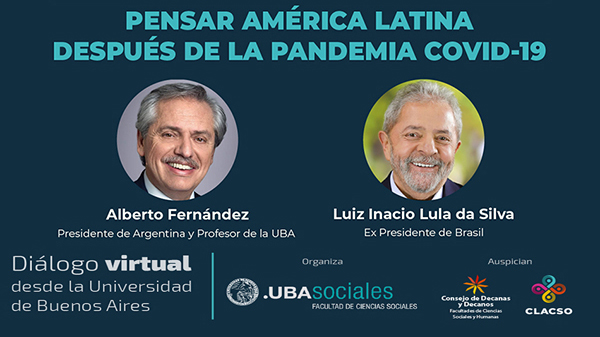
Dialogue between Alberto Fernández and Lula da Silva
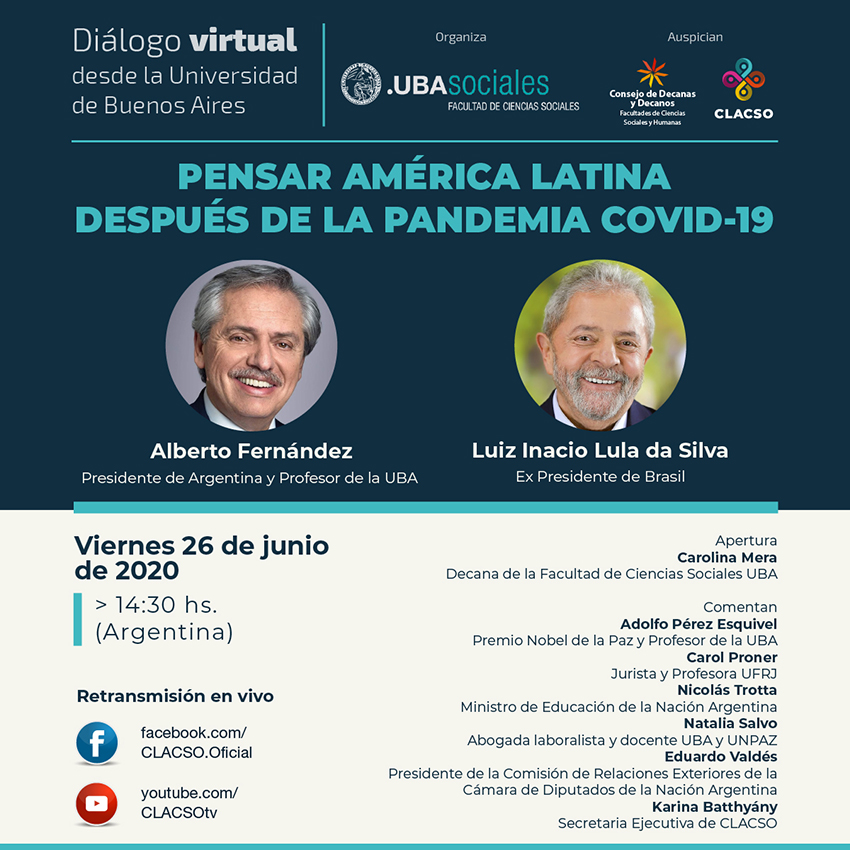
The Faculty of Social Sciences of the University of Buenos Aires organized the virtual dialogue “Thinking about Latin America after the pandemic” on Friday, June 26, with the participation of the President of the Argentine Republic, Alberto Fernández, and the former Brazilian president, Luiz Inacio Lula da Silva.
In his address, Lula da Silva highlighted his ties with Argentina, recalled the past before the neoliberal wave swept across much of the region, and asserted that, “together with several democratic leaders, we in Latin America have built an inclusive social policy movement.” He assessed the extent to which the pandemic is impacting his country under Jair Bolsonaro's government and expressed hope that, in the not-too-distant future, “democracy will allow for investment in education and health, rather than a state-run enterprise.”
Argentine President Alberto Fernández, after stating that “Lula is an immense figure not only for Brazil but for Latin America,” asserted that “the pandemic has destroyed the capitalist system as we knew it: it has jeopardized the functioning of the global economy. When men and women are infected, capitalism cannot function.”
He then elaborated: “I have the impression that the pandemic has turned the world upside down, it has thrown everything into crisis. The thing is, for the last 100 days, the world has been focused on death tolls, but it hasn't seen how the global economy has collapsed. The World Bank has said that there hasn't been an economic crisis like the one we're experiencing today since 1870. What we should be asking ourselves is what caused this crisis. And we should consider the characteristics of a pandemic, of a plague. Albert Camus, the author of 'The Plague'—a great writer—said that plagues, pandemics, epidemics have certain characteristics, they have a very clear bias: they take people's lives. But, in addition, they expose the misery of souls. And this pandemic has shown us both. It has shown us how disease takes people's lives and it has also shown us how human misery surfaces at certain times. Because, as Lula rightly said, something that for us is not up for debate: no one who has embraced the people's cause It can make you question what's truly important. Nothing is more important than life, nothing is more important than the health of the people, nothing is more important. However, there are others who believe that business is more important.
In the lead-up, CLACSOtv consulted members of CLACSO, who offered their views on the importance of this meeting between two Latin American statesmen.
Julián Rebón, from the Gino Germani Research Institute at the University of Buenos Aires and a member of the CLACSO Steering Committee, focused on the current situation in Brazil, where, in his view, what is evident “is that politics and what the State and civil society do or fail to do matters a great deal. Latin America had the dubious distinction of being the most unequal region in the world; today it has the terrible distinction of becoming the epicenter of the pandemic, where pre-existing inequalities are exacerbated and new ones are created. Brazil demonstrates how combining an obscurantist, anti-scientific, caveman-like policy that denies the existing knowledge about the pandemic with a neoliberal policy creates an explosive cocktail in terms of loss of life.”
In the special CLACSOtv program, hosted by Gustavo Lema, Director of Communication and Information at CLACSO, Karina Batthyány, Executive Secretary of the Latin American Council of Social Sciences, stated that “this is a crucial meeting at this time for Latin America and the Caribbean. Crucial because of the topic to be addressed, and obviously crucial because of the participation of former President Lula da Silva and the current President of Argentina, Alberto Fernández. I truly believe that the keys to the future for Latin America will be found there. A future that we at CLACSO have also been working on, for example, through a Social Observatory called 'Thinking about the Pandemic,' in which we have emphasized all the social, cultural, economic, political, environmental, and other dimensions related to the problems of the pandemic, but above all, looking ahead.”
For Nicolás Arata, Director of Training and Publications at CLACSO, “it’s a conversation between two great politicians, two great political leaders, who represent two major political forces on our continent, but above all—and this is at least my expectation—it’s about a way of understanding the future of Latin America, an integrated Latin America based on the principles of democracy, respect for human rights, inclusive social policies, and the presence of the State. So the hope it inspires in us is related to that: to being able to envision a united Latin America again, and not this Federation of states that act in a disjointed manner and, in the context of a pandemic, exacerbate its effects.”
Finally, Pablo Vommaro, Director of Research at CLACSO, highlighted the importance of the Social Observatory Thinking about the Pandemic, which to date has published 250 research projects. “This Observatory was about fostering, producing, and creating a space for reflection on the pandemic itself and, of course, on the post-pandemic era. That is, considering the processes that led to the virus becoming a pandemic and the public policies or national and global responses that shaped social dynamics during the pandemic, and also considering the processes in the post-pandemic period. It is a space that seeks to make visible the work of the CLACSO network itself—that is, the more than 700 CLACSO member centers, the 90 CLACSO working groups, the researchers in different countries, the fellows, the professors, and other members of the CLACSO network—so they can share their reflections and analyses based on rigorous evidence, but also to influence the course this pandemic is taking, at least in Latin America and the Caribbean.”
Sponsored by the Council of Faculties of Social Sciences and Humanities of Argentina and with the participation of CLACSO, the opening address was given by the Dean of that Faculty, Carolina Mera. Also participating were: Adolfo Pérez Esquivel, Nobel Peace Prize laureate and Professor at the University of Buenos Aires (UBA); Carol Proner, jurist and Professor at the Federal University of Juan Ramón Jiménez (UFRJ); Nicolás Trotta, Minister of Education of Argentina; Natalia Salvo, labor lawyer and professor at UBA and UNPAZ; Eduardo Valdés, President of the Foreign Relations Committee of the Argentine Chamber of Deputies; Víctor Santa María, General Confederation of Labor (CGT); and Karina Batthyány, Executive Secretary of CLACSO.
If you would like to receive more information about CLACSO's training programs:
[widget id=”custom_html-57″]
to our email lists.

