
Paulo Freire, articulator of emancipatory thoughts and struggles
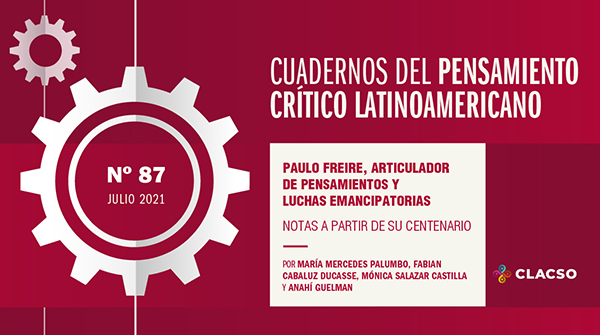
Within the collection of “Notebooks of Latin American Critical Thought”, CLACSO presents “Paulo Freire, articulator of emancipatory thoughts and struggles”, by María Mercedes Palumbo, Fabian Cabaluz Ducasse, Mónica Salazar Castilla and Anahí Guelman.
Paulo Freire, articulator of emancipatory thoughts and struggles
Notes from its centenary
And one of the great political tasks that must be accomplished is the constant pursuit of making today's impossibility possible tomorrow..
Paulo Freire, 1992
María Mercedes Palumbo*
Fabian Cabaluz Ducasse**
Mónica Salazar Castilla***
Anahí Guelman****
In the context of the centenary celebration of Paulo Freire's birth, we wish to emphasize that the vigor and relevance of his legacy for Latin America and the Caribbean in the 21st century lies, among other things, in his role as a unifying force. As a pedagogue and intellectual, he acts as a hinge for the many emancipatory political and pedagogical projects that exist today. Freire facilitates encounter, collaborative work, and fraternal dialogue among those who dedicate their lives to promoting educational discourses and practices for social transformation.
Perhaps for this very reason, Freire's legacy causes such discomfort among the conservative, neoliberal, patriarchal, colonial, and right-wing forces of Latin America. Perhaps this is why they strive to erase his legacy, to exclude his defenders, to repress those who, through creative expression, daily renew a liberating pedagogy. Freire's legacy is not met with indifference; his texts are not simply adding fuel to the fire of these opportunists' criticism, but rather quite the opposite. His work remains relevant; the problems posed in his books continue to spark heated debates in our societies; the concepts proposed in his pages resonate with new generations. Freire lives, beats, pulses.
To support our limited “working hypothesis,” we propose five key points that allow us to visualize Paulo Freire’s role as an articulator of thought and struggle: first, the connections his work generates around those who are committed and fight from within the educational field; second, the connections it provokes, by its very nature, in the neoliberal and neoconservative forces that challenge the mobilization processes that reference him by positing him as an exponent of ideologization; third, the connections fostered by Freire’s legacy from Latin American historical-pedagogical thought; fourth, the connections that this legacy allows between generations of educators linked to popular education and critical pedagogies in the present time; and finally, the connections that his work enables around the construction of a public and popular education.
I. Paulo Freire, articulator of emancipatory thoughts and struggles
The work and legacy of Paulo Freire have become essential reference points in the 21st century for all social and political forces committed to promoting radically democratic, humanist, empowering, and emancipatory projects and experiences within the educational and pedagogical fields. In this sense, the educator from Pernambuco allows for the articulation, interweaving, and development of numerous points of convergence among education workers' organizations, teachers' unions, rural and urban teachers' associations, popular education collectives, and students from teacher training colleges, education schools, and pedagogy programs. His work brings together multiple socio-educational actors; it unites school and university practices with educational experiences from popular movements; and it brings together anti-capitalist, anti-patriarchal, and anti-colonial political-pedagogical projects. In this sense, Paulo Freire is relevant and current for the 21st century, as he allows us to move forward in articulating and/or recognizing points of convergence among those of us who believe in and are committed to an emancipatory education.
Paulo Freire has been, and continues to be, an undisputed reference point for popular education, for the movements, projects, and educational experiences developed and carried out by popular movements in Latin America and the Caribbean. His texts are read and discussed in self-directed learning spaces, collective reflection workshops, and reading circles; his political-pedagogical proposals inform educational experiences, enriching them with questions, problematizations, and concepts; his reflections on liberation, dialogue, political engagement, autonomy, ethics, and epistemological curiosity—to name just a few categories—are analyzed and recreated daily throughout these lands. These experiences work with the knowledge of the people involved, engage in dialogue, and redistribute the power of knowledge. Therefore, we can confidently assert that popular education in the 21st century, to a greater or lesser degree, bears a Freirean influence.
For those whose practices are rooted in critical currents within the field of pedagogy—teachers, educators, and all other education workers—Freire's work and legacy serve as a wellspring of hope, nourishing the complex and daily practice of educating. With Freire, the struggles in defense of public education are strengthened, the processes of democratizing school culture are reinforced, efforts to build relevant, contextualized, and socially meaningful learning experiences are invigorated, and political-pedagogical projects committed to holistic processes of humanization, dignity, and social justice are strengthened. Ultimately, what we wish to emphasize is that the discourses, movements, practices, and experiences that are ethically, politically, and epistemologically grounded in critical pedagogies have been, and will continue to be, nourished by creative readings of Paulo Freire's legacy.
Furthermore, we could add that Paulo Freire has become a recurring source of inspiration for secondary and university students committed to building a liberating education. In this regard, it can be stated with certainty that Paulo Freire has been present in numerous student mobilizations, in the occupation of educational institutions, and in the demands, petitions, and proposals of student organizations. His words have circulated as photocopies, have been displayed on banners along the main avenues of our cities, have been painted on murals in public schools and university buildings, have been read at political and cultural events, and have been printed in brochures, pamphlets, fanzines, booklets, and countless other written and graphic materials produced by students throughout Latin America. Freire's legacy has nourished new generations for decades, the rebellious youth who do not resign themselves and do not give up on the process of building utopias, on what Freire called the viable unprecedenteds.
II. Paulo Freire, a figurehead despite the opposition of neoliberal and conservative sectors
As we have argued, Paulo Freire remains a political figure today, uniting a range of actors, struggles, and mobilization processes around the democratization of public education and a comprehensive emancipatory project that considers education a fundamental dimension of this movement. True to the principles of his work, the inseparable link between pedagogy and politics continues to be part of his legacy and of what is being debated and built around it today.
The significance of the name “Freire” is evident not only in the potential of the constructions that take it as one of their central pillars—hence the multiplicity of emancipatory articulations woven around his figure—but also in the starkness of the anti-Freirean politics promoted by conservative, neoliberal, patriarchal, colonial, and right-wing sectors of our continent. The centenary of the author's birth is thus marked by both celebration and hatred, depending on who is looking at it and from what perspective.
The case of Brazil is paradigmatic in this regard. The hatred of Freire is based on the accusation of “ideological education” associated with his work, his legacy, and the various educational experiences that are considered Freirean or can be interpreted in that light. The consolidation of the political movement around the Escola Sem Partido (School Without Parties) program positions Freire as the ultimate expression of indoctrination, ideologization, and the introduction of Marxism and leftist thought into the Brazilian educational system. In contrast to the values associated with the name Freire, they propose the necessary neutrality of the educational act. This neutrality encompasses teachers' positions based on the imperative of not transmitting their political preferences and opinions to students, as well as avoiding “incitement” to participate in mobilizations and other public demonstrations. In line with the Escola Sem Partido movement, we find the initiative to strip Freire of his title as Patron Saint of Education in Brazil.
In line with the above, in several Latin American countries, right-wing groups are taking strong initiatives against critical teachers who see education as a transformative process. They seek to dismantle teacher training programs that follow these principles and replace them with programs focused on entrepreneurship, and they aim to establish mechanisms for denouncing teachers who are activists, who hold gender perspectives, or who comply with sex education laws.
A clarifying example can be found in the numerous accusations leveled against teachers and educators in Latin America during the implementation of remote education in the context of the pandemic. The development of virtual classes as open sessions, often recorded, has strained the privacy of classrooms. Within this framework, right-wing sectors have taken some classes taught by teachers, generally out of context, and denounced them for generating processes of “ideological indoctrination” of new generations, simply for problematizing and placing at the center of educational reflection the major social conflicts present in our countries (Colombia and Chile have been paradigmatic in this regard). In this sense, distance education has served as a control mechanism for market-driven education and its most authoritarian conceptions. It has allowed reactionary groups in our societies to advance their criticism of those of us who, inspired by the Freirean legacy, have maintained the close and indissoluble relationship between education, politics, and ideology.
Another attempt to dismantle the link between education and politics is the development of emotional education models that promote the manipulation of individuals' emotions. The approach of so-called emotional education is particularly irritating, as it appears to offer space for working with the subjective, affective, and emotional when, in reality, it does the opposite: it aims to adapt individuals to the behaviors expected by the system, its policies of control and adaptation. Similarly, we can refer to the decontextualized and biologically detached views of individuals offered by neuroscience learning models, which reduce learners to their brain functions.
Even without explicitly mentioning Freire, these sectors find it necessary to establish seemingly “neutral” ways of teaching and learning. Based on this premise, a series of initiatives are articulated, some of which we have mentioned, against the politicization of education—a problem that the Pernambuco-born thinker and educator brought to the forefront.
In any case, the centenary reveals what we always knew: Freire's political nature. His capacity to inspire transformative projects and utopias. Neoliberal and conservative anti-politics is nothing more than the culmination of a type of politics that seeks to reproduce the existing order and to normalize the inequalities that structure our societies and that undoubtedly involve education. Politics doesn't come to pedagogy from the outside as a political ideology that seeps into the educational field; nor does pedagogy come to politics from the outside, employed as a resource or technique for indoctrination.
III. Paulo Freire, articulator of the Latin American democratic pedagogical tradition
Paulo Freire also articulates the best and most democratic Latin American historical-pedagogical tradition: one that seeks education for all and pays attention to the excluded and the oppressed. From the perspective of popular education, a single historical line cannot be established in Latin America. Adriana Puiggros (2010) does not find Freire's work to be included in readings of the Latin American political-educational heritage, perhaps because this is a characteristic of Brazil. However, this Argentine educator and historian shares with Simón Rodríguez—and we would add with José Martí, José Carlos Mariátegui, Luis Emilio Recabarren, Gabriela Mistral, and the Río de la Plata educators Jesualdo Sosa and Luis Iglesias, among others—concerns and commitments to the education of the impoverished and marginalized population. It is interesting to find the differences with the triumphant Europeanist traditions in many of our educational systems, which leave out part of this population and whose interest and objective is to homogenize languages, subjects and cultures.
In this sense, what the best Latin American tradition seeks in its different historical moments is also part of what Freire articulates and condenses: independence, growth, the liberation of the subject to be educated, which is far from the imposition of ideas, as well as the possibility of autonomous, critical, transformative thinking.
Even without sharing explicit theoretical references, this represents a profound articulation of humanist and revolutionary thought in the pursuit of equality and social justice. All these educators and colleagues firmly believed in the equality of all human beings and, therefore, in the need for everyone to have access to education based on their own knowledge. American knowledge that de-universalizes the European and the colonial. Peasant, Indigenous, and land-based knowledge. Popular knowledge valuable for beginning to think about the world. The anticolonialism expressed in each of these educators, in the diverse historical and geographical contexts they inhabited, is embodied in Freire, enriched by the African experience. Freire, without a doubt, produced a profound rupture of modern power-knowledge as an act that was not only democratic but also decolonizing. Therefore, we can speak of the articulation of anti-colonial and decolonizing pedagogical thought as a line that unites these pedagogies and synthesizes them in Freire, even before work began on the category of decoloniality and decolonial pedagogy from a group of Latin American authors, who do not always recover these traditions.
Contexts and their timing are valuable to each of these educators, and this is also clear in Freire. In turn, they all know that, from these contexts, the goal is to build a Greater Homeland, a Our America, a decolonized South, in which the peasant, indigenous, and urban-popular subject, and the issue of land, are central.
Each person, in their own way, knows and proposes that, to achieve this, it is necessary to break with the hegemonic socio-educational order, because only from their own perspectives can they construct thoughts and ideas that reclaim their own identity and allow for critical processes. It is necessary to invent and not err, to create and solve problems, not to copy or replicate. This is precisely what Freirean praxis, its proposals, and its profound pedagogical, political, and philosophical reflections offer us: Freire breaks with what is imposed through the deepest recovery of the subjects in order to carry out processes of critical reflection on the world, of developing critical consciousness.
The educator from Pernambuco is part of a group of pedagogues who experienced exile, including internal exiles, akin to confinement, such as those endured by Río de la Plata teachers Jesualdo Sosa and Luis Iglesias. From these exiles, each of them encountered new realities, learned, experimented, produced, reflected, and wrote. Freire symbolically reclaims all the exiles of his predecessors and develops a Latin American pedagogy that bequeaths to us countless possible ways of practicing liberating and emancipatory education, drawing upon the best traditions of the continent.
IV. Paulo Freire, a bridge between generations of educators
Historically, Latin America has experienced revolutionary fervor, embracing emancipatory projects for change. With the advance of neoliberalism and conservatism in recent years, we have witnessed movements, uprisings, and social and popular revolts with strong youth participation. As popular educators and critical thinkers, we need to support these movements through comprehensive and historical analysis, creating spaces for action.
In these organizational processes, the role of young people remains fundamental, embraced with fervor, righteous anger, and a desire for change; diverse young people whose demands include and transcend those historically associated with class struggle. It is in these contexts that it is important to articulate, weave together, engage in dialogue, look back, recover past experiences, and bring different generations closer together. On the one hand, to reclaim a history, a legacy, a tradition of struggles and political-pedagogical commitments. On the other hand, to break down deterministic, static conceptions, devoid of movement and historical perspective in the present.
As Subcomandante Marcos told us through the words of Old Antonio: “What we are always doing is searching for the deep trace; learn to look down and behind you, to follow the mark, follow it, don't lose it, because you won't find it up there.” One of those traces is Paulo Freire. It is necessary to make his thought a living reality in this present time, because of his emancipatory struggle, because of his pedagogical work to activate critical consciousness so that individuals confront utopias, embrace the option of transformation, and expose indifferent realities.
Today, we can see in young people these affected individuals, yearning for change. We are faced with a series of emerging manifestations of this affectation, in which Freire emerges as a unifying figure: the pedagogical approaches built upon art, the body, and diversity within social movements; the collectives, groups, and emerging initiatives that invoke Freire in their community work in working-class neighborhoods; and the academic institutions (universities, teacher training colleges, and national and international research and outreach networks) that have read and understood the author and, from that perspective, are adopting proposals for transformation. Therefore, it becomes necessary to map and engage in generational dialogue to recognize the legacy and the reinterpretations of Freire in younger generations.
This opens up spaces, both within and outside academia, where renowned intellectuals who embrace Freire's legacy converge, often from a place of closeness that implies having shared the same path as Freire himself, alongside a generation of young people who also subscribe to this tradition and see themselves as popular educators. As Alfonso Torres Carrillo (2020) points out, these young people adopt popular education as a meaningful and methodological framework in a creative way that expresses itself in new languages and narratives, one of whose hallmarks lies in its great aesthetic sensibility, without abandoning the legacy of previous generations.
Hence the challenge of continuing to promote the articulation of young people's voices, their actions, their concerns, their feelings and thoughts, around ways of reading and practicing Freire, in dialogue with those of previous generations. This places at the center what has been so powerfully emphasized in popular education: dialogue and the exchange of knowledge. In this intergenerational conversation, Freire once again connects us, circulating the word across generations, to question and problematize, and to continue imagining the paths we wish to leave to transform Our America.
The dialogue of knowledge, as many teachers have pointed out, is the space for recognizing the knowledge of young people and its importance, fostering a move beyond the culture of silence, encouraging self-awareness, presence, and a sense of value. This intergenerational dialogue of knowledge involves sharing our perspectives and understanding what we perceive of reality and how we position ourselves in relation to it. All of this is constructed dialogically, through conversation, exploring it through words, and from this dialogue emerges the process of developing critical consciousness. This dialogue also encompasses the reinterpretation, and undoubtedly the confrontation, of the legacy of older generations in a critical-creative exercise that expresses the unique worldview of today's youth.
V. Paulo Freire, articulator of streets and classrooms in the struggle for a public and popular education
The work carried out by Paulo Freire at the São Paulo Municipal Education Secretariat between 1989 and 1991 was a pivotal moment in the development of a project advocating for the construction of a public and popular education system. From classrooms to the streets, various educational organizations have championed the defense of public education and its strengthening through radical processes of democratization. From our perspective, it is clear that these struggles have been fueled, among other sources, by the experience fostered by Paulo Freire, Luiza Erundina, and the Workers' Party. In this sense, their legacy allows us to connect past and present struggles, struggles from different corners of Latin America to imbue public education with a popular and emancipatory purpose.
Many teachers, teachers' organizations, and educators bring Freire's ideas into public school classrooms, striving to democratize social relations, focusing on relevant and contextualized content that addresses students' needs and challenges, fighting to create spaces for deliberative participation, and working to strengthen the organizational structures of school communities. In other words, teachers have made a daily commitment to making public education accessible to everyone, imbuing it with democratic values. They challenge it from within its internal fissures and tensions, attempting to transform it for the benefit of all, reclaiming the common good and community.
The project promoted by Freire regarding popular public education had an explicit focus on curriculum and school management. With respect to the curriculum, he emphasized fostering its collective and democratic construction, promoting teacher and student participation; the creation of autonomous proposals by schools; ongoing reflection on educational practice and curriculum implementation, encouraging knowledge production by teachers; and the development of an interdisciplinary curriculum through the construction of generative themes, among other things. Regarding school management, from within the Ministry of Education, Freire promoted the creation of School Councils, democratic bodies formed through direct, equal, and open elections, which encouraged the deliberative participation of the various members of the school community.
Currently, various educational projects, organizations, and initiatives, and even some states, are championing the cause of a public and accessible education system. These efforts involve democratization, mobilization, and critique of the growth of the school system, privatization/commodification, and the imposition of a technocratic curriculum, as we will discuss below, alongside the simultaneous defense of the school as an institution and the guarantee of the right to education.
As we mentioned, the banners of the struggle for a public and accessible education allow us to clearly confront at least three major processes. First, we must address the continuous growth of the school system, which has manifested itself, on the one hand, in the extension of school days, promoting full-day programs where students must remain in educational establishments for approximately eight hours daily, and on the other hand, in the expansion of compulsory schooling to include early childhood education, incorporating children into the school system at a very young age. Within this context of the continuous growth of the school system, it is crucial that all educators commit to the struggles for the democratization of public education, recognizing it as a significant arena for political and pedagogical debate.
Secondly, it allows us to maintain active mobilizations and resistance against those forces that strive to further privatize and commodify education, as discussed in point II. These forces aim to continue undermining public schools, both materially and symbolically, and promote the incorporation of managerial and accountability logics into public administration. In this sense, fighting for a public and popular education allows us to oppose the global agenda of market-driven education and to strengthen the struggles of the Global South for emancipatory education.
Third, the struggle for a public and accessible education system enables a confrontation with technocratic curriculum policies, funded by international organizations, that promote standardized assessments, competency-based learning, meritocratic discourses, entrepreneurship, and unbridled individualism. Freirean approaches to popular public education have placed at the forefront the concern of committing to the democratization of the curriculum. This implies fighting to increase social participation in its design, decentralizing and empowering schools in their implementation, and radically reshaping its meaning, placing it at the service of building pluralistic, just, and dignified societies.
Committing to building a public and popular education in the 21st century means acknowledging the enduring relevance of democratic struggles in Latin America. From the perspectives of popular education and critical pedagogies, we understand the importance of democratizing the curriculum, management, assessments, learning processes, budgets, and more. We know that fighting for a public and popular education is strategic, and therefore, so is reclaiming and defending Freire's legacy. With Freire, we continue the struggles to democratize education in our societies. With Freire, we strengthen the struggles waged by projects, organizations, and experiences of emancipatory education in the present day.
closing notes
As we have been arguing, we wish to emphasize that Paulo Freire, in the 21st century, allows us to connect different eras, thoughts, projects, individuals, generations, and educational proposals in action. The life and work of this educator make it possible to intertwine the voices of many who have risen up and continue to rise up against oppression, who build horizons, who dedicate themselves to constructing utopias, and who, together with others, transform their realities. Freire's legacy inspires the political and pedagogical praxis of popular collectives and movements that, in the here and now, are committed to building the complex paths of emancipation.
We wish to celebrate Paulo Freire as a comrade who has been a touchstone for popular education and critical pedagogies, a comrade who has been instrumental in articulating multiple struggles against market-driven, authoritarian, patriarchal, and colonial education. A comrade with whom we engage in dialogue, a comrade we know how to listen to, but with whom we also know how to disagree. We do not consider it particularly relevant to celebrate patrons, elevate heroes, or deify individuals. We wish to celebrate Freire on his centenary as a fellow traveler, as an educator who, through his life and work, contributed to the emancipatory struggles of our peoples. A comrade who knew how to articulate and unite us, bringing us together in multiple and diverse practices, inspired by the almost infinite ways of reading, interpreting, and combining his work with the contextual and identity-based characteristics of each sphere. Beyond all its contributions, perhaps its unifying strength lies in this: in the understanding of the common people and their context, understood as unique and valuable, alongside the affirmation of the political potential of education. From this perspective, there are as many interpretations as there are readers, as many understandings as there are peoples, as many proposals as there are movements and collectives, as many ways of listening and critical analysis as there are educators, all articulated within the history, dynamics, and humanist, democratic, decolonizing, transformative, and liberating perspectives.
His legacy is contested, of that there is no doubt. His capacity for articulation is part of what is at stake. The neoliberal and conservative forces of Latin America and the Caribbean explicitly recognize the “danger” of Freirean praxis. For our part, as we have said, we recognize the liberating potential of his work. In the 21st century, Paulo Freire is among those comrades who enable the encounter and articulation of the different struggles striving to shape historical projects that place the dignity of human and planetary life at their center.
Referências bibliográficas
Puiggrós, Adriana (2010). From Simon Rodriguez to Paulo Freire: Education for Latin American IntegrationBuenos Aires: Colihue.
Torres Carrillo, Alfonso (2020). Scenarios, practices and debates of popular education in the 21st century. Algarrobo-MEL, 9, 1-27.
* Co-coordinator of the CLACSO Working Group on Popular Education and Critical Pedagogies. PhD from the University of Buenos Aires, Department of Educational Sciences. Assistant Researcher at the National Scientific and Technical Research Council (CONICET), Argentina.
** Co-coordinator of the CLACSO Working Group on Popular Education and Critical Pedagogies. PhD in Latin American Studies from the University of Chile. Professor and researcher at the University of Christian Humanism, Chile.
*** Co-coordinator of the CLACSO Working Group on Popular Education and Critical Pedagogies. PhD candidate in Social Sciences, Childhood and Youth from CINDE and the University of Manizales. Professor at the University of Caldas, Manizales, Colombia.
**** Member of the CLACSO Working Group on Popular Education and Critical Pedagogies. PhD from the University of Buenos Aires, Department of Educational Sciences. Professor and Researcher (IICE) at the Faculty of Philosophy and Letters, University of Buenos Aires, Argentina.
If you would like to receive more information about CLACSO's training programs:
[widget id=”custom_html-57″]
to our email lists.

