
"Ideological polarization has a lot to do with the importance of higher education."
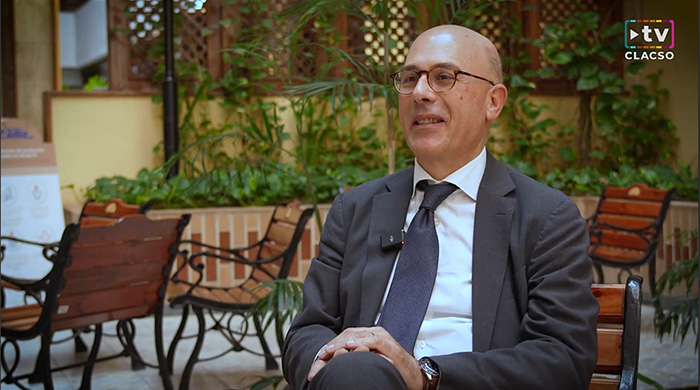
In the context of the XIV International Congress of Higher Education "University 2024" in Havana, Cuba, and the Forum "Higher Education and Social Transformation", organized by CLACSO on February 6, Francesc Pedró , Director of the UNESCO International Institute for Higher Education in Latin America and the Caribbean (IESALC), spoke with CLACSO.tv.
– Power struggles also exist in higher education, which plays a central role in democracies. What are the current challenges facing higher education?
Many of the challenges facing higher education are shared globally, particularly in the ideological and political sphere. The polarization of our societies to unprecedented extremes, especially on the far-right side, is a phenomenon we haven't experienced with this level of intensity in recent times. I would even say that, in a sense, some of the policies being proposed pose a significant risk of setbacks.
This is happening in a context where, despite the feeling that we've forgotten it, we are emerging from a pandemic, which undoubtedly necessitates a restructuring of public spending and investment. In this context, we in higher education have the misfortune of being included in the education package, which, amidst the economic recovery, isn't an attractive package for everyone; other sources of public spending seem more pressing at the moment. And secondly, within the education sector package, many people still consider higher education a luxury reserved for a minority. Therefore, it's not surprising that we are witnessing a progressive reduction in public spending or investment in higher education. So, I would say that the context is not particularly favorable.
But this ideological polarization is also, paradoxically, closely linked to the importance of higher education, which is where approximately 80% of the region's scientific output is produced. Therefore, whoever controls this scientific output ultimately controls the future of a country and the future of science itself; in other words, they can invest more in this sector rather than another.
Furthermore, even today, higher education plays a central role in shaping critical thinking about society. This is clearly seen in the fact that, whether we like it or not, higher education continues to train the intellectual and political elites of our countries. Of course, it's not the same to train them in a mindset focused on maximizing profits as it is to train them in a context where they are expected to help society recover. So, I think that explains this polarization and why we see it reflected in higher education now.
– Are there any concrete data on how the country emerged from the pandemic? Fairly clear data was available regarding secondary and primary education; what is known about universities?
I'm glad you asked this question, because we really don't know much. It feels like the return to classrooms in higher education went as if nothing had happened. It seems that in higher education, no one wants to acknowledge that there has indeed been a pandemic with unknown, unquantified effects. This is something that has been done in the school sector, where we know the impact, even the economic impact, that learning losses can have.
That's why our institute is working on quantifying learning losses. And I'd like to share one of our first preliminary findings: during the pandemic, students who were already well-positioned in terms of cultural, social, and technological capital—those who were accustomed, for example, to being connected at home or who knew exactly what to expect—benefited from the pandemic. Interestingly, they likely "learned more" during the pandemic than if they had attended classes. This is paradoxical. Conversely, at the other extreme, in the most disadvantaged quintiles, the opposite is true; they lacked technological capital, cultural capital, and probably even the necessary experience, and therefore their learning deteriorated drastically compared to what the traditional classroom experience would have been.
This isn't something unique to Latin America; it's something we're finding in many countries. However, I'm still surprised that this conversation isn't happening. I think it's the responsibility of UNESCO, and perhaps CLACSO as well, and other organizations to put this issue on the agenda. Because behind it all lies a question of learning inequity: not just learning loss, but inequity within that loss. Specifically, the material conditions under which people begin their studies are clearly a determining factor in their ability to study. Even assuming good connectivity, the reality is that experience using these technologies was available to some but not to others.
– Going back to what you mentioned at the beginning of this conversation, we've seen situations of defunding of higher education in several Latin American countries. But within that context, academic freedom also seems to be at risk, not only due to defunding but also due to the actual closure of some research divisions. Is there a risk to internal democracy within higher education?
More than that. In fact, if I may, I'd like to refer to the work of another United Nations body, the Special Rapporteur on the right to education, who is currently preparing a report on the state of academic freedom in the world, to be presented next June. I take that as an indication of the concern within the United Nations about the decline of academic freedom. And that has several components.
The first, and very clear, point is that university campuses were traditionally places where anyone could talk about anything. But circumstances are beginning to emerge, starting in developed countries like the United States and the United Kingdom, where this is no longer the case, where censorship exists. Secondly, there's an important issue in some Latin American countries: the rise of surveillance. This means that certain things circulating, for example on social media, are censored by university authorities. And thirdly, of course, we have increasing government intervention in the management of institutions. We've seen, for example, the closure of eight major universities in Nicaragua, beginning with one that was widely recognized worldwide for its defense of human rights.
The United Nations, UNESCO in particular, and our institute have denounced this situation as absolutely intolerable, yet it is happening. So, returning to the initial question, this polarization translates into the suppression of certain types of discourse. In Latin America today, conversations about gender identity are not allowed in higher education in some countries. That is the reality. At the same time, we have other places where higher education institutions, universities in particular, continue to be bastions, not just of academic freedom, but even of freedom of expression.
– Within this framework, there is joint work between CLACSO and UNESCO regarding open science, which has a strong intersection with the issue of academic freedom. What does open science mean, and why is it so central to transformation?
– I would summarize it with a phrase that I think is very clear: what makes us human is knowledge. Any barrier between us and knowledge becomes a process of alienation or dehumanization. In practice, particularly in this region, a large part of the research and academic work is funded with public money. Is it acceptable that the results of that research are subject to mechanisms not only of privatization but also of commodification? That is to say, that the very research team that produces science in order to build a public good with public funds, when it wants to see the reception of its work or its own work, has to pay.
What's also happening is that we're in a process of cultural change, because people think—I believe mistakenly—that open science means free science. But we frequently receive, for example, invitations from various organizations or institutions suggesting we participate in an open access publication. And they tell us, well, but the cost of this participation is two, three, or four thousand dollars. So, our concern is that, in any case, someone has to pay for that publication. I think we need to untangle the Gordian knot of understanding that open science is not the same as free science, so that when we apply for research funding, we necessarily have to include a chapter for the publication. Even if we want and advocate for open access publishing, it has a cost. Ultimately, I think it's very important for people to understand that open science is one thing, and free access science is another. Someone has to make that extra effort, and I believe that's in the hands of the research teams who have to budget for it in their projects.
– Finally, what is the importance of the link between UNESCO and CLACSO in the construction of what we are talking about here?
– We depend on CLACSO, because a large part of the work and research that contributes to our publications comes from people who have been trained at or are part of CLACSO institutions. We certainly need to strengthen this relationship, because there is a very important agenda for CLACSO that is shared with UNESCO. Beyond our shared interest in open science, we believe that higher education is probably the most important vehicle for communication, and that is where we should develop a joint agenda.
If you would like to receive more information about CLACSO's training programs:
[widget id=”custom_html-57″]
to our email lists.

