
For the care of life and health
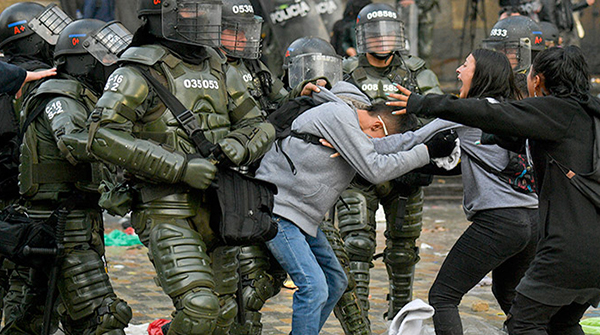
A call to Colombian society from the Public Health sector
The members of the Master's and Doctoral programs in Public Health at the National University of Colombia emphatically reject the escalation of violence in the country and the violation of human rights, and express to Colombian society our concern about the deteriorating state of life and health in the current situation. It is urgent to find a path for the collective construction of a society that finally overcomes violence and focuses on the care of life, both human and non-human, which is how health should be understood, beyond the mere treatment of the sick.
The country has entered a period of social and political conflict that demands legitimate, territorial spaces for dialogue and collective action, rather than closed-door talks at the Presidential Palace. With the peace process, a large part of Colombian society, especially those most affected by the internal armed conflict, experienced a glimmer of hope. Very soon, that hope began to fade with the victory of the "No" vote in the October 2016 referendum. The implementation of the Final Agreement, signed in November of that same year, has not received the necessary impetus or institutional support. On the contrary, since the current administration took office, the sector opposed to the Agreement has tried by all means to reduce it to a matter of targeted reintegration of former combatants, while simultaneously renewing agreements with large landowners in regional, national, and transnational economic sectors, based on the country's supposed comparative advantages. This vision of development has systematically led to extractivism, environmental depredation, dependent importation of all kinds of goods and services, and the loss of food sovereignty.
The foregoing explains the emphasis of the three tax reforms proposed by the current government, which are centered on broadening the tax base to include middle- and low-income sectors, barely affecting large property owners, while public spending is directed toward debt repayment rather than overcoming social inequality. On several occasions, the government has spoken of the need for pension reform that fully develops the tiered individual savings model and eliminates the defined benefit system, thus favoring the protected financial sector more than individuals. In terms of labor flexibility and cost reduction, labor reform proposals have been made, which are currently progressing with the possibility of hiring and contributing to social security on an hourly basis. In the area of higher education, the expansion of student loans continues while funding for public institutions is restricted, and demand-side subsidies are consolidated through tuition payments for the poor, especially in public institutions.
At the same time, the extermination of social leaders continues in the areas where the Comprehensive Rural Reform should be taking hold, with all its instruments: the substitution of illicit crops, reparations for victims, and a progressive process of political democratization. None of this has happened. On the contrary, the struggle for territory has returned in an even more brutal form.
Faculty of Sciences, Faculty of Humanities, Faculty of Nursing,
Faculty of Medicine and Faculty of Dentistry
44th Street No. 45-67 – Building 862: Camilo Torres Unit. Block C2. Office 403
Bogotá, Colombia [email protected]
If you would like to receive more information about CLACSO's training programs:
[widget id=”custom_html-57″]
to our email lists.

