
Racialized pandemics: building horizons of Afro-diasporic struggle
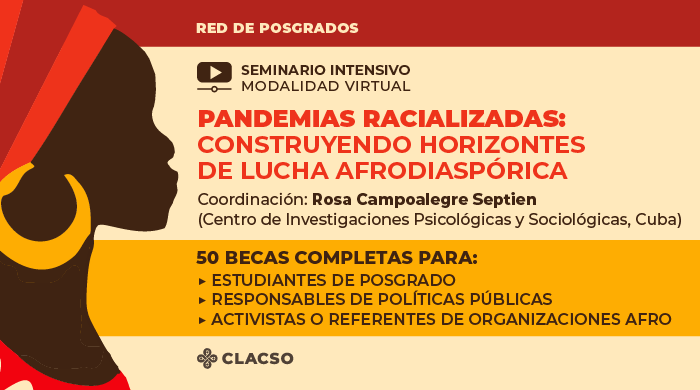
Intensive Virtual Seminar
Chair: CLACSO
COORDINATION: Rosa Campoalegre Septien (Center for Psychological and Sociological Research, Cuba)
PROFESSORS:
- Nilma Lino Gomes (Federal University of Minas Gerias, Brazil).
- Quince Duncan (National University of Costa Rica)
- Claudia miranda (Federal State University of Rio de Janeiro, Brazil).
- Karina Bidaseca (Latin American Council of Social Sciences, Argentina).
- Anny Ocoró Loango (Latin American Faculty of Social Sciences. FLACSO-UNTREF).
- Santiago Arboleda Quiñonez (Andean University Simón Bolívar, Ecuador).
- Carlos Álvarez Nazareno (Institute of Advanced Social Studies. UNIAFRO. National University of San Martín, Argentina).
- Roberto Borges (Celso Suckow da Fonseca Federal Center for Technological Education, Brazil)
- Jenny Torres (Alternative City Association, Dominican Republic).
- Jacques Bertrand Mengue Moli (University of Yaoundé, Cameroon).
- Helena da Gracia Fonseca Veloso (Catholic University, Angola)
Start date: November 23 | Applications: 28/10 al 14/11
Duration: 4 weeks
Virtual Modality: 5 synchronous and 3 asynchronous meetings
Full scholarships – Intensive seminars
The Virtual Intensive Seminars These are intensive training proposals that address diverse topics, putting a range of current issues on the agenda for debate in the region.
The Latin American Council of Social Sciences (CLACSO) invites master's and doctoral students, public policy officials, leaders and activists from organizations of the Afro-descendant movement,
to participate in the seminar Racialized pandemics: building horizons of Afro-diasporic struggle.
This training proposal with decolonial, Afro-feminist and comparative perspectives aims to promote the articulation between academia and the Afro-descendant movement in Latin America and the Caribbean.
With this objective CLACSO offers 50 full scholarships to students of:
- Postgraduate programs with thesis projects in areas related to Afro-Latin American and Afro-Caribbean studies, preferably linked to a CLACSO member center.
- Public policy officials with an impact on racial issues.
- Activists or representatives of Afro organizations working in areas related to the topics covered in the seminar
The applications will be subjected to a technical evaluation stage, verifying that all of them meet the criteria and requirements established in the rules of the competition; then they will be sent to the members of the jury for their evaluation; and 50 applicants will be selected.
Those selected will be informed through the CLACSO website and by email.
The scholarships cover 100% of the tuition cost.
RESULTS OF THE CALL FOR APPLICATIONS
Having concluded the evaluation process of the applications received within the framework of the Call for Proposals, the following is reported:
- that were received 82 applications;
- that the applications were subjected to a technical evaluation, verifying that all of them met the criteria and requirements established in the competition rules;
- That, according to the evaluations carried out, the Academic Committee has selected the following applicants to be awarded the vacancies in accordance with the specifications in the terms and conditions, as detailed below:
SELECTED APPLICANTS:
| Name | Last Name | Guarantee / Institution to which it belongs |
| Aime | Sosa Pompa | CMKW Radio Mambí station. Santiago de Cuba |
| Alma María | Areco Delgado | Member of «Black Voices» | Afro-feminist Cultural Manager. |
| Amaury | Vázquez Villalón | Cuban activist |
| Ana Carolina De Oliveira | Rib | University of Brasilia, Brazil |
| Ana Isabel | Marquez | University of Carabobo, Venezuela |
| Ana Laura | Zeballos Puccherelli | Gabriel Rene Moreno Autonomous University, Bolivia |
| Aura Marina | Hurtado Alvarado | University of Valle, Colombia |
| Carla | iron | National University of La Plata, Argentina |
| Catarina | Nunda | Agostinho Neto University, Angola |
| Cindy Patricia | Herrera Estrada | University of Cartagena – Montessori School Cartagena – Kalamarí Spanish School |
| Claudia | Monteiro Fernandes | Yeah. CRH – UFBA Humanities Studies Center |
| Claudia | Correa Núñez | Montevideo Municipal Government |
| Cleonice | Da Silva | Matambas Lbtiq Group |
| David Alejandro | Gómez Arriaga | National Network of Afro-Mexican Youth/Tembembe Center for Afro-Mexican Studies |
| David Maximiliano | Rodríguez Bolaños | Lamb of God Baptist Church, |
| Dedaldina | Euric | Catholic University of Angola |
| Diana Marcela | Mosquera Castle | Caldas University |
| Domingas | Joaquim | Catholic University of Angola |
| Elizabeth | Alvarenga Pereira | Federal University Goiás, Brazil |
| Fernanda Daniela | Olivar Rodriguez | Afro-Latin American Studies Collective, Uruguay |
| Florence | Zorrozua Island | Community Organization Foundation, Argentina |
| Franciny Maria | Molina López | Akoben Afrofeminist Collective, Costa Rica |
| Franklin Esteban | Gudiño Batallas | Andean University Simón Bolívar, Ecuador |
| Geydis Elena | Fundora Nevot Nevnevotnevot | Social Policy Network, Cuba |
| Giovanna Gabriela | De Leon Fernandez | Colectivamujeres, Network of Afro-Latin American, Afro-Caribbean and Diaspora Women, Uruguay |
| Iliana Johanna | Carabalí Méndez | Network of Afro-Ecuadorian Youth of the Ancestral Territory of Chota, Salinas, Concepción and Guallupe, Ecuador |
| José | Nkosi | Agostinho Neto University, Angola |
| José Jeremiah | Pérez Rabasa | CONICET-Unla |
| Jose Ramon | Castillo Fernandez | State University of the West of Paraná, Brazil |
| Juan David | Macuace Torres | Foundation for the Social and Sexual Diversities of Black Communities WE ARE IDENTITY, Colombia |
| Juliana Das Graças | Gonçalves | Municipal Prefeiture of Belo Horizonte, Brazil |
| Kátia Santos | Souza Dos | NATIONAL NETWORK OF IMMIGRANT LEADERS, Argentina |
| Kruskaya Cristina | Hidalgo Cordero | Ecuador |
| Luis Andres | Padilla Suarez | FLACSO Ecuador |
| Marbel Jasmine | Delgado Castle | Common Good, Dominican Republic |
| Maria Antonia | Méndez Mercado | Network of Afro-Mexican Women, Mexico |
| Maria Carla | Figuerola Domenech | Municipal Government of Plaza de la Revolución, Havana, Cuba |
| Maria de Lourdes | Rodríguez Peña | Faculty of Information and Communication, Uruguay |
| Mary Sandra | Chagas Techera | Matamba-Lbtiq Group, Argentina |
| Maryury | Diaz | Afro-Latin American Women's Gathering (Tema), Argentina |
| Maya | Correia | USP, Brazil |
| Mayra Jaqueline | Ari Condori | Association of Councilwomen and Mayors of La Paz, Bolivia |
| Molly Marie | Hamm-Rodriguez | University of Colorado Boulder, United States |
| Nengumbi Celestin | Sukama | Argentine Institute for Equality, Diversity and Integration – IARPIDI, Argentina |
| Omar Gerardo | Martinez Roa | National University of La Plata, Argentina |
| Pablo | Segovia Zurano | Activist/Journalist, Spain |
| Regina | Pajares Carrillo | ODRI, Peru/Chile |
| Sabrina Paula | Farioli | FLACSO, Argentina |
| Silvana | blessed | Undersecretary of Racial Equality of the Prefeitura of Guarulhos, Brazil |
| Tania Duarte | Díaz Pérez | Affirmative Caribbean, Colombia |
| Victor | Vásquez Ibáñez | Ibero-American University Puebla, Mexico |
| Victoria | Pereira Beltrán | Afro-Latin American Studies Collective, Uruguay |
| Ximena | González Broquen | CETS IVIC in Link with the Ministry of Foreign Affairs of Venezuela, Decolonial School of Caracas, Venezuela |
| Yeison Fernando | García | Afro Consciousness, Spain |
This seminar will be a space where students from the three editions of International Graduate Schools, from 2017 to 2019, will come together in the roles of professors, tutors and participants in open sessions.
A counter-hegemonic, Afrocentric and intersectional perspective is adopted, which accounts for coping strategies and post-pandemic alternatives.
The course will take place on the CLACSO Postgraduate Network's virtual platform from November 23 to December 05, as part of a tribute to María Remedios del Valle, Mother of the Argentine Nation, and to all Black women with significant contributions to the history of Latin America or who were prominent figures in the struggle for independence. It will also be a special occasion to remember the victims of the COVID-19 pandemic.
Looking ahead to the pandemic, the seminar integrates three thematic axes:
The first axis is allocated to: Afroepistemologies and Maroon pedagogies delving into its value for coping with the crisis, through the analysis of Afro thought leaders, among whom Manuel Zapata Olivera and Achille Mbembe stand out.
The second axis is focused on the Racialized women in the pandemic in light of Black feminisms Collaborative networks lead to narratives of resistance and re/existence of these women in diverse contexts, leadership styles, and strategies of struggle. They conclude the section dedicated to the study of the Education, art and Afro-descendant youth.Challenging prevailing public policies and weaving alternatives, from Afro-descendant perspectives in the face of pandemics and beyond.
The contents of this seminar not only construct a counter-hegemonic cartography of the impacts of pandemics in the Americas and Africa, but also account for what the responses from academia and the Afro-descendant movement have been and may be.
This seminar is an initiative of the CLACSO Working Group "Afro-descendants and counter-hegemonic proposals", continuing the academic and struggle program beyond the International Decade for People of African Descent (2015-2024).
Added to this context is now COVID-19, which has become a global pandemic that tests the capacity of societies in all aspects.
It is a racialized pandemic not only because its main victims are Afro-descendant and Indigenous peoples, but also because, as a trend, it is “managed” from the Necropolitical in the dilemma posed by Achille Mbembe (2011): “decide who lives and who dies“and in the deepening of Fanon’s existential drama (1952):”(...) I must free myself from what is suffocating me because I truly cannot breathe.".
This historically ignored drama recently horrified the world and generated broad social mobilizations in response to the brutal murder of George Floyd in the United States, a country that shows the ultimate expression of a lethal triad: opulence-racism-death.
The situation of Afro-descendant peoples, aggravated by the impacts of the pandemic, makes it unavoidable to study such processes in depth from the place of enunciation of these peoples, in the consistent way that Audre Lorde (1984) bequeathed to us “without the master's tools".
However, COVID-19 exacerbates and perpetuates other racialized and endemic pandemics, including poverty, ecocide, the educational and migratory crises faced by Black people, invisibility, and violence. In response to this situation, new forms of resistance and re-existence are emerging among Afro-descendant communities, with the actions of racialized women and Afro-descendant youth being particularly relevant. This critical analysis is adopted from an intersectional perspective, revealing how the interplay of race, gender, class, and territory deepens the impact of COVID-19.
The imperative is to confront this racialized pandemic and make visible the process of unlearning/relearning in order to move towards a post-pandemic context. The main thematic focus of this seminar is the evaluation of the impacts of the COVID-19 pandemic and the articulation of strategic responses to its challenges.
Consequently, the historical meaning and the theoretical-methodological scope that characterizes this seminar are re/signified, capable of producing dialogue from the Southern Cone, through Latin America and the Caribbean, to Africa.
GENERAL PURPOSE
To develop a collective space for reflection and action to address the post-pandemic context from a critical, Afro-diasporic, and anti-racist approach.
SPECIFIC OBJECTIVES
That the students:
- Reflect collectively on the impact of the pandemic on deepening inequalities and structural racism that affects black populations.
- Make visible the political thought and action of academics, leaders of the Afro-descendant movement and students of our CLACSO International Graduate Schools “Beyond the Decade”, during and after the pandemic.
- Contribute to the design and implementation of public policies that promote the rights of Afro-descendant populations.
The seminar will be held in two stages.
The first stage It will be intensive for two weeks.
In the second week of the intensive stage, it will be linked with the IV Congress of Postcolonial Studies and the VII Postcolonial Feminism conference organized by CLACSO and UNUSUR.
The second stage It is intended for the preparation of the final project, which must be submitted one month after the School ends; at this stage they will have the support of tutors.
Given the virtual format of this seminar, it adopts a participatory and proactive methodological strategy that articulates resources and collaborative learning strategies, such as:
- Topic presentation classes through sessions synchronous. The correlation will consist of one hour of class and one hour of debate.
- Explanatory videos that problematize the content, as a basis for the classes conducted in the asynchronous modality.
- Discussion forums in both sessions, preferably to be held in the afternoon.
- Panels of students from the CLACSO International Graduate Schools “Beyond the International Decade for People of African Descent”, linked to the forums.
- Presentation of the Racialized Pandemic Series at the IV Congress of Postcolonial Studies and the VII Conference on Postcolonial Feminism.
- Anti-racist laboratory for the identification and deconstruction of racist images, messages, and practices. Construction and dissemination of content for anti-racist counter-discourse. Includes the Film Noir Discussion Forum.
- Written, graphic and performative narrative productions in debate forums, anti-racist laboratories and final evaluative activity.
The intensive seminar consists of eight interconnected classes based on the overall objective set.
Each session includes the reading of at least one text from the bibliography. At the end of the classes, a final activity will be held to conclude the seminar.
The second week of the seminar will include teaching activities that will be linked to the 5th Congress of Postcolonial Studies and the 7th Conference on Postcolonial Feminism.
Class 1: The Racial Question and the New Coronavirus in Brazil
Professor in charge: Nilma Lino Gomes (Federal University of Minas Gerias, Brazil).
2 Class: Manuel Zapata Olivella: Eugenic nation, current pandemic and post-pandemic horizons from the unity of the African diaspora.
Professor in charge: Santiago Arboleda Quiñonez. (Andean University Simón Bolivar, Ecuador)
Class 3: Afro-diasporic coordinates for decolonization and anti-racism in education in Latin America.
Professor in charge: Anny Ocoró Loango (Latin American Faculty of Social Sciences. FLACSO-UNTREF)
Class 4: Black feminisms, racialized women and pandemics: realities and emergencies.
Professor in charge: Rosa Campoalegre Septien (Center for Psychological and Sociological Research, Cuba)
Class 5: Networks Collaborative and Ethno-educational
Professor in charge: Claudia Miranda (Federal University of the State of Rio de Janeiro, Brazil).
Class 6: Afro Art Facing the Challenges of the Pandemic
Professors in charge: Karina Bidaseca (Latin American Council of Social Sciences, Argentina/NUSUR and UNIAFRO, IDAES/UNSAM) and Roberto Carlos da Silva Borges (Federal Center for Technological Education Celso Suckow da Fonseca, Brazil)
Class: 7: Afro-descendant youth facing the challenges of pandemics
Professor in charge: Carlos Álvarez Nazareno (Institute of Advanced Social Studies. UNIAFRO. National University of San Martín, Argentina). Jackeline Aparecida Ferreira Romio (Social Vulnerability Network – ALAP, Brazil)
Class 8: The COVID-19 Pandemic in Africa: Provisional Findings and Lessons in Dialogue with the Caribbean.
Professors in charge: Jacques Bertrand Mengue Moli (Institute of International Relations, Cameroon), Jenny Torres (Alternative City Association, Dominican Republic) and Helena da Gracia Fonseca Veloso (Catholic University, Angola).
- Arboleda Quiñonez, Santiago. (2016). “I have seen the night”. Nomads No. 45. Bogotá: Central University. Pp. 270-272
- Bidaseca, Karina. (2019). The "Doors of No Return" in Africa: decolonial performativity and feminist aesthetics in Afro-transatlantic memories in Ana Mednieta and Édouard Glissant. In Campoalegre, Septien Rosa and Ocoró-Loango, Anny (coord.) Afro-descendants and counter-hegemoniesDefying the decade
- Borges, Roberto. Cinema Negro, or new coronavirus and racialized pandemic. In Rosa Campoalegre Septien. (Coord.). The Racialized Pandemic: Debates from Afroepistemology (III). 1st ed. Buenos Aires: CLACSO, 2020, v. III, p. 36-46.
- Campoalegre, Rosa. (Coord). (2002). CLACSO Dossier: Spatialities of Black Women in Latin America, the Caribbean and Africa. Geopattern. v. 4 n. 3.
- Economic Commission for Latin America and the Caribbean. (2018). Afro-descendant women in Latin America and the Caribbean: Debts of equalitySantiago, Chile: ECLAC.
- García Salazar, Juan and Walsh, Catherine. (2017). Thinking by sowing/sowing by thinking with Grandfather Zenón. Quito, Universidad Andina Simón Bolívar: Abya-Yala.
- Gonzalez, Lelia. “A Juventude Negra Brasileira ea Questão do Desemprego”, 1979. In Spring for the black rosesLélia Gonzalez, 2018. Xango Group. (2019).
- Lino Gómez, Nilma. (2020). A racial questão eo novo coronavirus in Brazil. In Campoalegre, Rosa. Ancestry, anti-racism and current eventsThe Racialized Pandemic Series: Debates from Afroepistemology (3) pp 10-26
- Lorde, Audre. (1984). The master's house is not dismantled with the master's tools. In Campoalegre Septien, Rosa and Bidaseca, Karina (2017) Beyond the Decade of Afro-descendant Peoples, Buenos Aires: CLACSO.
- Manuel Zapata Olivella. (2020). “The Rebellion of the Genes: American Miscegenation in the Future Society.” Second Edition. In press.
- Mbembe, A. (2016). Critique of Black ReasonBarcelona: NED, editions. (Introduction and Chapter I, pp. 25-82).
- Mbembe, Achille. (2016). Themes. Necropolitics: biopower, sovereignty, State of exception, politics of death. Art & Essay. Revista do PPGAV/EBA/UFRJ, (32) dez, p. 123-151
- Mbembe, Achille. (2020). The brutalism of anthropocene.
- Miranda, Claudia. (2019). Beyond a fairy tale: resistance and other lessons for the historiography of the African diaspora. In Campoalegre Septien, Rosa and Ocoró Loango, Anny (Eds.). Afro-descendants and counter-hegemonies: Challenging the decade (pp. 27-63). Buenos Aires: CLACSO.
- Monié, Frédéric. (2020) Sub-Saharan Africa during the Coronavirus/COVID-19 pandemic: spatial diffusion, impacts and challenges. Space and Economy. Year 9, n.18.
- Rangel Marta and Del Popolo, Fabiana. (2011). Afro-descendant youth in Latin America: diverse realities and (un)fulfilled rightsSantiago, Chile: ECLAC CELADE. (2011).
- Carioca Network of Black Ethno-educators (2020). Ethno-educational networks and other educations in the face of the global crisis. In Campoalegre Septien, Rosa. Ancestry, anti-racism and current events - The racialized pandemic: Debates from Afro-epistemology (III). Buenos Aires: CLACSO.
- Thiong'o, N. (2017). Shifting the center. The struggle for cultural freedomsBarcelona: Rayo verde editorial. Chapters I and II
- Trouillot, M. (1995). An unthinkable history. The Haitian Revolution as a non-event”, chapter 3. In, Silencing the Past. Published by arrangement with Beacon Press and International Editors' Co.
- Campoalegre, Rosa. (Coord. (2020). The racialized Pandemic. In Ancestralities, Anti-racism and Current Events (I,2,3).
The course assessment is formative and based on systematic activities, primarily independent work, forums, an anti-racist workshop, and other collaborative learning activities. The following requirements apply to passing this seminar:
- Active participation in 80% of the synchronous activities planned during the course, including discussion forums, anti-racist laboratory, and other work required in the classes.
- Final Assessment Approval. The final assessment will be carried out according to one of the following methods: Submission of the final assessment work. You may select one of the following options:
- Preparation of a final monograph. The following suggestions may be considered:
- Analytical summary of one of the texts worked on in the seminar.
- Critical essay, which articulates at least two of the classes developed in the seminar
- Analysis of a concept, analytical or methodological perspective that accounts for a problem or topic addressed in the seminar.
- Case study with a comparative and propositional approach.
- Report on work or support provided to an Afro-descendant organization
Papers should be between 5 and 7 pages long, on letter-size paper, 1.5 line spacing, and include bibliographic references and text, following APA style guidelines. The best papers will be published in the bulletin “Ancestry, Antiracism and Current Affairs,” organized by the CLACSO Working Group “Afro-descendants and Counter-Hegemonic Proposals.”
FAQ
- Postgraduate programs with thesis projects in areas related to Afro-Latin American and Afro-Caribbean studies, preferably linked to a CLACSO member center.
- Public policy officials with an impact on racial issues.
- Activists or representatives of Afro organizations working in areas related to the topics covered in the seminar
The basic requirements for taking an intensive online seminar are:
- Availability of at least 4 hours per day (2 hours in the morning and 2 hours in the afternoon) for synchronous meetings during the first week of the course and 4 hours per week for asynchronous classes in the following 3 weeks
- Internet access.
- Reasonable handling of communication and computer tools.
- Language proficiency in the language in which the course will be taught. The official languages are Spanish and Portuguese.
Inquiries to [email protected]

