
Southern Ecosocial Pact
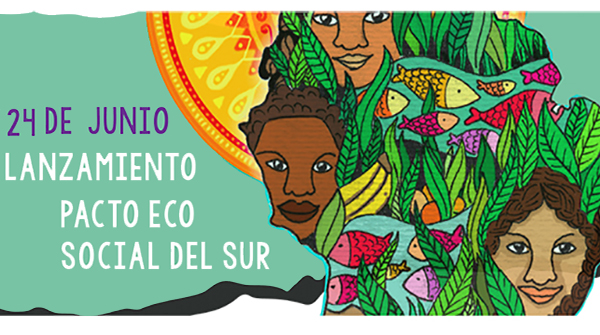

On Wednesday, June 24, the Southern Ecosocial Pact was presented with the slogan "For a Social, Ecological, Economic and Intercultural Pact for Latin America."
The presentation was given by:
Maristella Svampa (Argentina) Sociologist, researcher, writer
Mario Rodríguez Ibáñez (Bolivia) Diversity Network, Wayna Tambo
Arturo Escobar (Colombia) Anthropologist
Moderated:
Breno Bringel (Brazil) Latin American Sociological Association
They commented:
Francia Márquez (Colombia) Afro-Colombian socio-environmental activist
Karina Batthyány (Uruguay) Executive Secretary of CLACSO
Edgar Mojica (Colombia) General Secretary of the Central Unitary of Workers
Rudrigo Rafael de Souza e Silva (Brazil) National Board of the Homeless Workers Movement
Patricia Gualinga (Ecuador) Kichwa Native People of Sarayaku
Mina Lorena Navarro (Mexico) Sociologist and researcher
Vandana Shiva (India) Ecofeminist, philosopher and writer
Nnimmo Bassey (Nigeria) Socio-environmental activist
Supported by: CLACSO and ALAS
Adhere to the Southern Ecosocial Pact
This initiative was born from a group of people and organizations from different Latin American countries. We are motivated by the urgent need to build social dynamics capable of responding to and counteracting the dynamics of capitalist restructuring, wealth concentration, and ecosystem destruction that we see emerging amidst the COVID-19 crisis, and to shape, together with those who wish to join us, a collective horizon of transformation for Our America that guarantees a dignified future.
For a long time, the elites told us that it was impossible to stop the markets or the great machine of capitalist accumulation, but it turns out that it is possible to activate the emergency brake when it is decided that life is in danger.
The crisis laid bare by the pandemic has exacerbated inequalities and shows that our future is at stake. Part of the population is confined to their homes, while another part faces infection, repression, and hunger. Indigenous and Afro-descendant communities are exposed to a new wave of extermination; patriarchal and racist violence and femicides have increased. Meanwhile, old and new power groups are taking advantage of the emergency to ensure that the “return to normal” or “new normal” does not leave them without benefits.
The pandemic is a tragedy for many people, whose pain we share. But the pause imposed on global capitalism by COVID-19 also represents an enormous opportunity for change: to build our future based on caring for life.
Even though deep wounds to nature remain, this forced slowdown also meant a deceleration of ecosystem destruction, mainly due to the decrease in CO2 emissions.2The world's middle classes are collectively experiencing that it is possible to live without the excessive consumption that causes environmental destruction and threatens life itself on the planet; that happiness and quality of life have more relevant dimensions than possessing and accumulating things, such as living in a network of reliable affective relationships.
It has become clear that rural life, a sense of community, care, and reciprocity are central to sustaining life; that, despite living in a capitalist system, we do not live for and by capital. We are becoming aware that direct marketing, exchanges without money, and networks outside of capitalist markets now meet many of our basic needs; and we are experiencing that they have space and potential for the future.
Even in formal settings, ideas previously inconceivable or considered unfeasible are now central to the global agenda. Economic agencies like ECLAC are proposing a universal basic income, and the International Monetary Fund is recommending that governments introduce a wealth tax to counteract the scandalous inequality and reduce fiscal deficits. In the Global North, social and political movements are striving for a new global eco-social pact to save the planet, one that integrates social and environmental justice.
Building upon proposals developed collectively in diverse contexts, we propose a Social, Ecological, Economic, and Intercultural Pact for Latin America. This Pact is not a list of demands directed at the governments in power. Rather, it invites us to construct collective visions, agree on a shared path for transformation, and establish a foundation for platforms of struggle in the most diverse spheres of our societies. It calls upon social movements, territorial, trade, and neighborhood organizations, communities, and networks, as well as alternative local governments, parliamentarians, judges, and public servants committed to transformation, to shift the balance of power through plebiscites, legislative proposals, and many other strategies with real impact, enabling an organized and mobilized society to impose these changes on existing institutions.
In this sense, the following points seek to articulate redistributive, gender, ethnic, and environmental justice. Some of them envision a more prominent role for public institutions, while others refer more to the practices and de facto changes that emerge from the ground up and expand horizontally.
-Solidarity-Based Tax Transformation. National proposals for tax reforms based on the principle: “Those who have more, pay more – those who have less, pay less.” These proposals should include taxes on inheritance, large fortunes, mega-projects, financial income, and, as a transitional measure, environmental damage. Instead of everyone paying universal taxes, and only some having social protection, we propose that only those with the most resources pay taxes, but in return, everyone is protected.
-Cancellation of external debts of states and construction of a new global financial architecture. In these extraordinary times, it is justified to cease payments on external debt, as was done in 1931/32, and as proposed by the United Nations Conference on Trade and Development (UNCTAD), French President Emmanuel Macron, and Pope Francis. Canceling the external debt of countries in the Global South constitutes a first step toward historical redress for the ecological and social debt incurred by core countries since colonial times.
-Creation of national and local care systems that place the sustainability of life at the heart of our societies. Care is a right and, as such, must include a more active role for the State and businesses in ongoing consultation and shared responsibility with communities. This will allow us to combat job insecurity and achieve a better distribution of caregiving responsibilities, in terms of social class and gender, since these responsibilities currently fall unequally on families and, within families, on women. We must promote public policies that link care with social protection, addressing the needs of dependent elderly people, children, people with severe disabilities, and other individuals who are unable to meet their basic needs.
-A Universal Basic Income that unifies social policy through the introduction of a basic income for all, replacing the targeted conditional cash transfers inherited from neoliberalism, in order to escape the poverty trap. This is in line with the recent recommendation from ECLAC to Latin American governments. Reducing working hours without reducing wages, to distribute both formal employment and caregiving responsibilities.
-Prioritize Food Sovereignty. At a time when Latin America has the highest concentration of land ownership in the world, it is essential to develop policies aimed at land redistribution, access to water, and a profound reform of agricultural policies, moving away from industrial export agriculture with its disastrous environmental and social effects. This involves prioritizing agroecological, agroforestry, fishing, peasant, and urban production, promoting a dialogue of knowledge. Strengthen peasant and local markets. Create seed distribution networks to ensure their free circulation, without intellectual property restrictions. Reinforce rural-urban distribution networks and community certification between consumers and producers. Promote social, collective, and community ownership of land, generating sovereignty for those who care for and work it, and protecting them from speculation.
-Building post-extractive economies and societies. To protect cultural and natural diversity, we need a radical socio-ecological transition, an orderly and progressive exit from dependence on oil, coal, and gas, mining, deforestation, and large-scale monocultures. It is necessary to move towards renewable, decentralized, decommodified, and democratic energy systems and collective, safe, and high-quality mobility models. We must reduce the risk of climate collapse, a threat more serious than the pandemic, as floods, droughts, landslides, and fires demonstrate.
-To reclaim and strengthen spaces for information and communication from within society, currently dominated by corporate media and social networks that are part of the most powerful corporations of our time. To challenge historical notions of coexistence, not only through citizen media, but also from the streets, public squares, and cultural spaces.
-Autonomy and sustainability of local societies. The pandemic has revealed the fragility of global production chains and the value of local and national efforts. The immense creativity of Latin American peoples must be the foundation for political changes that promote the autonomy and sustainability of local territories and societies. It is essential to strengthen the self-determination of Indigenous, peasant, and Afro-American peoples, as well as popular urban community movements, in economic, political, and cultural terms; demilitarize territories and society as a whole; support local markets; democratize access to credit; support small and medium-sized enterprises; and promote local community energy sovereignty based on sustainable and renewable models.
-For sovereign regional and global integration. It is imperative to promote local, national, and regional exchange systems at the Latin American level, with autonomy from the globalized world market, thus opening alternatives to corporate monopolies. Introducing currencies parallel to the dollar at different scales would allow for a relative decoupling from the dangerous dynamics of the world market, strengthening trade between countries in the region and their complementary economic diversification.
If you would like to receive more information about CLACSO's training programs:
[widget id=”custom_html-57″]
to our email lists.

