
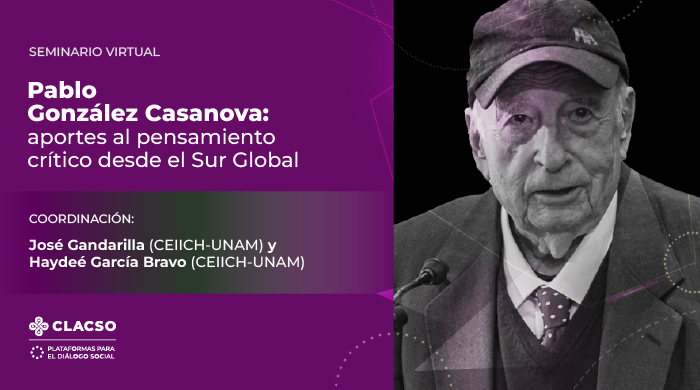
Pablo González-Casanova: contributions to critical thinking from the Global South
Chair: CLACSO
Coordination: José Gandarilla y Haydeé García Bravo (CEIICH, Center for Interdisciplinary Research in Sciences and Humanities/UNAM, National Autonomous University of Mexico)
Home: 10 / 10 / 2024 | Registration: 08/05/2024 al 09/10/2024
Workload: 12 weeks – 90 hours.
This paper offers a panoramic view of Pablo González Casanova's intellectual journey, allowing us to situate his place in the construction of Latin American social thought and, consequently, his contributions to the development of critical thinking from the Global South, with a special emphasis on his interdisciplinary research approach. To this end, through a review of a highly selective portion of his work, we will identify several stages in his production, related to a series of thematic areas of peripheral intellectual creation, thus revealing the specificity and originality of his contribution.
- Earning a place in the “new sociology”. Towards an understanding of the social in its entirety.
- From development to exploitation: The notion of internal colonialism.
- Diagnoses on the social sciences and university project by Pablo González Casanova.
- Contributions of Pablo González Casanova to Latin Americanism, as a framework for analysis and a program of study.
- Critique of neoliberalism and global colonialism.
- González Casanova's Marxism, or "towards a peripheral critical theory".
- Marx's scientific-critical program for the critique of complex and adaptive capitalism.
- For a characterization of the State, from Latin America and the Caribbean.
- Colonial ethnicities, the jungle theory, and the formation of concepts from indigenous peoples.
- The world seen from the South, and interdisciplinary research.
- Alonso, Jorge. Pablo González Casanova. An exceptional personality. Interinstitutional Chair, University of Guadalajara, CIESAS, Jorge Alonso, 2022.
- Farfán, Rafael, "The contribution of Pablo González Casanova to the formation of a critical theory of society in Mexico (1966-1970)", in Sociológica, Vol. 9, Number 24, January-April 1994.
- Gandarilla, José. “From systems far from equilibrium, probable paths and disputed alternatives. And from the proposal for their study in González Casanova” in Ackerman, John M., Ambrosio Velasco and René Ramírez (coords.). Pablo González Casanova. Democracy and radical thought”, Mexico City, PUEDJS-UNAM, 2023.
- Gandarilla, José. “From 'internal colonialism' to 'global colonialism'. A vindication of its analytical status in the work of Pablo González Casanova”, in Almanza Hernández, Roberto R. and Victor Hugo Pacheco Chávez (coords.), Theorizing from small places. Proposals and practices of political construction in the global south, Colombia, Universidad del Magdalena, 2020.
- Gandarilla, José. “Notes on the construction of an intellectual instrument. 'Internal colonialism' in the work of Pablo González Casanova”, Pléyade. Journal of Humanities and Social Sciences, No. 21, First Semester 2018, Dossier: Postcolonial Studies: Latin American Genealogies.
- Gandarilla, José. “Pablo González Casanova, from the sociology of exploitation to the sociology of complex capitalism: the power of autonomies in politics and intellectual creation” in Gandarilla, José. University, knowledge and complexity. Approaches from a critical thinking, La Paz, Bolivia, CIDES-UMSA, 2014.
- Gandarilla, José. “Pablo González-Casanova. Interdisciplinarity and complexity”, Buenos Aires, UNGS, 2021.
- García Bravo, María Haydeé, “Radical Imagination: Pablo González Casanova and the Institutionalization of Interdisciplinarity in Mexico”, in Crespo, Francisco; Soto, Luis Diego; Villa, Juan Carlos and Pablo Riveros (eds.) Perspectives for the Development of Inter- and Transdisciplinary Work in Latin America, Santiago de Chile: University of Chile, 2023,
- González Casanova, et al, Sociology of Latin American Development (a guide for its study), Mexico: Institute of Social Research-UNAM, 1970, “Latin American classics and the sociology of development”.
- González Casanova, P. (2019). Words of Dr. Pablo González Casanova (Speech on the occasion of the creation of CELA. Latin American Studies.
- González Casanova, Pablo, "The triumph of capitalism as a topic in the theory of exploitation", in Dialectica, New Era, Year 18, Number 27, Spring 1995, Mexico.
- González Casanova, Pablo, "The New Dialectic" in The New Metaphysics and Socialism, Siglo XXI Editores, Mexico, 1982.
- González Casanova, Pablo, "On Marxism in Latin America", in Dialectica, Year 12, Number 20, December 1988, Mexico.
- González Casanova, Pablo, “Latin America: The evolution of critiques of social science”, in Daniel Camacho. Debate on Dependency Theory and Latin American Sociology, San José: EDUCA, 1979.
- González Casanova, Pablo, “Causes of the rebellion in Chiapas” [1994], in González Casanova, Pablo. 2009. From the sociology of power to the sociology of exploitation. Thinking about Latin America in the 21st century, Bogotá: CLACSO-Siglo del hombre editores.
- González Casanova, Pablo, “Internal Colonialism [a redefinition]”, in Boron, Atilio, Javier Amadeo and Sabrina González (eds.), Marxist Theory Today, Buenos Aires: CLACSO, 2006.
- González Casanova, Pablo, “Knowledge of America (Sociological Notes)”, Cuadernos Americanos, Vol. LIV, Nov-Dec, 1950, No. 6.
- González Casanova, Pablo, “Capital: A Classic of Critical Science” in The Flight of the Phoenix: Capital: Critical Readings 150 Years After Its Publication: 1867-2017, Pablo González Casanova ... [et al.]; coordinated by Roger Landa; edited by David Alvarado; Manuel Azuaje Reverón. Buenos Aires: CLACSO, 2018.
- González Casanova, Pablo, “Organized Capitalism. Between Order and Chaos”, Desacatos, no. 28, September-December 2008.
- González Casanova, Pablo, “The gift, foreign investments and social theory”, in Notebooks of the Seminar of Scientific and Philosophical Problems, Second Series, Volume I, Mexico: UNAM, 1957.
- González Casanova, Pablo, “The white blackbird. Essays on provincial philosophy” Cuadernos Americanos, Vol. LXII, Mar-Apr, 1952.
- González Casanova, Pablo, “Globality, neoliberalism and democracy”, in González Casanova and John Saxe-Fernández (eds.), The current world. Situation and alternatives, Mexico: CEIICH-UNAM/Siglo XXI Editores, 1996.
- González Casanova, Pablo, “The conquest of Latin America”, Tareas, No. 83, 1993.
- González Casanova, Pablo, “Colonial Ethnicities and the Multiethnic State” [1996], in González Casanova, Pablo. 2009. From the Sociology of Power to the Sociology of Exploitation. Thinking about Latin America in the 21st Century, Bogotá: CLACSO-Siglo del Hombre Editores.
- González Casanova, Pablo, “Fifth stage: from 1959 to the present day”, in Imperialism and Liberation. An Introduction to the Contemporary History of Latin America, 1978, Mexico, Siglo XXI editores.
- González Casanova, Pablo, “Plural society, internal colonialism and development” Latin America, Year VI, No. 3, July-September 1963.
- González Casanova, Pablo, 1969. Sociology of exploitation, Mexico City, Siglo XXI editores, “The development of capitalism in colonial and dependent countries” [1959].
- González Casanova, Pablo, 1969. Sociology of exploitation, Mexico City, Siglo XXI editores, “Sociology of exploitation” [1968.
- González Casanova, Pablo, 2000. “The formation of concepts in indigenous peoples (the case of Chiapas)”, in Velasco Gómez, Ambrosio (coord.), The concept of heuristics in the sciences and the humanities, Mexico: CEIICH-UNAM/Siglo XXI Editores.
- González Casanova, Pablo, Study of Social Technique. Mexico: National Autonomous University of Mexico, Collection of Scientific and Philosophical Problems, No. 7, 1958, Chapter XV. “Democracy as a path of social science and political knowledge.”
- González Casanova, Pablo. (1979). “The political context of university reform. Some considerations on the case of Mexico.” In P. Dooner and I. Lavados (Eds.), The Latin American university: A decade's vision. Santiago de Chile: CPU.
- González Casanova, Pablo. (1990). “Thinking about the University” in Cuadernos Americanos, No.20, March-April 1990.
- González Casanova, Pablo. [2002]. “Dialectical Dynamics. Clarifications on Some Marxist Concepts” in Turner, Jorge and Guadalupe Acevedo. 2005. Sergio Bagú. A Classic of Latin American Social Theory, Mexico City, FCPyS-UNAM-Plaza y Valdés.
- González Casanova, Pablo. “Corporate Capitalism and Social Sciences” in Critique and Emancipation, (9): 23-42, first semester of 2013.
- González Casanova, Pablo. “The new sociology and the crisis of Latin America”, in Antonio Murga and Guillermo Boils. Latin America: Dependency and Underdevelopment, San José: EDUCA, 1973.
- González Casanova, Pablo. “The necessary university (Outline for a project)” in Pablo González Casanova (2001) The necessary university in the 21st century. Mexico: Era.
- González Casanova, Pablo. “The social sciences” in González Casanova, Pablo and Guillermo Bonfil. The social sciences and anthropology. Two essays, Mexico: National Productivity Center, 1968.
- González Casanova, Pablo. 1984. “Social sciences in Latin America” in Mexican Journal of Political and Social Sciences, Vol. 30, Nos. 117-118.
- González Casanova, Pablo. 1985. “The new hegemony” in Power to the people, Mexico City: Océano.
- González Casanova, Pablo. 1987. "The metaphysical penetration in European Marxism" in Barker, Colin, et al. 1987. Critical Marxism, critique of Marxism, Culiacán, Autonomous University of Sinaloa, Renewal Collection, No. 10.
- González Casanova, Pablo. 1990 “Introduction” and “The theory of the State and the world crisis”, in The State in Latin America. Theory and practice, Mexico City: United Nations University-Siglo XXI editors, 1990.
- González Casanova, Pablo. 1995 “Prologue” and “The State and Politics”, in Vuskovic, Pedro, et al. Latin America, Today, Mexico City: United Nations University-Siglo XXI editors.
- González Casanova, Pablo. 1997 "The Jungle Theory Against Neoliberalism and for Humanity. (Intertext Project)" in Perfil de la Jornada, Thursday, March 6.
- González Casanova, Pablo. 2002. “The neoliberalism of war and the challenges of critical thinking” in Latin America in motion, no. 351.
- González Casanova, Pablo. 2016. “Latin America and the world: crisis, trends and alternatives” in Gentili, Pablo and Nicolás Trotta (eds.). Latin America: Democracy at the Crossroads, Autonomous City of Buenos Aires: CLACSO-Editorial La Página SA
- González Casanova, Pablo. 2017 [1995]. “Global colonialism and democracy” in Exploitation, colonialism and the struggle for democracy in Latin America, Mexico: Akal, 2017.
- González Casanova, Pablo. The new sciences and the humanities: From academia to politics, Barcelona: Anthropos/IIS-UNAM/Editorial Complutense, 2004. Chapter 1 Interdisciplinarity and complexity, and Chapter 2. Complexity and contradictions.
- Illades, Carlos. Marxism in Mexico. An intellectual history. Mexico: Taurus, 2018.
- Ouviña, Hernán. “Pablo González Casanova: Latin Americanist sociologist and insurgent commander” in Desinformémonos. Journalism from below, February 11, 2022.
- Perus, Françoise. “The first work of Pablo González Casanova” in Anthropos. Journal of scientific documentation of culture, No. 168, September-October 1995.
- Preciado Coronado, Jaime A. 2023. “The notion of democracy in Pablo González-Casanova”. In Torres Guillén, Jaime (Coordinator) Readings on the work of Pablo González Casanova. Homage to 100 years of his birth 1st ed.–Zapopan, Jalisco, Mex.: CLACSO.
- Roitman, Marcos, “Prologue. Pablo González Casanova in Latin American sociology: The ethics of commitment” in González Casanova (2017). Exploitation, colonialism and the struggle for democracy in Latin America, Mexico: Akal, 2017.
- Sánchez Rodríguez, María del Consuelo. “Pablo González Casanova, internal colonialism and rebel indigenous people” in Ackerman, John M., Ambrosio Velasco and René Ramírez (coords.). Pablo González Casanova. Democracy and radical thought”, Mexico City, PUEDJS-UNAM, 2023.
- Torres Guillén, Jaime, The concept of internal colonialism, Mexico: UNAM/IIS, 2017, 14 p., in Collection Concepts and fundamental phenomena of our time.
- Werz, Nikolaus. 1995. Modern sociopolitical thought in Latin America, Caracas: Nueva Sociedad, “The emergence of the 'new sociology' and the debate surrounding dependency”.
|
|
Discount for one payment until 01/10 |
In one payment after 01/10 |
|
CM Plenos |
$85 |
$150 |
|
CM Associates |
$85 |
$150 |
|
No link |
$105 |
$190 |
FAQ
The basic requirements for taking a seminar are:
- Availability of at least 4 hours per week to dedicate to the seminar course.
- Internet access.
- Reasonable handling of communication and computer tools.
- Language proficiency in the language in which the course will be taught. The official languages are Spanish and Portuguese.
The seminars last 12 weeks, plus the completion of a final project. A total of 90 hours of dedication will be credited.
A course consists of twelve classes, each accompanied by required reading bibliography, supplementary bibliography, discussion forums and training activities proposed by the teaching team, partial deliveries and a final project.
The course is online and asynchronous. Some instructors may propose synchronous activities. In those cases, the time and date will be agreed upon beforehand between the teaching team and the students to ensure everyone's participation.
To pass the seminar, you must participate in at least 80% of the discussion forums and activities proposed by the teachers, have completed the scheduled partial deliveries, and pass the final work.
|
|
Discount for one payment until 01/10 |
In one payment after 01/10 |
|
CM Plenos |
$85 |
$150 |
|
CM Associates |
$85 |
$150 |
|
No link |
$105 |
$190 |
The possible payment methods are credit card, bank transfer and bank deposit.

