
Opinion: Democracy as restraint
From electoral manipulation to coercive hegemony:
The State as a condensation of the class struggle in times of imperial tutelage
Prepared by: Galel Briceño
Specialist in economic studies and
social services of the Secretariat of Strategic Planning
Member of the Honduran Sociological Association
The Honduran general elections of November 30, 2025, are not an institutional anomaly or an isolated technical crisis, but rather an episode structurally consistent with the flawed political control of the democratic process. Through an analytical chronology and a chronicle of these days of political uncertainty, this brief analysis examines how the electoral system operated as a state mechanism for the biased management of conflict, articulating restrictive institutional designs, practices of electoral manipulation, and persistent US interference.
From a critical perspective, it is argued that Honduran democracy operates under a logic of containment, where electoral competition exists, but the effective redistribution of power remains severely limited to the hands of US interference and the dominant class configurations, represented by the neo-conservative Liberal and National parties.
Elections and the State: a structural reading key for these days
To begin this exploration of the days following the November 30th elections, we need to be clear that the elections themselves are not neutral events nor technical instances separate from power relations. Therefore, I would urge us to view the electoral system as part of the State in a relational sense, that is, as a material condensation of power relations between Honduran classes and class fractions (Poutlanzas, 1978). Within this framework, the central function of these and other elections in Honduras has not only been to select authorities, but also to regulate political conflict, establish limits to the dispute, and produce legitimacy for a given social order and a given class order.
In this profoundly unequal society, this regulatory function takes on a particularly intense character, just as we are experiencing in these dark days of prolonged political crisis. We see that inequality is expressed not only in income distribution, but also in the distribution of political power, organizational capacities, and the real possibilities of influencing the State (Therborn, 2013). Elections, far from correcting these asymmetries, tend to reproduce them when the institutional design and the administration of the process are captured by dominant factions. And, well, we have already seen how the configurations of Honduran ruling classes have demonstrated how the will of the majority can be overridden by the interests that these powerful minorities have at stake.
This analytical and critical framework is fundamental to understanding what has happened since November 30, 2025. Below, I present an interpretive log of these 17 days, regarding the events that have occurred so far in the political arena:
November 28: The pardon of Juan Orlando Hernández as cynical interference and a reorganization of the political field
Donald Trump's announcement of the pardon granted to Juan Orlando Hernández two days before the elections constituted a highly significant political event (Heraldo E., 2025a). This was not an isolated decision by the US judicial system, but rather a cynical external political intervention that reconfigured the electoral context at a critical moment.
The literature on US interventionism allows us to interpret this act as part of a persistent hierarchical mindset in US foreign policy toward Latin America, where democracy is secondary to geopolitical stability and the protection of strategic interests (Schoultz, 2018). Since the 2009 coup, Honduras has become a paradigmatic case of this logic. As Frank (2018) documents, the country was subjected to a prolonged cycle of de-democratization tolerated and functional to Washington's interests.
From the perspective of global political economy, Robinson (2014) offers an incisive insight: the pardon can be understood as an action consistent with the interests of a transnational capitalist class that uses state apparatuses, including the US, to stabilize strategic territories. This act operated as a mechanism of hegemony, redefining the limits of what is possible and sending a disciplinary imperial signal to local political actors. It is no coincidence that the support went to the conservative party, which surrendered sovereignty and territory through the Strategic Development Zones (ZEDEs) to representatives of global corporate groups aligned with Trump, and which are also deeply interested in geopolitical control from Honduras over the region, continually threatening Venezuela from the Caribbean.
November 30: Election day and control of the electoral system
The election day unfolded under a close competition, but was marred by widely reported structural irregularities: voter transportation, threats from organized crime, clientelism, purchase of credentials, logistical problems and persistent failures of the Preliminary Electoral Results Transmission (TREP) system (Criterio.Hn, 2025).
As Norris (1994) aptly points out, elections fail when structural weaknesses such as inequality and clientelism converge with institutional weaknesses such as rule design and electoral administration, and international weaknesses such as external pressure and selective observation. Honduras exhibited these three dimensions simultaneously, on the same day, and to this day remains mired in this situation.
And so, in that tense context, the extension of voting hours from 5:00 pm to 6:00 pm (Radio Progreso, 2025) clearly illustrated the type of practices that Sarah Birch (2011) conceptualizes as electoral malpractice —that is, not necessarily illegal, but certainly politically biased. In contexts of low institutional trust, these decisions expand administrative discretion and erode the perception of impartiality. Such is the control exerted by the National Party over the National Electoral Council (CNE).
Furthermore, in this context, we must be very clear that electoral systems are not neutral, but rather certain institutional arrangements that tend to concentrate power, while others favor inclusion (Lijpart, 1994). In Honduras, the design of the system and its administration have historically operated as mechanisms for amplifying the political interests linked to the dominant bloc, restricting genuine competition.
December 1-4: Release of former president Juan Orlando Hernández (JOH) and social protest, sovereignty under dispute
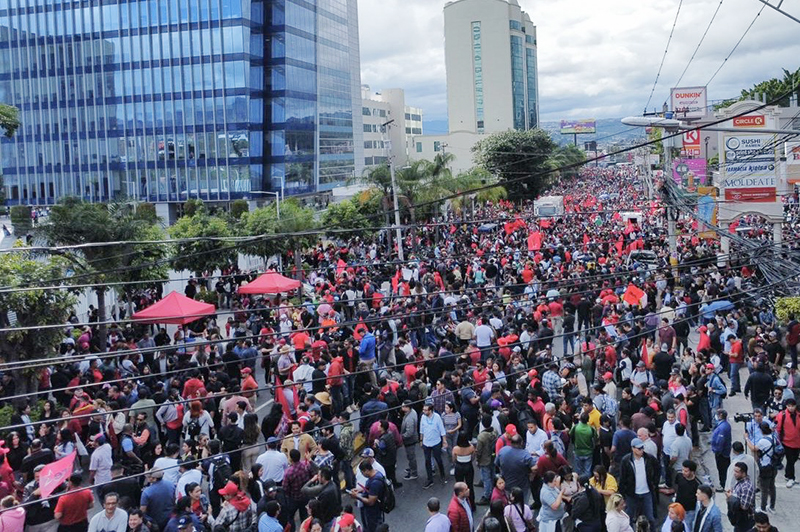
Between December 1 and 3, the release of former president Juan Orlando Hernández—who had also been imprisoned for trafficking many tons of cocaine—was confirmed, and the official pardon document was published (Digital, 2025). On December 4, social organizations protested in front of the United States Embassy (Heraldo E., 2025c).
The shift of the conflict from the electoral body to the US diplomatic mission was not merely symbolic; it expressed a collective political interpretation of the actual site of strategic decision-making. Viewed through the lens of political justice, this situation reveals a form of structural exclusion, where broad sectors of society are left out of effective decision-making spaces, even when they formally participate in electoral processes (Frasser, 2013). This, undoubtedly, was the citizenry unveiling the mask of imperialism, which cynically influences the fragile bourgeois liberal democracy that claims representation but fails to represent the will of the people.
This protest also pointed to a hegemonic crisis, revealing the dominant bloc's inability to maintain internal consensus without resorting to external oversight and extraordinary acts of power. Because, of course, these are imposed conservative powers.
From December 4 to 9: Preliminary Electoral Results Transmission System (TREP) allegations of fraud and “electoral coup”
The failures of the TREP system, the slow count, and institutional opacity intensified allegations of fraud (Heraldo E., 2025d). In this context, the notion of an “electoral coup” emerged strongly.
So far, this interpretation of reality would be quite in line with what Andreas Schedler (2002) describes as the "manipulation menu," a repertoire that includes pre-election biases, control of the referee, manipulation of the vote count, and strategic use of legality. Furthermore, we can add to this mix the work of Cheeseman and Klas (2018), who demonstrate that these mechanisms allow for the "fixing" of elections without resorting to massive fraud or open violence.
This type of process constitutes a contemporary form of democratic erosion, more effective than the classic coups to which traditional and neoconservative political parties like the National Party are accustomed, because it preserves the institutional facade. However, following this line of thought, we can conceptualize the Honduran case as a competitive authoritarianism, where electoral competition exists, but unfolds on terrain structurally skewed by the abuse of state power.
From December 10 to 16: special scrutiny, cartelization and closure of the power bloc
The announcement of a special recount of more than 2,700 tally sheets (Hondudiario, 2025) did not resolve the crisis. Disputes over the composition of the verification boards and allegations of political sabotage (Contracorriente, 2015) demonstrated that the problem was not technical, but rather political and structural.
Thus, it is clear that the call of the Honduran Council of Private Enterprise for stability and order (COHEP, 2025) must be read from the cartel party thesis (Katz & Mair, 1995), because in times of crisis, parties and economic interests converge to shield the system, prioritizing governability over democratic legitimacy, even though citizens are demonstrating in front of the same electoral institution denouncing an evident fraud and electoral coup.
On the other hand, the intervention of the Organization of American States (OAS) confirmed the limits of international observation pointed out by Hyde (2011) and Kelley (2012) when the costs of being denounced are less than the benefits of manipulating, observation ends up functioning as a device for legitimizing the existing order.
Structural balance: managed democracy and contained conflict
As of December 16, 2025, Honduras still lacked definitive results, with thousands of disputed ballots and a citizenry increasingly distrustful, and above all, conflicted and polarized. And as I stated at the outset, this situation cannot be explained as an institutional anomaly, much less as a failure of the Preliminary Results Transmission System (TREP). This is nothing more than the expression of the normal functioning of a democracy managed by the dominant class and its neoconservative National and Liberal parties, which control the electoral system; all in collusion with imperialism and its corporate interests in the region. In this scenario, the electoral system acts as a mechanism for containing social conflict, ultimately imposing the interests of any other power group, far removed from the interests of the vast majority.
In short, it was a matter of playing by the rules of a bourgeois state once again, one that reorganizes its domination without abandoning the form of liberal representative democracy and ultimately fails to represent the popular will. Furthermore, it is a hegemony under strain, increasingly resorting to the tutelage and direct and indirect coercion of imperialism. And finally, it is also a democracy emptied of political justice, which is reproduced in the effective access to power and thus plunges us into abrupt and violent inequalities.
Highlighted
Bermeo, N. (2016). On democratic backsliding. Journal of democracy.
Birch, S. (2011). Electoral Malpractice. Oxford University Press.
Cheeseman, N., & Klaas, B. (2018). How to rig an election. Yale University Press
Against the current. (2015). Amid allegations of irregularities and fraud, the special scrutiny remains stalled.
Criterio.Hn. (2025). Election results under the shadow of fraud allegations.
Digital, P. (2025). Hernández, pardoned by Trump.
Frank, D. (2018). The long Honduran Night. Haymarket Books.
Fraser, N. (2013). Scales of justice. Polity Press.
Heraldo, E. (2025a). Donald Trump will pardon Juan Orlando Hernández.
Heraldo, E. (2025b). El Heraldo Document: Trump granted full pardon to JOH. Heraldo, E. (2025c). Protests in front of the US Embassy against the pardon of JOH.
Heraldo, E. (2025d). TREP failures and slow counting.
Hondudiario. (2025). CNE plans to begin special scrutiny.
Hyde, S. (2011). The pseudo-democrat's dilemma. Cornell University Press.
Katz, R., & Mair, P. (1995). Changing models of party organization and party democracy.
Kelley, J. (2012). Monitoring democracy. Princeton University Press.
Lijpart, A. (1994). Electoral systems and party systems. Oxford University Press.
Norris, P. (1994). Why electoral integrity matters. Cambridge University Press.
OAS. (2025). MOE/OAS Honduras Report.
Poutlanzas, N. (1978). State, power and socialism. Verso.
Private, CH (2025). COHEP.
Progress, R. (2025). Press release: Voting hours extended.
Robinson, W. (2014). Global capitalism and the crisis of humanity. University Press.
Schedler, A. (2002). The menu of manipulation. Journal of democracy.
Schoultz, L. (2018). In their own best interest. Harvard University Press.
Therborn, G. (2013). The killing fields of inequality. Polity Press.
Way, L., & Levitsky, S. (2010). Competitive authoritarianism. Cambridge University Press.
Photo by Douglas Vargas
This text expresses the position of its author and not necessarily that of the centers and institutions that make up the CLACSO international network, its Steering Committee or its Executive Secretariat.

