
“Never again to the arrogance of the extreme right, to anti-democratic expressions”
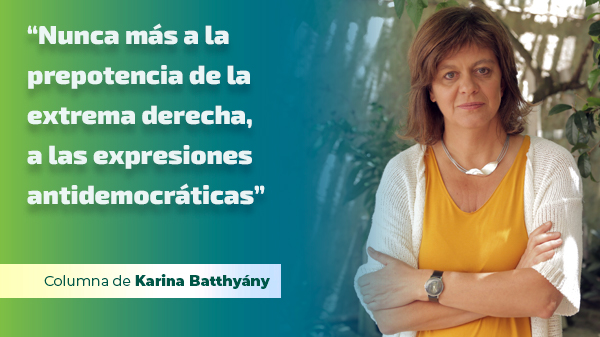
(Transcription of Karina Batthyány's Column)
(In InfoCLACSO – February 22, 2023)
Regarding the outlook for 2023, it would be difficult to summarize everything we have ahead of us at CLACSO. Therefore, as with any discussion that always involves selection criteria and discretion, I will focus on one of our major projects: Platforms for Social Dialogue (PDS).
There, we intend to bring into dialogue precisely these three elements that we at CLACSO believe are key to social impact and transformation. What am I talking about? Indeed, within the academic sector, the knowledge sector, the production of knowledge—which, of course, is carried out by CLACSO, its Member Centers, its Working Groups, and its various members—we aim to engage in dialogue with social movements and organizations, and with those in the field of public policy, in order to try to have a social impact and transform our region, our Latin American and Caribbean societies, towards more just, more egalitarian, more democratic societies, with greater respect for rights and greater opportunities for everyone.
At the Platforms for Social Dialogue (PDS), we have been actively working since the last months of 2022, holding a series of meetings throughout Latin America and the Caribbean, in different countries and territories, on the themes that bring us together. These are themes that we consider to be the central issues facing our Latin American and Caribbean region today, as well as the social sciences and humanities. These are also the issues we discussed and worked on together at our last Latin American and Caribbean Assembly held in Mexico in June 2022.
What issues or topics am I talking about? We're talking about themes related to rights, violence, and gender equality; the environment, climate change, and social development; social movements and activism in Latin America and the Caribbean; migration and human mobility; inequality and poverty in our region; the reconfiguration of the current world of work; the right to education, public policies, and pedagogical alternatives currently under discussion in Latin America. And also, of course, democracy, human rights, and peace.
These are the eight pillars that structure these Platforms for Social Dialogue (PDS), where we want to invite everyone to engage in dialogue, debate, and build alternatives for these major critical issues facing our region. We will hold a series of events throughout the year, of varying types, in different spaces for in-person, virtual, and hybrid meetings, all aimed at moving forward in this direction.
Of course, whenever we have a working session on these platforms, we will be here at InfoCLACSO reporting on what is happening, what the discussions are, and where these platforms are ultimately headed. That will be one of the main focuses of our work in 2023.
-Absolutely, Karina. You've managed to group together and bring together the major themes and main points that CLACSO will address in 2023. Obviously, we'll then delve into the specifics of these issues, including events, meetings, forums for debate, and spaces for reflection, week after week, providing details that will materialize in countless materials, meetings, and new challenges. On another note, we can address some current issues: Peru, without a doubt, has been a source of concern for us since last year due to the ongoing political and social crisis. The Council even issued statements regarding the situation and the concerns that have arisen surrounding Peru's political and social crisis.
Yes, absolutely, it's a matter of great concern to us. And, of course, as CLACSO, we have spoken out against this situation of political and democratic instability in Peru, issuing various news reports and statements on the subject. For example, the most recent one concerns a violent intervention at the University of San Marcos in Lima, Peru, a university where several departments are CLACSO Member Centers. There, CLACSO, along with its Steering Committee, strongly condemned the police repression at the University of San Marcos, where several police officers, accompanied by armored vehicles, entered the campus to evict and arrest delegations from other parts of the country who were present. This police entry—our statement says—is a flagrant violation of autonomy and a further escalation of violence, which at that time had already claimed 50 lives. CLACSO, of course, rejects the government's decision to resort to violence to confront the crisis in the country and the attitude of the Peruvian government, which places itself outside the bounds of respect for human rights in general. CLACSO thus expresses its solidarity with the Peruvian people, demands an end to the state of emergency, a cessation of violence and repression, and the holding of fair and democratic elections that reflect the will of the Peruvian people. This statement was one of CLACSO's pronouncements regarding the situation in Peru. We continue to observe this situation, it concerns us, and it forms part of one of the key issues we have mentioned within the framework of these Platforms for Social Dialogue (PDS), linked to democracies, human rights, peace, and processes of political instability, which precisely call into question those democratic expressions so necessary in our countries. We, as CLACSO, wish to reaffirm that the use of violence is absolutely unacceptable in any situation in a country and that violence cannot be used to confront these crises. We want to promote dialogue to finally find a peaceful solution for the people of Peru and, of course, to express our solidarity with the Peruvian people once again. Perhaps we should continue down the path of holding new, fair, and democratic elections that reflect the will of the Peruvian people. This was one of the issues that was on the agenda during the InfoCLACSO recess and in our region, and we must bring it to the forefront today.
-The other major topic, Karina, had to do with Brazil: a very complex January 8, 2023, which clearly made us think of what happened in the United States, a truly dramatic situation, and there were also statements regarding this issue from CLACSO. What is your analysis?
First, there was concern prior to January 8th about the threats being made regarding whether or not Lula da Silva would be allowed to take office. We celebrated on January 1st that Lula had indeed assumed the presidency, but on January 8th we were shocked by the news. And, of course, CLACSO joined the voices of all democrats worldwide in condemning the attempted coup d'état by supporters of former President Bolsonaro, who attacked public buildings in Brasília and called for the overthrow of the newly installed Lula government. Once again, CLACSO declared: Never Again, never again to the arrogance of the extreme right, to the anti-democratic expressions that seek to impose unpopular policies through violence. We know what happened next in terms of the reaction of Lula da Silva and his entire government. It's important to remember that even in those first hours, when confusion reigned, many presidents in our region quickly expressed their solidarity with the newly elected president of Brazil, Lula da Silva, and with the Brazilian people. CLACSO clearly conveyed its solidarity and support to the Brazilian government and people during that dramatic moment, a week after Lula assumed the presidency, which he reached through democratic means, following four years of an unpopular, racist administration that caused so much harm to Brazil and, above all, to its people.
-What levels of attention should we pay to democratic processes in the region? Because evidently, even on issues that seem already won, impossible to overthrow or reverse, we see situations that catch our attention…
Absolutely. It's a matter of concern for us; we're paying close attention to these processes of political instability and attempts to destabilize democratic processes in Latin America and the Caribbean. Of course, all of this is within the framework of the analysis we're also conducting and promoting at CLACSO regarding the role of these right-wing or new right-wing movements in our region.
If you would like to receive more information about CLACSO's training programs:
[widget id=”custom_html-57″]
to our email lists.

