
New forms of resistance violence against neoliberal Chile
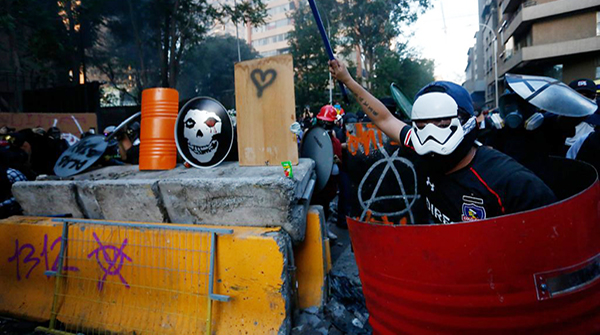
What we have seen on the streets of Chile since October is not the armed apparatus of a political party, or a revolutionary movement seeking to seize political power to build a different society, but rather a practice of direct self-defense against the violence of neoliberalism. What we observe is a coordinated effort by individuals or groups carrying out a series of creative and interconnected actions to defend themselves and others from police violence.
While political violence is undoubtedly multifaceted, we can affirm that in Chile today, it does not operate as a means of gaining political power. We are witnessing the use of violence as a form of self-defense against police repression and resistance against the violence of neoliberalism, which differs enormously from the armed struggle of the 1970s, 80s, and part of the 90s, and which we cannot possibly understand if we view it through the lens of past political categories. Analyzing the memories of political violence in our recent past is a necessary exercise to understand that this form of resistance is very different from that of the revolutionary movements of those years.
In post-dictatorship Chile, a transformation occurred in the practices and meanings of what we understand as political violence. The repressive violence of the State—exercised as State Terrorism during Pinochet's civic-military dictatorship—found in the 1990s an institutional framework that allowed it to function comfortably within a democracy and a legitimacy it had previously lacked. The “transition to democracy” established the idea that public order and citizen security are fundamental rights, and that democracy is a value in itself that must be protected even at the cost of emptying it of content and any political project that seeks justice and equity. Under this discursive and normative framework—that is, one that shapes meanings and norms of behavior—the Security Forces continued to repress political dissidents, protected by the legitimacy granted to them as guarantors of public order. State political violence did not cease to exist in post-dictatorial Chilean democracy, and what we observe today in the streets of our country is nothing more than the exacerbation of the operation of a strongly violent and repressive institutionality that continues to act with impunity.
In the 1990s, not only did state violence transform, but so did its uses as a form of political struggle. The three armed groups or political-military organizations that operated during the dictatorship—the MIR (Revolutionary Left Movement), the FPMR (Manuel Rodríguez Patriotic Front), and the MJL (Lautaro Youth Movement) or MAPU Lautaro—continued to operate (at least some factions of them) until around 1994 [1]. By the mid-1990s, these groups were no longer engaged in military activity. Their members had been heavily persecuted, murdered, lived in exile, or were imprisoned in the High Security Prison (CAS). Armed struggle as a means of achieving a revolutionary political project and as a way to access political power ceased to be used and has not resurfaced since.
Although the memories of the political struggles of the 1990s have not yet been systematically documented, it was undoubtedly a period of significant activity. These struggles, which denounced and challenged the neoliberal model and the continuation of the transition, were silenced by the media, persecuted by the forces and institutions of the democratic state who perceived them as a threat, and repressed by the police. It is in this context that political movements and collectives—starting in the 1990s—resorted to the use of “violent” methods as a strategy for gaining visibility, but above all, for self-defense.
It is precisely the reflections of these groups on the violence of neoliberalism and patriarchy, as well as the legitimacy (or lack thereof) and the appropriateness (or lack thereof) of using violence as a strategy for political action, that shed light on what we are experiencing today. What we have seen in the streets of Chile since October is not the armed apparatus of a political party, or a revolutionary movement seeking to seize political power to build a different society, but rather a practice of direct self-defense against the violence of neoliberalism. What we observe is the coordinated action of individuals or groups carrying out a series of creative and interconnected actions to defend themselves and others from police violence. This is not an organized movement (at least for now) with prior military training that uses the context of popular rebellion and its demonstrations as a platform to achieve its objectives, but rather a situational collective whose objective and identity are realized in the resistance they wage.
The boundary of the First Line is clear when viewed from the perspective of the opposing side (the police), but less so when viewed from the perspective of the demonstration itself. In this latter view, it is not so much a line as a broad and porous space, made up of a set of roles sometimes performed by the same people and other times by those who move between them. There are “shield bearers,” “shooters,” “firefighters,” and “picketers.” There are also those who tend to the wounded and help demonstrators combat the effects of tear gas. The First Line is not separate from the demonstration but rather a part of it, occupying the position of frontal resistance against the violent onslaught of repression. The purpose of its existence is twofold: defense and the creation of the conditions that make the demonstration possible. Like all collective action, it is reasonable to assume that its practices are, at least in part, a learning process based on the memories of other struggles, which is always a creative process of dialogue with the past.
To understand the actions of the First Line as part of an armed movement that could be influenced or even orchestrated by a nonexistent Soviet bloc (with Cuba and Venezuela as Latin American representatives) is a mistake bordering on the ridiculous. If the Chilean government wants to end what it sees as violence that threatens democratic institutions, its solution is simple. It must stop repressing demonstrations, allowing, and even guaranteeing, the systematic and massive exercise of social protest, and responding to the demand to end the violence of neoliberalism.
Isabel Piper Shafir
PhD in Social Psychology, Department of Psychology, University of Chile. Member of the CLACSO Steering Committee for Chile and Peru
[1] Actions such as attacks, ambushes or sabotage; “recoveries” of food, weapons or money; executions; kidnappings; rescue of political prisoners; armed propaganda (Rosas, 2013).
eldesconcierto.cl – 19.01.2020
If you would like to receive more information about CLACSO's training programs:
[widget id=”custom_html-57″]
to our email lists.

