
“It is impossible to advance left-wing proposals without incorporating a feminist perspective.”
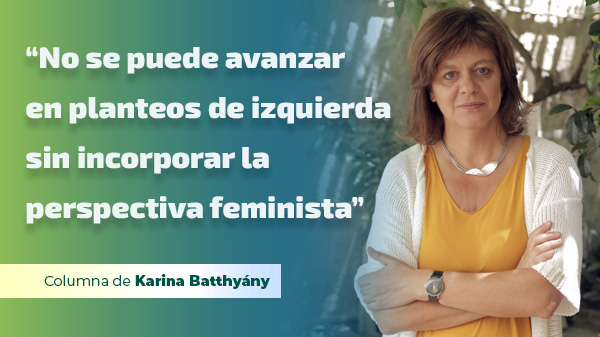
Transcript of Karina Batthyány's column
in InfoCLACSO – August 2, 2023
Today, I propose we talk about a topic that we consider central to Latin America and the Caribbean: the links between the left and feminism.
We can speak of a feminist left: we must start from the premise that since the beginning of this century, there has been an enriching and integrative dialogue between feminisms and the political left, giving rise to a space of convergence, articulation, reflection and proposals in pursuit of a more equal, more just society.
Today, in 2023, it is important to consider the evolution of feminist movements on the one hand, but also of the left and progressive movements in Latin America and the Caribbean. And there, we can start from two simplified premises.
First, the premise of the left focuses on the struggle for social and economic equality, advocating for distributive justice and the recognition of rights. The left incorporates these elements into its political and partisan platforms in its various regional expressions, challenging the established power structure and aiming to transform it for the benefit of the most disadvantaged and marginalized classes in our region.
Second, I ask myself: How can we not integrate feminism and the left? Equality is precisely what's at stake, incorporating the gender dimension and working on issues of distribution and recognition.
From a theoretical point of view, those of us who dedicate ourselves to this topic, following Nancy Fraser, usually suggest that this is one of the dilemmas of the Feminist Movement in the tension between knowledge and distribution.
So how can we not consider the link between feminism and the left when the goals of a truly left-wing movement cannot be achieved without integrating feminism? Because we cannot speak of social equality, economic equality, distributive justice, and the recognition of rights without incorporating the feminist perspective.
Furthermore, it represents an opportunity to broaden and recognize that oppressions, from the point of view of the sex-gender system, are indeed a fundamental component of social inequalities, which in Latin America and the Caribbean the left undoubtedly intends to overcome, eliminate or reduce.
This is where some fundamental reasons begin to emerge as to why a feminist perspective within the political left is not just necessary, but essential. I would even venture to say that it is impossible to advance truly left-wing political proposals without incorporating this feminist perspective. I will share some points regarding these foundations.
First, there's the idea of an intersectional view of inequalities. Feminism has demonstrated this intersectionality and, therefore, the recognition that oppressions and discrimination are interconnected and overlap with each other, forming the web of inequalities we addressed at the Mexico Conference in 2022. Furthermore, these inequalities affect different groups of women unequally. A feminist left clearly considers this complexity and fights for social justice, taking into account the intersections of gender, race, class, sexual orientation, gender identity, disability, and so many other dimensions.
Secondly, we must place at the center the idea of equality, which is still far from being achieved in Latin America and the Caribbean and in the world. In our region, the most serious issue is wage equality and equality of employment opportunities. If we truly want to work towards equal pay for everyone, there is no way to do so without incorporating this feminist perspective, which is precisely concerned with closing this wage gap and eliminating discrimination in the workplace, ensuring that all people, regardless of gender, receive a fair wage and have equal opportunities to access jobs and advance their careers.
Third, there is the critical perspective on the sexual division of labor, which is probably feminism's main contribution to the left-wing debate. Feminism has challenged the idea that this sexual division of labor, which so many take for granted, assigns domestic and caregiving responsibilities exclusively to women. Furthermore, feminism has shown how this unequal division of labor is the root cause of gender and social inequalities. Of course, feminism has advocated for the equitable redistribution of domestic and care work, as well as the recognition and appreciation of these tasks. Therefore, a left that does not question this critical perspective on the sexual division of labor is failing to meet the aforementioned objectives.
Fourthly, there is the issue of care, where the left and feminism intertwine in a powerful bond that promotes the construction of a more just and egalitarian society. Care is essentially the attention given to dependent people, such as children and the elderly. From a left-wing perspective, care often becomes a fundamental element in establishing policies and measures that guarantee the well-being and dignity of all people, particularly focusing on how to (re)distribute care work.
Fifth, we have reproductive rights. Feminism has clearly raised the issue of women's right to make autonomous decisions about their bodies and reproductive health, including access to sexual and reproductive health services, contraception, and the right to legal and safe abortion.
Generally, a feminist left cannot ignore these issues. In turn, we have political participation and leadership. A feminist left actively promotes women's political participation and leadership at all levels of society, striving to eliminate the barriers that impede this participation and promoting equal representation in decision-making positions.
There is also a related issue: gender-based violence. A left that doesn't place this problem at the forefront, knowing how it affects all women in the region, is far from achieving the goal we mentioned at the beginning. Therefore, this must be a central theme on the left's agenda, and particularly on the agenda of a feminist left.
What am I getting at? Ultimately, the left needs to be feminist to truly address inequalities. If we're not going to remain solely focused on rhetoric regarding inequalities in all their dimensions, including gender inequality, we must address them comprehensively and effectively, recognizing the multiple dimensions of oppression and fighting for equality in all areas of society.
Only through this committed alliance between the left and feminism will we be able to move towards more just, inclusive, and respectful societies. Furthermore, it is important to remember that all our societies owe a debt to women and to feminism. And the left has the ethical, moral, and political obligation to embrace this legacy and build a different society in the face of gender inequalities.
We cannot advance this collective idea of social transformation without incorporating feminist perspectives at the heart of these transformative processes. If the left is unable to embrace these political demands, its proposal for social and political transformation will undoubtedly lose legitimacy, become very limited, and fail to be truly transformative.
From my perspective, we need feminist policies to interrupt the worsening processes of deepening inequality that are occurring in Latin America and the Caribbean. It is crucial that this challenge be addressed in electoral debates, but also in the more fundamental discussions taking place within the Latin American left.
CLACSO has defined itself as a feminist institution and organization that aims, within a limited framework of action and work, to provide answers to these issues.
We must be very careful not to trivialize feminism when we are talking about historical structures of inequality that are anything but trivial. We must adopt a critical and transformative perspective, committed to building a more just and egalitarian society, in line with the goals of feminism, which are aligned with the goals of the left in our region.
If you would like to receive more information about CLACSO's training programs:
[widget id=”custom_html-57″]
to our email lists.

