
“We cannot analyze the advance of the right wing in a one-dimensional way.”
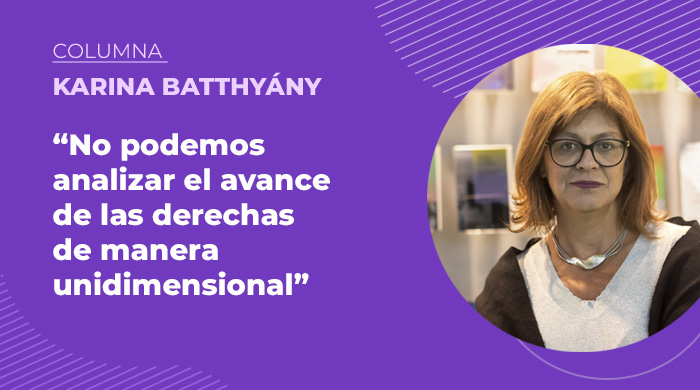
Transcript of Karina Batthyány's column
in InfoCLACSO – June 19, 2024
From across the ocean, there is news that worries us greatly. The results of the 2024 European Parliament elections show, generally speaking, a shift to the right in some countries like France and Germany.
At CLACSO, we have linked these far-right expressions to the phenomenon of democracy, specifically how democratic expression is manifesting itself in some European countries and in the Latin American region. Once again, we must bring to the forefront the analysis of inequalities and the search for change by some governments and political representatives for alternative solutions.
Inequalities create challenges to democratic systems, particularly in Latin America but also in Europe, with processes of political instability that give rise to authoritarian processes such as the desire to restrict freedom of expression, guaranteed access to justice for all, and restrictions on the various forms of social and political participation of individuals.
Likewise, in contexts of concern, it is necessary to analyze the expressions of violence in different dimensions associated with inequality, drug trafficking with its extreme forms of manifestation, and the violence generated by the police and repressive apparatuses in our countries, which attempt to contain social protests against profoundly unpopular measures.
An example of this violence is what happened in Argentina with the Senate's approval of the "Ley Bases" (Law of Basic Rights), and the brutal repression seen in the vicinity of the National Congress. Another important factor is the phenomenon of political polarization affecting our Latin American countries and the European context, as it poses a challenge to democratic systems.
In countries like Argentina and Uruguay, we find societies divided between those aligned with progressive movements and others aligned with conservative movements, where the central dispute is over the welfare model, that is, identifying and locating the main responsibility for generating that welfare and what the role of the State is.
If we position ourselves from the progressive side, we understand a decisive participation of the State in terms of the concrete responsibility of providing well-being for everyone in education, work, health, social security, among other pillars that have been added recently such as the link in social protection and the issue of care.
If we move from the progressive to the conservative axis, the approach is typical of neoliberal models: the reduction of the state to its bare minimum in terms of ensuring the well-being of all citizens. Furthermore, we consistently observe contradictions, ambivalence, and crossroads in the advancement of democratic processes, and more specifically, in the advancement of progressive movements worldwide.
2024 is a major election year, with more than half the world's population voting—that is, making decisions about elections and government renewal. It's important to see how the population in different countries positions itself based on these electoral expressions observed in various regions.
– More than 60 countries will hold national elections, which is a very large number and significantly alters the political landscape. How much do you think certain situations of inflation and economic crisis worldwide are related to people's anger and political change? Or do you think societies are becoming more conservative in some parts of the world?
– We can never analyze these phenomena in a one-dimensional way. The two elements you mention are important. Undoubtedly, the global economic crisis is shaping these electoral movements we're observing. Inflationary processes, in some cases like Argentina's, are scandalous. In other countries, inflation is more moderate, but it's still eroding people's income to meet their basic daily needs. There are also the more geopolitical disputes, which are shaping the main global trends—namely, the rivalry between China and the United States and the decline of the current dominant American model.
There are two other recurring dimensions: first, the rejection of foreigners, of migration—in short, xenophobia. Whether associated with a more conservative or more progressive ideology, this view of the other, of the foreigner, the stranger, the one who “takes away my opportunities,” who threatens my security and my income, always appears as a constant theme. Second, conservative movements establish feminism as a common enemy, particularly the advancement of women's and LGBTQ+ rights, as the core of their far-right arguments.
– One of the major rallying cries of the far right is antifeminism, opposing women's movements and their legislative advances. How do you currently analyze feminism in relation to the advance of antifeminist politics and a certain retreat in some parts of the world, especially in Argentina?
– Antifeminism is a common element of these conservative movements, which reject advances in the area of women's and LGBTQ+ rights. And this isn't merely argumentative; it's also verifiable: we have concrete data from countries in Latin America and the Caribbean where these antifeminist ideologies and expressions are in power.
In El Salvador, very specific measures are being taken to curtail existing rights, for example, those related to violence against women's bodies and those associated with Voluntary Interruption of Pregnancy (VIP). In El Salvador, we see concrete examples of increased penalties and criminalization. And in Argentina, we see the closure of the Ministry of Women and Gender Equality and the elimination of programs run by secretariats focused on preventing gender-based violence.
So, these aren't simply arguments or rhetorical elements of these antifeminist movements; they translate into very concrete measures, such as cuts in the recognition of unpaid work in terms of social security for women. In the case of Argentina, if some of the proposed measures are approved, many Argentinian women who would currently be entitled to a pension or retirement benefit would lose it in the future, precisely because of the elimination of recognition for the unpaid work that women perform, all that is related to caregiving.
We must ask ourselves: How do we confront all these challenges in terms of defending acquired rights against extreme expressions? This relates to everything we are promoting at CLACSO in terms of broad social dialogues, incorporating knowledge generation about these phenomena, but in dialogue with social movements and organizations, as well as with those in the field of public policy.
That is a strategy we want to reinforce in this context to discuss concrete measures that can strengthen democratic processes in our region, because I am convinced that when democratic processes are strengthened, these extreme expressions have no place.
Strengthening democratic processes involves addressing inequality, promoting civic education—that is, the concrete construction of citizenship in our countries—and working to protect all human rights without exception for everyone, such as freedom of expression, freedom of assembly, the right to vote, and the right to social and political participation. It also entails strengthening the institutions that make up democratic systems and are associated with the legislative, judicial, and executive branches.
– At CLACSO, we've created the Library of Women, Gender, and Diversity. Given the importance of women in shaping academia, social movements, and public policy decision-makers, we've established a space to safeguard collective memories and fundamental works for understanding the dimensions of inequality, right?
– Yes, absolutely. This knowledge and experience cannot be erased by decree. That's why, in March, CLACSO decided to make all the materials, experiences, and outputs of what was the Ministry of Women, Gender, and Diversity in Argentina available on our website. With access to these materials, we can continue to develop forward-looking alternatives and proposals.
If you would like to receive more information about CLACSO's training programs:
[widget id=”custom_html-57″]
to our email lists.

