
"We don't pay enough attention to cultural fissures."
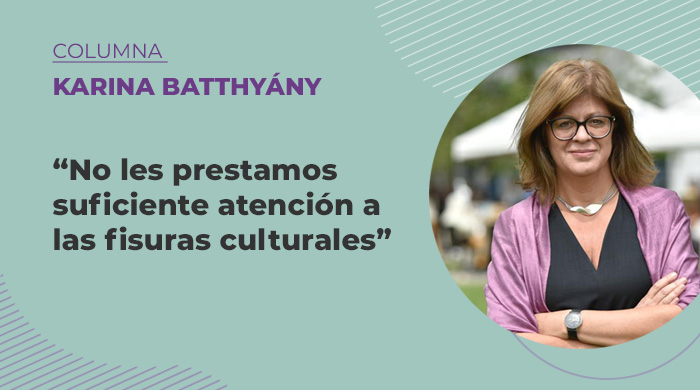
Transcript of Karina Batthyány's column
in InfoCLACSO – April 3, 2024
First, I want to emphasize that we have been working on the issue of right-wing movements sequentially through a series of activities that began last year within the framework of what we call 40-50-50: the 40th anniversary of the return to democracy here in Argentina and the 50th anniversary of the coups in Uruguay and Chile. Speaking of these issues today means introducing what is happening at the level of right-wing expression, especially the relationship between the right wing and the new right wing and democracy in Latin America.
In the series "The Rise of the Right in the World," we focused primarily on the Southern Cone, but we know this is a phenomenon throughout Latin America and the world, as we find these expressions in other regions as well. Why do this? Because it's an issue that concerns and engages us. It's also a central focus of our Platforms for Social Dialogue, which connect knowledge production with public policy and social movements and organizations. Moreover, we held this event here at CLACSO, during the week of March 24th, with all that this date implies in relation to democracy, human rights, and "Never Again," in terms of memory, truth, and justice.
These topics, which might seem to follow separate paths, are actually all interconnected. I'd like to begin with a reflection related to democracies. Those of us who have dedicated ourselves to the social sciences for many years experienced a significant moment in Latin America, and especially in South America, when there was talk of democratic recovery. I'm referring, of course, to the periods following the civilian and military coups in our countries.
I remember studying sociology at that time, or in the early stages of Uruguay's return to democracy, and this was a central theme of reflection. It was about what democracy entails, having recovered it and strengthening it daily, in the various spheres and dimensions we refer to when we talk about democracy. Years later, we perhaps thought it was a settled issue, at least in terms of analysis, study, and research, because democracies had been restored in our region, in most countries. So, it didn't seem to be on the agenda.
However, we were surprised or challenged once again to place this issue not just as another topic, but as a central concern for everyone, but particularly for those of us in the social sciences. This is largely due to the emergence of these right-wing movements, new right-wing movements, or far-right movements that are challenging democratic gains we believed to be irreversible.
What we see in some countries, like Spain with Vox, France with Marine Le Pen, or, I could cite Donald Trump in the United States and Javier Milei in Argentina, is a risk to democratic systems. I believe that, while in principle it operates within a democratic framework, there is a risk in terms of what we used to call democratic consolidation, and secondly, and primarily, in terms of human rights, the rights of everyone.
Because beyond democratic rules, what is being called into question are the rights of the various groups being attacked. This is no longer a projection of what might happen, for example, if we look at the Argentine case, but a reality. Certain rights have been curtailed, eliminated, and undermined in this short time, in the little over 100 days that Javier Milei's government, for example, has been in power. This is a phenomenon that, even within the framework of liberal democracy, with all that this implies, has manifestations in practically every country in our region.
At the seminar the week of March 20th, our colleague from Transform! Europe, Marga Ferré, presented a map showing the evolution of right-wing political expressions, parties, and movements around the world. I, for my part, focused on Latin America. Today, the rights of everyone are under discussion, and there we have very concrete examples. We can consider the rights of people with disabilities in Argentina, where there has been a significant reduction, with layoffs at the National Disability Agency, or what has happened with the National Institute Against Discrimination (INADI).
Let's think, more generally, about everything that has happened in terms of rights related to gender, women, and gender minorities. I think the most symbolic thing is the prohibition of inclusive language, the prohibition of a gender perspective, as if that could be prohibited by decree. As a corollary to all of this, there's the elimination in Congress of the former Women's Hall, now called the Hall of Heroes. I think that's a telling indicator.
Furthermore, there are some very specific dangers that I think we need to consider, linked to this threat from right-wing governments. The primary goals of these right-wing governments are to weaken and, if possible, eliminate the foundations of the welfare state. It's curious that in Argentina, which, along with Uruguay, is one of the two countries in Latin America and the Caribbean that have developed something resembling a welfare state, there is an emphasis on cutting public services, particularly social services. I'm talking about things as basic as education, healthcare, and social security.
This has a direct impact on everyone's living conditions, which is even more serious for the most vulnerable sectors. But it affects us all in our daily lives. Furthermore, there is a concrete setback in the field of Human Rights with the conservative positions taken by these new right-wing movements on all social issues, with particular emphasis on gender and feminism. I believe we face specific dangers there, even within the democratic system.
Within the context of these ongoing transformations, there appear to be very angry societies in some countries that do not see satisfactory answers to their problems within the framework of liberal democracies. And so, they tend towards far-right sectors that restrict rights and, in some cases, even vote against their own interests…
Regarding what you're referring to—this attack on or going against the foundations of that system of individual and collective well-being—there are some elements that I think are important. The first is inequality. We can't forget that we're analyzing all of this in a context and in a region where inequality is a historical structural characteristic, but also one that has deepened in recent years. Let's remember that Latin America in general had been going through a period of narrowing inequality gaps, but from 2015/2016 onward, depending on the data we use as a reference, they widened again. And the pandemic only served to widen that inequality gap. So, there's a first element to consider.
The second point relates to the discontent you mentioned, which is mostly linked to economic crises. Situations of economic constraint and lack of growth create fertile ground for seeking alternatives to this inequality and economic crisis.
I believe there's a third element related to security. It's astonishing how, in all our countries, this issue of security, whether real or imagined, ranks among people's top concerns. I'm referring to situations of violence, crime, public insecurity, and, of course, situations associated with drug trafficking. Perhaps, if we trace these security problems, they were present before the pandemic, but from my perspective, they've been exacerbated by it.
Another security-related factor is health insecurity, which put lives at risk. All the rhetoric we remember from the pandemic era led, in many cases, to our acceptance of incredible levels of control over our lives, our movements, and our daily behaviors. Perhaps this also created fertile ground for this type of behavior, this idea of the need to securitize social relationships and life in society.
It's no coincidence that these right-wing movements generally come to power with rhetoric about a hardline approach, crime control, the possibility of existence, and standards that allow for the free movement of everyone. The famous quest for order. I think these elements can help us understand this.
And also something we've been saying for a while now: the discontent with the political class, as it's called here in Argentina, the famous "caste," the political establishment in different countries. Here I think it was very clear. The need for something different arises, even if that "different" sounds terrible.
It has to do with that general discontent with the political class, and notice that I say with the political class and not necessarily with political parties. I like to make that distinction because political parties are essential for democratic life. Without political parties, democratic life is not possible, at least not in the forms of democratic organization we have.
The last point I want to mention concerns cultural conservatism, that is, the return of some very conservative discourses in cultural terms. I recall some discussions and exchanges we've had here related to what I like to call the fissures in the cultural order. In many cases, they've ceased to be fissures and are perhaps cracks, as they say here in Argentina. But these fissures in the cultural order, to which we probably haven't paid enough attention due to the economic crisis, the health crisis, and some political events.
When I say we don't pay enough attention to them, I'm referring to social scientists. We became somewhat negligent when we saw these fissures emerging. And that's where these tremendously conservative discourses, which we also thought were a thing of the past in the social sphere, begin to appear. Again, the prime example of this expression of conservatism is everything related to gender relations, that invented concept of gender ideology, which is nothing more than an expression of this cultural conservatism.
I believe that rampant antifeminism is a regrettable characteristic shared by all these right-wing expressions. They focus their cultural battle on this because they feel threatened by the advancement of women's rights and the rights of LGBTQ+ people in our countries. They perceive threats to the symbolic and power positions they have always held, due to the progress made by women and feminist movements. There are very clear examples of this: the fight against inclusive language that I mentioned, or this idea that it's time for women to return to their traditional roles, to the home, to taking care of their children, domestic life, and little else. That's what we're analyzing today, to understand, but above all, to build alternatives.
The major concern arising from the rise of these new right-wing movements is what the checks and balances are. For example, in Argentina, many people in ministries have just learned they've been laid off, and the question arises of how these institutions will function without them. It seems all too easy to destroy things that took so long to build and are so fundamental to democratic life. What do you think are the checks and balances on these situations?
These examples you're giving are nothing more and nothing less than the central tenet of these right-wing governments' proposals: shrinking the state to its bare minimum based on the belief that the market regulates everything. We see that it doesn't. For example, yesterday I was attacked by mosquitoes, and there's practically no way to buy repellent in Argentina. The country is experiencing a dengue crisis unlike anything ever seen before in its history. So where is the market? I'm giving this example to show how that absurd argument falls apart.
But getting back to your question, I think there are two key elements. First, we must try to strengthen, as much as possible, the various institutions of democracy and their independent functioning: the Executive, the Legislative, and the Judicial branches. This is the foundation of the democratic system, and the independence of these three branches is fundamental. For example, we cannot allow governance by decree, overriding the Legislative and Judicial branches.
The second point, which I believe is even more important within the framework of functioning democratic institutions, is the strengthening of spaces associated with citizen oversight—that is, the real exercise of citizenship by everyone. Citizenship is an essential component of democracy. This implies civil society, social organizations, and organized social movements with agendas, working to monitor what is done by the various branches of government. And denouncing wrongdoing when necessary, as we are doing here in Argentina, working alongside our member centers, organizing, discussing, and proposing alternatives for this very complex moment.
If you would like to receive more information about CLACSO's training programs:
[widget id=”custom_html-57″]
to our email lists.

