
"We need a comprehensive view of where the post-pandemic development model is coming from."
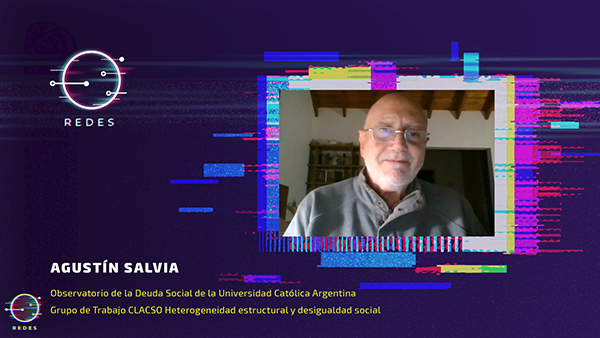
Within the framework of the Cycle of virtual conversations on Social Security and Pension System organized by CLACSO, Friedrich Ebert Foundation, IADE and the CLACSO Working Group on Social Security and Pension Systems, CLACSOTV interviewed Agustín Salvia, from the Social Debt Observatory of the Catholic University of Argentina and co-coordinator of the CLACSO Working Group on Structural Heterogeneity and Social Inequality.
Interviewed by Gustavo Lema
According to Salvia, “Latin America is a continent plagued by inequality and poverty, despite the progress that occurred in general terms during the first decade of the 21st century; and the second decade was a decade of setbacks, losses, and significant deterioration in the progress that had been achieved. It has always been a region with many structural inequalities that are expressed in terms of income poverty and deprivation, but which also translate into substantive aspects of daily life, in education, the quality of education, how educational systems, health systems, and employment systems are divided or fragmented and segmented. How production systems turn out to be the strongly heterogeneous system that gives different qualities of employment, different protection systems and social security. While it is true that Latin America has been progressing in this regard, it is also true that Argentina experienced severe crises during the last 30 years, which tended to lead to a setback. And the last period, to get closer to the stage of the last 3 or 4 years, with a forecast of very low growth for Latin America, with an increase in poverty, even inequality, Argentina was not outside of that context in the global context, but also from its own policies that generated failures in terms of growth and a deterioration in terms of stagnation, inflation, which left us with very high levels of poverty. Let's calculate that, according to the National Institute of Statistics, the last quarter of 2019 ended with 38,4% of people living in poverty in Argentina. Perhaps it is not a comparable measure with other Latin American countries, but it means that when the government of Mauricio Macri, the last government, came in, we had 29 or 30% poverty and we already reached that 38,4 at the last moment of the political period. In that context came Covid-19, the coronavirus, with an effect in health terms that initially were not so important in terms of the initial virulence of what was happening in Europe or Asia, but the quarantine policy put a more or less generalized limit in Latin America, with different nuances, it put a limit, a barrier of containment to the advance of this pandemic, generating conditions of isolation and protection of the populations sometimes not the most vulnerable, sometimes they were. But basically, through isolation, a relatively primitive tool, forced and mandatory isolation would place us in a situation of protection against contamination, against the spread of the disease. It was not a corrective measure, it was not a superior measure, it was a protective measure, and therefore the disease progressed. And along with the disease, the economic crisis also advanced. From economies sometimes with more resources and sometimes with less, but with limited resources in any case for underdeveloped countries, with very few possibilities of intervening when one stops the economy, of giving containment to the informal sectors, to those who were already poor. They weren't poor because they didn't work or didn't receive enough income through social programs—because in Argentina, 30% of the population currently has a social assistance or social protection program—but because when you stop the economy in these segmented and fragmented economies, it produces a profound deterioration. In the first instance, from the informal sector, from those who have odd jobs or day-to-day activities, based on interactions in public space, generating goods and services for the popular sectors in informal markets. In response to this shock, the Argentine government, like other Latin American countries, implemented assistance policies.
Later, Agustín Salvia proposed: “We need to be a sustainable society, and with more poverty and more inequality, it won't be, neither for the ruling and business classes nor for the poorest and most vulnerable sectors. We will require a civilizational agreement in terms of taking a step forward. The post-pandemic era opens up that opportunity. This doesn't mean it's guaranteed; for that, we need projects with a medium- and long-term vision and leaders and social and political organizations capable of understanding the complexity, not just the small role assigned to each of us. Undoubtedly, we have all become poorer in this context; we have all been victims, but we must have a comprehensive view of where the post-pandemic development model for Latin America is headed. This needs to be debated and must begin to guide us in organizing not only political actions but also the construction of state policies around alternative strategies.”
If you would like to receive more information about CLACSO's training programs:
[widget id=”custom_html-57″]
to our email lists.

