
"We need policies to promote access to public higher education"
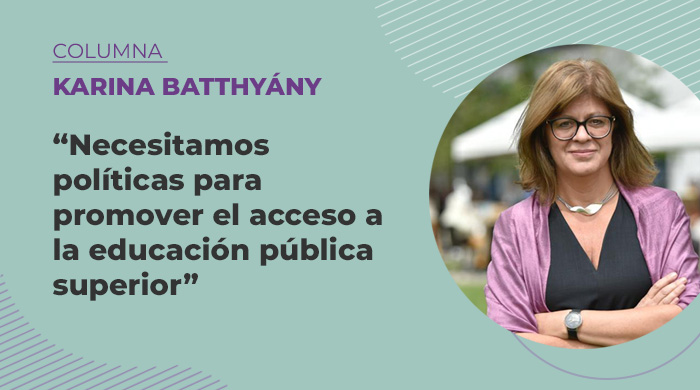
Transcript of Karina Batthyány's column
in InfoCLACSO – September 18, 2024
Today I want to systematically address the topic of Higher Education, Public Universities, and their current challenges, as we are going through a particular juncture in our region marked by crossroads of various political, social, and economic phenomena. Therefore, it is essential to deepen our critical reflection on public university higher education, its scope, limitations, and challenges at both the national and regional levels, starting from the premise of defending it as a human right.
The 2018 Regional Conference on Higher Education (CRES) made this point very clearly: access to, use of, and democratization of knowledge as a social, collective, and strategic good are fundamental to guaranteeing basic human rights. Furthermore, why limit this human right to only certain levels, such as primary and secondary education, without including university education?
The 2018 CRES also stated that education, science, technology, and the arts must be a means to freedom and equality without distinction based on social status, gender, ethnicity, religion, or age. Education is not a commodity. And the CRES affirmed: “We urge nation-states not to sign bilateral or multilateral free trade agreements that treat education as a for-profit service or encourage forms of commodification at any level of the education system.”
Since the 80s, in our Latin American and Caribbean region, higher education has been subject to a growing process of commodification at both the local and international levels. Even in countries with a strong tradition of public, free, and secular universities, the sustainable financing of higher education has yet to be discussed, and it remains part of a niche market or private business outside of public funding planning.
Therefore, we must insist on recognizing higher education as a public and social good and a human right. However, there are currently difficulties in its implementation by states, as well as in the effective ability of all citizens to exercise this right in their daily lives.
In turn, we observe financial and economic adversities in the countries of the region, which call into question the human right to public higher education with a structural characteristic, in terms of inequality, in the insufficient investment in educational systems and quality training.
Higher education as a human right connects with the broader issue of the right to lifelong learning. At this point, there are some important dilemmas within the framework of public higher education that remain to be resolved in our region, such as concrete policies to promote equitable access to it.
There are three key elements to consider regarding the functioning of these economies. The first is that Latin America is one of the most unequal regions in the world in terms of income and wealth. The expansion of demand for higher education is driven by secondary school graduates from low-income households. Consequently, they cannot access private education, and given the insufficient supply of public higher education, their aspirations to continue their studies at the university level are thwarted. In several Latin American countries, the expansion of higher education placements is occurring more in the private sector than in the public sector.
Secondly, we have the issue of gender in the university system and gender equality in higher education. In recent years, within Latin American and Caribbean university structures, we have seen the emergence of feminist programs, groups, and studies. Furthermore, we have observed significant growth in terms of academic departments, institutes, and teams that have broadened research agendas and renewed methodological perspectives in this area. This does not mean that gender inequalities within public universities have been overcome, but rather that they have gained greater visibility and now challenge the processes of knowledge production and dissemination, as well as the institutional structures and configurations regarding faculty careers and participation in decision-making spaces within universities.
Finally, there is the question of the role of open science in the production and dissemination of knowledge, and how it is evaluated in decisions regarding the structure of teaching, research, and university spaces. At the Latin American Forum on Scientific Evaluation (FOLEC), we are working to promote alternatives in the evaluation and dissemination of knowledge, as well as in research production, that also consider the inequalities associated with access within university structures. We recognize the need to advance regional agreements and institutional commitments at the national and regional levels to ensure access to knowledge without any barriers, that research results are available to everyone, and to modify how knowledge and individual and collective research trajectories are evaluated.
In this sense, what is currently being contested at the regional level is the conception of knowledge as a public good, with open access policies and the promotion of an academic and political discourse that considers knowledge production and its applications as part of the social capital for the emancipation of our countries. In other words, what is at stake is how we value scientific knowledge and how, based on these issues, we can build more equitable and democratic systems. These debates contribute to designing educational models that not only update the relationship between research, teaching, and outreach within a framework of regional cooperation open to non-university communities, but also incorporate other forms of knowledge to generate more enriching dialogues within the higher education system in general and universities in particular.
At the regional level, we are attentive to the processes of political instability in several countries that directly threaten the development of knowledge in universities and research institutions, whether through budget restrictions or restrictions on academic and intellectual freedom.
Ultimately, education at all levels must become a right for everyone. CLACSO is a forum for critical voices that collaboratively builds alternatives to place the discussion of public higher education as a human right at the forefront in Latin America and the Caribbean, and to further promote democracy, solidarity, interdependence, critical thinking, and transformative thought. At our #CLACSO2025 Conference in Colombia, we will continue an initiative we began in Mexico at #CLACSO2022 within the framework of the Rectors' Forum, to discuss the challenges currently facing Latin American and Caribbean universities.
– Following your line of thought, I think it's difficult to see countries changing their policies related to public universities in response to changes in government periods, rather than through long-term state policies, particularly in terms of university funding…
Unfortunately, we are used to these ups and downs in our region, which call into question the progress in the conception of higher education as a right and a public good, beyond the specific wills of the governments in power in our Latin American countries.
Furthermore, in many cases, public universities are targeted by certain ideological sectors at the regional and global levels, which seek to transform higher education into a commodity rather than a right, cutting back and minimizing the existence of these institutions. At CLACSO, we will always stand in defense of public universities as a central element, among other things, for strengthening democracy and building citizenship in our countries.
If you would like to receive more information about CLACSO's training programs:
[widget id=”custom_html-57″]
to our email lists.

