
Ñande reko or experiences of “good living” in rural women's, indigenous and youth organizations in Paraguay
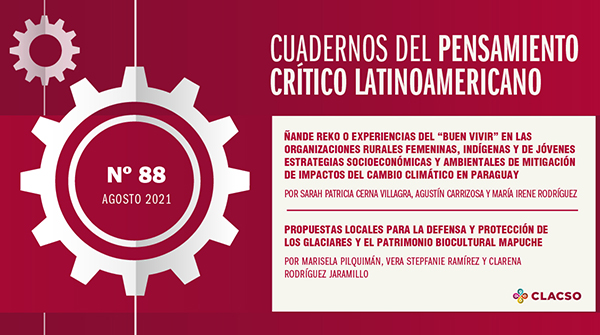
Within the "Latin American Critical Thought Notebooks" Collection, CLACSO presents "Ñande reko or experiences of 'good living' in rural women's, indigenous, and youth organizations. Socioeconomic and environmental strategies for mitigating the impacts of climate change in Paraguay," by Sarah Patricia Cerna Villagra, Agustín Carrizosa, and María Irene Rodríguez. And "Local proposals for the defense and protection of glaciers and Mapuche biocultural heritage," by Marisela Pilquimán, Vera Stepfanie Ramírez, and Clarena Rodríguez Jaramillo.
Ñande reko or experiences of “good living” in rural women's, indigenous and youth organizations
Socioeconomic and environmental strategies for mitigating the impacts of climate change in Paraguay
Sarah Patricia Cerna Villagra*
Agustín Carrizosa**
María Irene Rodríguez***
Presentation
This research is being conducted with the following objectives: 1) to gather perceptions from participants in rural areas of Paraguay regarding the vulnerability of their communities to the effects of climate change; 2) to identify measures being implemented to adapt to the negative impacts of this phenomenon; and 3) to identify experiences of socioeconomic and environmental sustainability within their organizations. Additionally, given that this research project is taking place within the context of the COVID-19 pandemic, information was also collected on the socioeconomic implications of the pandemic for the organizations and communities interviewed.
The participants in the study are primarily rural women who identify themselves as peasant women, Indigenous women, or both. Of the 26 participants, 17 are women and 9 are men. The research was also expanded to include men, women, and young people who are part of the organizations in which these women leaders participate and who interact directly with them in productive activities and community support. Together with members of these organizations, they carry out climate change-related initiatives in their communities and define women as central actors in the development of climate change adaptation and mitigation measures.
The participants belong to six community-based organizations that produce agricultural goods for sale and self-consumption, provide training and capacity building in agroecological practices, and develop support measures for their communities. Representatives from three Indigenous communities that practice production for self-consumption and sale were also interviewed. The methodological approach used for data collection was qualitative. It was based on semi-structured interviews designed to gather information on the following thematic areas:
• The perception of the participants regarding vulnerability to climate change, its impact on the community and on their productive activities.
• Relationship between gender roles and vulnerability to climate change.
• Identify the social and productive measures that participants implement to cope with events related to climate change.
• Identification of the social and political work that rural women carry out from community organizations or independently.
• Additionally, perceptions were collected regarding the negative impact generated by COVID-19 and on the measures implemented by the participants to deal with it.
• Perception of local needs in relation to the impacts of climate change and COVID-19.
Political analysis
In Paraguay, the predominance of the agro-export agricultural model generates significant economic gains for Paraguayan and foreign business sectors that own large estates and cultivate monocultures of grains (using imported seeds), and whose relationships with the political elite are long-standing. This hegemonic model of export-oriented agriculture, sustained by political and socioeconomic structures, runs counter to the agroecological approach implemented by various rural organizations. Despite the obstacles they face, these organizations continue to mobilize all available resources to implement their productive projects, some of which are ecofeminist.
This study highlights how the social, educational, and agricultural initiatives of these Indigenous organizations and communities incorporate the principles of agroecology. Economically, these initiatives focus on creating local support networks that foster and promote the production and marketing of products from farming families, strengthening local markets to develop community autonomy. Environmentally, they are based on food production through the responsible use and protection of present and future natural resources, without dependence on synthetic substances and inputs. Politically, they advocate for the visibility and legitimization of the worldview of rural communities, redefining power relations regarding the use and management of productive knowledge and natural resources. Socially, they strengthen community identity and promote solidarity and the formation of community networks, incorporating into their social dynamics the appreciation and transmission of traditional farming and Indigenous practices. Essentially, this paradigm challenges the hegemonic model on multiple levels, which is why the resistance of these Indigenous organizations and communities is meaningful.
Regarding the impact of climate change on communities, their productive activities are affected by increased droughts, high temperatures, and the difficulty in predicting seasonal climate variations, which are necessary to identify for certain types of crops. Additionally, precarious housing is harmed by increased winds, storms, and floods, which, in the worst cases, forces the relocation of entire communities.
Climate change has distinct consequences for men and women, as women face double and triple workloads because they juggle household chores with productive tasks for family consumption, small-scale sales to generate additional income, and community activities. Therefore, in the face of climate events, women lose opportunities to generate income for their households and ensure their families' food security. Meanwhile, adult and young men are forced to migrate to other areas in search of profitable alternatives that allow them to generate additional income to help their families, leaving women—primarily mothers, grandmothers, sisters, and/or daughters—responsible for the care of young children.
Despite the aforementioned difficulties, these Indigenous organizations and communities demonstrate a significant capacity for agency among their members to mitigate the impact of climate change and maintain a certain level of food security during the pandemic. These measures are the result of a combination of ancestral knowledge, traditional agricultural practices, and agroecological approaches, as well as ecofeminism, which have been embodied in sustainable economic, social, and environmental projects and initiatives. However, the viability of these projects is limited by restricted access to financial resources and, in turn, faces institutional obstacles because historically, state management has promoted the export-oriented agribusiness model to the detriment of small-scale, family-based farming. This explains the limited state support in rural communities through programs and subsidies for farmers with sustainable agroecological projects and fewer resources.
Finally, an important theme highlighted in this research is the generation of networks and the maintenance of solidarity among the communities and members of the interviewed organizations, where women and young people play a leading role. This sense of belonging to a social organization and the solidarity they generate and sustain over time are the pillars that enable the coordination of locally managed initiatives to address the impacts of climate change and the COVID-19 pandemic.
Guidelines
Recommendations for public policies on climate change identified in the consultation process, taking into account a gender, youth and intercultural perspective.
1. To strengthen and promote the leadership of women, youth, and Indigenous representatives through participatory processes for the development of policies, plans, and projects, with a local and national perspective. To achieve this, it is necessary to:
• Technical training and awareness-raising on climate change, adaptation and management of climate events, as well as measures to reduce Greenhouse Gas (GHG) emissions in rural communities;
• Training on political participation issues aimed at women, youth and indigenous peoples, accompanied by spaces for reflection that include, among the discussions, issues related to climate change and its local impacts;
• Implementation of initiatives that promote the work and coordination of organizations led by women, youth and indigenous peoples, who make up the most vulnerable links in the national agricultural sector;
• Creation of projects coordinated by the Paraguayan State, designed from a gender and intercultural perspective, that consider the different gaps and needs between men and women in rural areas, seeking to reverse them and, in turn, promote respectful dialogue with Indigenous peoples, without adopting a paternalistic or welfare-based approach. • Incorporation, by the government, of the worldview of “good living” (buen vivir) of rural communities and Indigenous peoples into the process of developing national measures to address climate change. This worldview of “good living” is ancestral and reflects the perspective of Indigenous communities before and after the Spanish conquest.
2. Strengthen the capacity of women, youth, and indigenous communities to cope with the present and future impacts of climate change that affect their food production for self-consumption and sale. This requires:
• Provide greater technical and agricultural support from the government, incorporating alternatives that protect, strengthen and promote traditional and ancestral practices used by women, youth and indigenous peoples, such as agroecology;
• Incorporate the use of a scientific and technological perspective in accordance with the traditional productive model of “good living” and agroecology;
• Increase the reach of government support programs for peasant and indigenous communities facing crop losses as a result of the impacts of climate change;
• Promote and strengthen those education programs for young people that include topics of sustainable agricultural production, which facilitate income generation and strengthen their food security;
• Provide support for the acquisition and use of available technologies to strengthen water harvesting and irrigation systems for agricultural production, since the most important impacts are related to water stress;
• Generate alternative access to credit and agricultural insurance for peasant and indigenous production, taking into account a gender and intercultural perspective;
• Support small-scale agricultural sectors for the transport, placement and sale of their products in local markets; • Generate inclusive mechanisms that facilitate access to certification on agroecological production, so that family farmers can market their products in formal markets.
* PhD in Political and Social Sciences from the National Autonomous University of Mexico. Master's degree in Political Science from the University of Salamanca. Specialized in Gender Studies by CLACSO. Associate Researcher categorized at Level 2 of the CONACYT PRONII program. University professor and researcher. Member of the Paraguayan research team that received a CLACSO grant within the framework of the "Environment, Climate Change and Good Living in Latin America and the Caribbean" competition.
Master 's degree in Climate Change from the Australian National University. Bachelor's degree in Business Administration from the National University of Our Lady of the Assumption. Specialist in international climate change agenda issues from the College of Engineers of Peru and the Green Fund. Member of the Paraguayan research team that received a CLACSO grant within the framework of the "Environment, Climate Change and Good Living in Latin America and the Caribbean" competition.
* ** Holds a degree in Social Work from the National University of Asunción (Paraguay), with a Master's degree in Social Sciences from the Latin American Faculty of Social Sciences. Project Coordinator at Seeds for Democracy. Professor in the Social Work program at the Faculty of Social Sciences of the National University of Asunción. Member of the Paraguayan research team that received a CLACSO grant as part of the "Environment, Climate Change and Good Living in Latin America and the Caribbean" competition.
Local proposals for the defense and protection of glaciers and Mapuche biocultural heritage
Marisela Pilquimán*
Vera Stepfanie Ramirez***
Clarena Rodríguez Jaramillo***
Presentation
The survival of glaciers is under threat. The rise in global temperatures is compounded by the pressure from extractive industries, mass tourism, and the commodification of life fostered by a neoliberal economic model that has promoted the unlimited exploitation of natural resources, causing irreversible losses of cultures, biodiversity, and ecosystem services. While the Chilean state supports an approach ostensibly aimed at protecting glaciers, it de facto excludes other forms of knowledge and wisdom held by Indigenous peoples, who throughout their history have managed to relate to and adapt to these ecosystems. This is the case of the Mapuche people, in whose ancestral territory the Pichillancahue Glacier is located, in southern Chile. Inspired by the biocultural elements of interest associated with this glacier, a series of recommendations emerge from participatory action research that combines and reinterprets Mapuche knowledge and practices with scientific knowledge from Western society, which can guide the improvement of public policy in this area.
Analysis
Historically, indigenous peoples have witnessed the presence of glaciers and have established ways of relating to, adapting to, and conserving them; however, little is known about the meanings and importance they attribute to them as they are integrated into their ecosystems. In the case of the Mapuche people (“people of the land” in their language, Mapuzüngun), their knowledge and practices have contributed to shaping the territories they inhabit, territories that have ecosystemic value and cultural importance. However, the differences between this people's worldview and the Western vision of relating to nature that underpins the country's economic development model have led to the emergence of defense processes from within their territories. These processes seek not only the protection of their physical-biological ecosystems but also of their socio-cultural, economic, and spiritual practices, which are currently threatened not only by extractive activities but also by the political and administrative boundaries established by spaces such as national parks. These boundaries impede the development of ancestral activities of Mapuche communities and, in turn, define uses and services in favor of tourist interests without the community's due participation in establishing them.
This defense of their territory and way of life is supported by their claim to the right, as Indigenous peoples, to protect and manage their territories autonomously. However, this cannot be effectively exercised in all contexts, given that their demands clash with development projects, both state-run and private, supported by the dominant national society.
It is worth noting that Chile lacks specific legislation regarding glaciers. Therefore, they are subject to general or sectoral laws that regulate other matters and only tangentially address them, offering limited protection, with little citizen participation and a cumbersome regulatory framework that is difficult to implement in practice. Neither the Water Code nor the Mining Code makes any mention of glaciers; both legal frameworks were enacted during the Pinochet dictatorship in parallel with the implementation of the neoliberal economic model and have not been substantially modified since the return of democracy by subsequent governments that have maintained this model. Currently, a bill for the protection of glaciers is being processed, but it has faced strong opposition from the productive sector, primarily the state-owned and private mining industry. An examination of the bill reveals no reference to Indigenous peoples, nor have Indigenous organizations participated among those presenting their arguments before the Environment Committee and the Energy and Mines Committee regarding this bill. This notable omission reflects the invisibility of Indigenous knowledge and biocultural heritage within the dominant regulatory system.
This situation, therefore, highlights the need to refocus the debate on finding management alternatives that integrate the vision of living beings—nature, knowledge, and practices—as well as the resilient potential of Indigenous peoples, to provide local responses to the new scenarios posed by climate change and local and national agendas. The challenge, then, is to generate relevant information that makes visible the knowledge of these peoples for the protection of glacial ecosystems.
Recommendations
It is necessary to clarify that the optimal context for implementing the proposals presented below would be, firstly, constitutional recognition of Indigenous peoples in Chile, which would expand the administrative, legal, and representational resources available for addressing their demands. Secondly, it would require a shift in the development model, moving from the current approach focused on expansion, accumulation, and commodification of life to one that respects the diverse ways of being, existing, and acting present in their territories. However, progress in implementing these recommendations would not depend on changes to these two aspects.
The recommendations presented follow the biocultural approach and are configured from the areas and objectives of work identified during the research as basic and complementary for the protection of the glacier and other ecosystems.

- Co-design and co-implement strategies for the conservation and management of biocultural heritage, incorporating the perspective of indigenous peoples. Current models of protection and conservation have maintained a purely scientific approach, excluding the perspectives of Indigenous peoples. The understanding these peoples possess regarding the interdependence of the physical, biological, and cultural elements present in each ecosystem provides significant knowledge that, in a respectful and horizontal dialogue with the scientific community, should lead to effective proposals for territorial reorganization and the safeguarding of territories to address climate change and other threats.
- Promote transdisciplinary/critical research processes in accordance with the logic and interests of indigenous peoples. Current research typically relies on the scientific paradigm as its foundation, relegating Indigenous peoples and their worldviews from analysis and proposed solutions and interventions. Today's conservation and protection challenges require moving beyond biased and static views of reality to foster more holistic perspectives that can overcome the obstacles of the dominant model. Recognizing that other ways of understanding territory exist reaffirms the crucial role Indigenous peoples have played for centuries in ecosystem conservation.
- To validate the protocols, sociocultural and spiritual practices proposed from the worldview of indigenous peoples for the protection of territories. Indigenous communities possess ancestral knowledge and practices for relating to ecosystems, managing and safeguarding the biocultural heritage present in their territories. Identifying and incorporating this knowledge into government management would generate comprehensive strategies to address the threats facing ecosystems and would contribute, in part, to easing some of the conflicts faced by communities demanding dignity and respect for their culture, practices, and territory.
- Promote dissemination and training strategies from a biocultural perspective, that allow officials, professionals/technicians, and communities in general to understand the approach and its implications for everyone's lives. The purpose of raising awareness about this issue at the citizen level is to highlight the responsibility that each stakeholder has, both within and outside the territory, for the care and protection of ecosystems and respect for the peoples who inhabit them.
- Recognize other alternative forms of economy generated from the territories, which seek to adapt to the proposals of good living of the indigenous peoples, showing that the economic dimension integrates productive, reproductive and exchange actions, under traditional sociocultural and spiritual logics, which go beyond the commodification of natural commons and life.
- Generate adjustments to the Chilean regulatory system, that considers the forms of productive and exchange activities specific to indigenous peoples and avoids the adoption of homogeneous models that make the Mapuche worldview invisible.
- Adopt the biocultural approach in public policies and management toolsRecognizing the interdependence that exists among the biological/physical, cultural, and spiritual elements within a single ecosystem, this perspective facilitates the development of comprehensive proposals and increases the visibility of Indigenous peoples and other inhabitants of the territory in analyses and alternatives for protection, management, and conservation.
- Implement co-management models with indigenous peoples for the administration and protection of biocultural heritage in protected natural areas and other territories, recognizing with this strategy the right of indigenous peoples to manage and protect their territories according to the logic of their own worldview.
- Promote the participation of indigenous peoples in the planning and management of territoriesThe real participation of communities in territorial planning and management processes would contribute to safeguarding biocultural heritage, making the ancestral knowledge and practices of indigenous peoples visible, as well as designing more relevant and situated actions.
- Strengthen the commitment of the Chilean State to comply with national and international regulations related to the protection of glaciers and biocultural heritageTo strictly comply, in good faith, with national regulations and the international agreements to which the State has committed itself. For example, Article 2 of the International Labour Organization's Convention 169 states that "Governments shall assume the responsibility for developing, with the participation of the peoples concerned, coordinated and systematic action with a view to protecting the rights of these peoples and ensuring respect for their integrity." This principle should, at the very least, guide Chilean law regarding the integration of indigenous peoples, but, in light of the facts, it is neither fulfilled in good faith nor completely. For these reasons, independent bodies (national or foreign) are also required to monitor the effective implementation of these regulations.
* PhD in Geography. Academic at the University of Los Lagos, Center for Regional Development Studies and Public Policies, CEDER, Osorno, Chile. Member of the Chilean research team that received a CLACSO grant within the framework of the competition “Environment, Climate Change and Good Living in Latin America and the Caribbean”.
* ** Bachelor of Science in Environmental Sciences. Candidate for a Master's degree in Human-Scale Development, Austral University of Chile. Researcher at the Manfred Max-Neef Foundation, Valdivia, Chile. Member of the Chilean research team that received a CLACSO grant within the framework of the "Environment, Climate Change and Good Living in Latin America and the Caribbean" competition.
* ** Bachelor's degree in Social Work, Master's candidate in Rural Development, Austral University of Chile. Professor at the Technological University of Chile, INACAP, Valdivia campus, Chile. Member of the Chilean research team that received a CLACSO grant within the framework of the "Environment, Climate Change and Good Living in Latin America and the Caribbean" competition.
If you would like to receive more information about CLACSO's training programs:
[widget id=”custom_html-57″]
to our email lists.

