
Multiculturalisms and transculturations: theoretical debates for understanding contemporary societies in Latin America
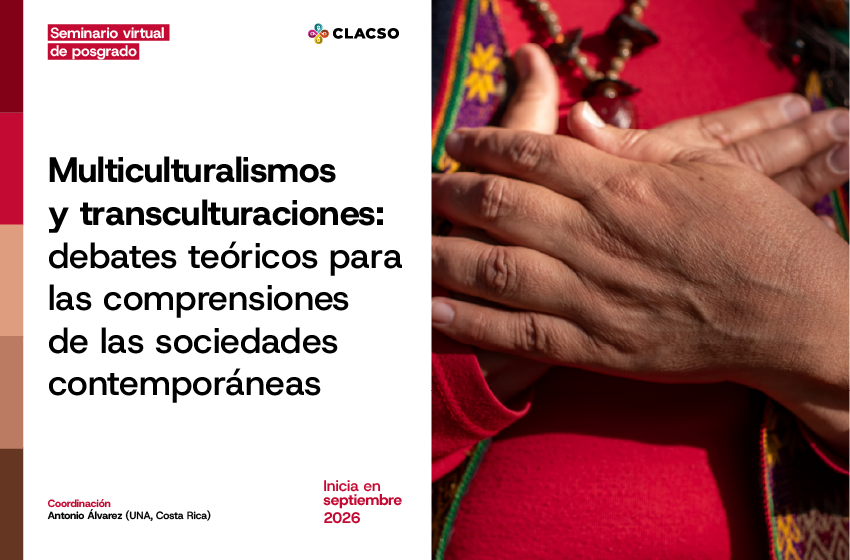
Seminar 2612
Coordination: Antonio Álvarez (UNA, Costa Rica)
Start date : 17/09/2026 | Registration : 5/06/2026 to 16/09/2026
Workload: 10 weeks – 90 hours.
Contemporary Latin America has been characterized by a series of significant historical events that have shaped its course as a geographical and cultural region of the world, from the end of World War II in 1945 to the present day. Undoubtedly, the continent was one thing then, and it is quite another now. In this sense, one of its main historical and cultural characteristics has been its broad and rich process of transculturation, manifested in diverse ways in the countries and regions that make up Latin America. Coined in 1940 by the anthropologist Fernando Ortiz, the term transculturation both synthesizes and explains the historical and artistic-literary development of many Latin American states. Since then, it has become one of the most important interpretive contributions that thinkers from the continent have made to the international social sciences. Today, these disciplines recognize this contribution, as well as its continued relevance and use.
The historical, theoretical, and methodological knowledge that the term implies and demands provides any researcher or social scientist dedicated to Latin American issues or to its specific national reality with an interpretive model of the continental context and of numerous national problems. Racism, slavery, minorities, artistic and literary culture, identities, and the processes of cultural mixing, among others, are part of the themes and problems that can be reflected upon from the perspective of transculturation.
In continental literature, transculturation has a prominent presence through its two most important aesthetics of the 20th century, namely, magical realism and marvelous realism.
Parallel to the intellectual and cultural rise of transculturation and with the beginning of the Second World War (1945), several political and cultural phenomena of international significance emerged. The Cold War, the process of decolonization in the Third World, and the 68 cultural movement were among a larger list. In this explosive global context, a new term arose in the cultural centers of the main Western societies—namely the United States, Canada, and England—associated with the new forms of social organization demanded by the era: multiculturalism.
Born during the 1960s, multiculturalism rose in the West and much of Latin America throughout the rest of the century as a new model of social organization and cultural interpretation. Many countries in the region progressively declared themselves multicultural states with diverse cultures. From our present in the 21st century, transculturation and multiculturalism are two terms laden with historical interpretations, cultural values, and political and ideological representations, which at times share national spaces; at others, they are contested by their proponents in pursuit of intellectual, political, and cultural dominance in the nation in question. For these reasons, the course begins with this mutual and complex existence, which becomes fundamental for doctoral students in order to acquire and deepen sociocultural knowledge and theoretical-methodological tools for their intellectual development and their interpretive capacities regarding contemporary Latin American societies, as well as their own, that is, Costa Rican society.
In turn, the course will offer students various cognitive opportunities derived from the aforementioned social phenomena and the thematic content proposed below. Furthermore, it aims to: -increase their knowledge of the historical, social, and cultural aspects of Latin America through its social sciences, art, and literature; -enhance their capacity for comparative analysis of certain Latin American social realities by examining the interplay between transculturation and multiculturalism; -finally, develop solid cognitive and interpretive skills to construct their critical thinking using the resources of cultural studies, cultural history, and both of these disciplines.
GENERAL PURPOSE:
To analyze comparatively, from the broad theoretical arsenal of continental social sciences, the history and contemporary societies of Latin America, the manifestations and representations of multiculturalism and transculturation as the main current interpretive models of their cultures, systems of social organization and nation-states.
SPECIFIC OBJECTIVES:
- To establish the theoretical and methodological foundations for the comparative analysis between multiculturalism and transculturation based on the origins, evolution and historical and philosophical horizon of modernity in relation to Latin America.
- To characterize the origins, general evolution and contemporary manifestations of multiculturalism and transculturation in Latin America from a current perspective.
- Compare the principles, scope, and sociocultural and political perspectives of multiculturalism and transculturation in Latin America through its history, its current societies, and some representative examples from art and literature.
- To determine, based on the counterpoint between multiculturalism and transculturation, the historical and social viability of both terms for the study and current understanding of Latin America and its different cultural realities.
- Modernity, culture and power in theoretical views in Latin American perspectives.
- Latin America, modernity and the cultural implications of colonization.
- Evaluation seminar. Modernity, colonization and cultural impacts in Latin America.
- Latin American transculturation: concepts and interpretive approaches.
- Transculturation and continental literature.
- Multiculturalism in Latin America.
- Multicultural societies in Latin America, between politics and historical reality.
- Transculturation and multiculturalism in comparative perspectives from music and the visual arts.
- Alvarez Pitaluga, Antonio (2022). The subjectivity of the historian. Brief notes on a past and present theme. History Journal No. 86, July - December, 2022 • pp. 1-27.
- Boaventura de Souza Santos (2022). Thesis on the decolonization of history. Argentina, CLACSO.
- Acanda, Jorge Luis. Civil society and hegemony. Cuba, Juan Marinello Institute of Cultural Research, 2001.
- Alvarez Pitaluga, Antonio (2021). Cultural perspectives on the history of Latin America: essays for a debate. Costa Rica, National University of Costa Rica- Panama, National University of Panama.
- Granda, Germán (1968). Transculturation and linguistic interference in contemporary Puerto Rico (1898-1968). Colombia, Bogotá, Instituto Caro y Cuervo.
- Ortiz, Fernando (1983) Ortiz, Fernando. Cuban Counterpoint of Tobacco and Sugar. Cuba, Havana, Social Sciences Publishing House. -
- Ortiz, Fernando (1906). Afro-Cuban Underworld. The Black Sorcerers. Spain, Madrid, Editorial-América.
- Ortiz, Fernando (1946). The Deception of Races. Cuba, Havana, Editorial Páginas.
- Álvarez Pitaluga, Antonio (2020). “Magical realism and marvelous realism: interpretive models for the cultural history of Latin America.” Revista Historia, no. 81, January - June, pp. 37-63.
- Estrach Mira, Núria (2001). “The mask of multiculturalism.” Scripta Nova Magazine. (Spain), University of Barcelona, no. 94 (104).
- Zapata Silvia, Claudia (2019). Crisis of multiculturalism in Latin America. Social conflict and critical responses from indigenous political thought. Costa Rica, Editorial UCR.
- García, Canclini, Néstor (1990). Hybrid Cultures. Strategies for Entering and Leaving Modernity. Mexico, Editorial Grijalbo.
- Rodríguez, Emilio J. (Sel. and prologue) (2012). Alejo Carpentier. Caribbean Chronicles. Cuba, Editorial Letras Cubanas.
- Martí, José (1891). “Our America.” United States, The New York Magazine (January 10, 1891).
| Early registration (until 10/08) | General registration (11/08 to 10/09) | Registration without discount (11/09 to 16/09) | |
| Full or Associate Member Center | $100 | USD 150 | $200 |
| No link | $150 | USD 225 | $300 |
FAQ
The basic requirements for taking a seminar are:
- Availability of at least 4 hours per week to dedicate to the seminar course.
- Internet access.
- Reasonable handling of communication and computer tools.
- Language proficiency in the language in which the course will be taught. The official languages are Spanish and Portuguese.
The seminars last 10 weeks, plus the completion of a final project. A total of 90 hours of dedication will be credited.
A course consists of ten classes, each accompanied by required reading bibliography, supplementary bibliography, discussion forums and training activities proposed by the teaching team, partial deliveries and a final project.
The course is online and asynchronous. Some instructors may propose synchronous activities. In those cases, the time and date will be agreed upon beforehand between the instructors and the students to ensure everyone's participation. Attendance at synchronous sessions is not mandatory.
To pass the seminar, you must participate in at least 80% of the discussion forums and activities proposed by the teachers, have completed the scheduled partial deliveries, and pass the final work.
| Early registration (until 10/08) | General registration (11/08 to 10/09) | Registration without discount (11/09 to 16/09) | |
| Full or Associate Member Center | $100 | USD 150 | $200 |
| No link | $150 | USD 225 | $300 |
The possible payment methods are by credit card or bank transfer.
Inquiries: [email protected]

