
Social movements and new paradigms
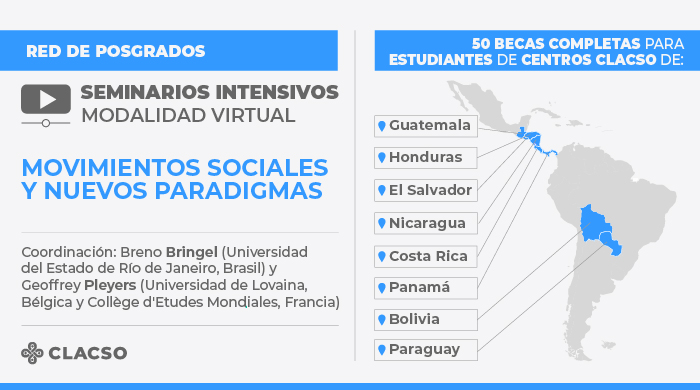
Intensive Virtual Seminar
Chair: CLACSO
COORDINATION: Breno Bringel (Rio de Janeiro State University, Brazil) and Geoffrey Pleyers (University of Leuven, Belgium and Collège d'Etudes Mondiales, France)
Teaching team: Maristella Svampa (National University of La Plata, Argentina) and Paolo Gerbaudo (King's College London, England)
Start date: 28/09 | Application period: 21/8 to 7/09
Duration: 4 weeks
Virtual Modality: 5 synchronous and 3 asynchronous meetings
Full scholarships – Intensive seminars
The Virtual Intensive Seminars These are intensive training proposals specifically aimed at students from CLACSO centers, which address diverse topics, putting a range of current issues on the agenda for debate in the region.
The first edition of the Virtual Intensive Seminars was conceived in coordination with representatives from the Centers in Central America, Bolivia and Paraguay.
CLACSO offers 200 full scholarships (50 per seminar) to students from CLACSO Member Centers in Paraguay, Bolivia, Honduras, Guatemala, El Salvador, Panama, Costa Rica and Nicaragua.
The scholarships cover 100% of the tuition cost.
Applications will be submitted through the CLACSO website.
Apply for a scholarship:
Enter here to complete the application form
The available scholarships will be awarded to students from CLACSO Member Centers after being evaluated by an academic committee
The call for applications will be available until September 7 2020.
RESULTS
Having concluded the evaluation process of the applications received within the framework of the Call for 200 scholarships for Intensive Virtual Seminars – aimed at CLACSO Member Centers in Central America, Bolivia and Paraguay.
- that the applications were subjected to a technical evaluation, verifying that all of them met the criteria and requirements established in the competition rules;
- which were then sent to the jury members for evaluation;
- That, according to the evaluations carried out, the Academic Committee has selected the following applicants to be awarded the vacancies in accordance with the specifications in the terms and conditions, as detailed below:
SELECTED APPLICANTS
(They will have 100% of their tuition covered)
| Name | Last Name | Member Center | Country |
| Abiud | Urbina Suárez | Inter-University Center for Latin American and Caribbean Studies. Polytechnic University of Nicaragua [CIELAC/UPOLI] | Nicaragua |
| Alejandro Elio | Garrido Gomez | International Institute for Integration of the Andrés Bello Convention Organization [III-CAB] | Bolivia |
| Allan Daniel | Martinez Molina | Faculty of Humanities and Legal Sciences. National Autonomous University of Nicaragua [UNAN-Managua] | Nicaragua |
| Alma Leticia | Sagastume Muñoz | Institute of Political and Social Research. School of Political Science. University of San Carlos of Guatemala [IIPS/USAC] | Guatemala |
| Ana Esperanza | Sáenz De Tejada Garcés | Institute of Political and Social Research. School of Political Science. University of San Carlos of Guatemala [IIPS/USAC] | Guatemala |
| Ana Maria | Schroeder Barrantes | Faculty of Social Sciences. Faculty of Social Sciences. National University [UNA] | Costa Rica |
| Andrea Fernanda | Lopez Rodriguez | Institute of Political and Social Research. School of Political Science. University of San Carlos of Guatemala [IIPS/USAC] | Guatemala |
| Anely Jazmín | Tejada Cabachuela | Institute of Political and Social Research. School of Political Science. University of San Carlos of Guatemala [IIPS/USAC] | Guatemala |
| Angelica Virginia | Ruiz Zardán | International Institute for Integration of the Andrés Bello Convention Organization [III-CAB] | Bolivia |
| Astrid Yessenia | Mendoza | Institute of Political and Social Research. School of Political Science. University of San Carlos of Guatemala [IIPS/USAC] | Guatemala |
| charles ariel | Escudero Nuñez | Center for Latin American Studies "Justo Arosemena" [CELA] | Panama |
| Celeste Maria | Houdin Gomez | Faculty of Social Sciences-UNA. National University of Asunción [FACSO-UNA] | Paraguay |
| Cenia Melizza | Marroquín Solís | Institute of Political and Social Research. School of Political Science. University of San Carlos of Guatemala [IIPS/USAC] | Guatemala |
| Claudia Lorena | Count Lutin | Institute of Political and Social Research. School of Political Science. University of San Carlos of Guatemala [IIPS/USAC] | Guatemala |
| Daniel Danery | Korea Steps | General Coordination of Postgraduate Studies of the Faculty of Social Sciences. -National Autonomous University of Honduras [UNAH] | Honduras |
| David Manases | Triminium | Directorate of Scientific Research. National Autonomous University of Honduras [DICU/UNAH] | Honduras |
| Desiderio Gregorio | Ochoa Carballo | JAINA Study Community [JAINA] | Bolivia |
| diego andres | Alvarado Moreno | Institute of Political and Social Research. School of Political Science. University of San Carlos of Guatemala [IIPS/USAC] | Guatemala |
| Edlin | Third Padilla | Latin American Faculty of Social Sciences, Guatemala [FLACSO] | Guatemala |
| Edson Otto René | Gutiérrez Zamora | Institute of Political and Social Research. School of Political Science. University of San Carlos of Guatemala [IIPS/USAC] | Guatemala |
| Efrain | Gomez Lara | Center for Studies of Economic and Social Reality [CERES] | Bolivia |
| Eloísa Giselle | Meléndez Cuéllar | Departments of Social Sciences and Humanities – UCA. Central American University [DCSH-UCA] | El Salvador |
| Ezel Obed | Hernández Gamero | Latin American Postgraduate Program in Social Work. National Autonomous University of Honduras [PLATS/UNAH] | Honduras |
| Gloria Geraldina | Olivares Calderón | Departments of Social Sciences and Humanities – UCA. Central American University [DCSH-UCA] | El Salvador |
| Heidy Paola | Reynoso Ortiz | Institute of Political and Social Research. School of Political Science. University of San Carlos of Guatemala [IIPS/USAC] | Guatemala |
| Hugo Percy Alejandro | Stormont Muñoz | Latin American Faculty of Social Sciences, Guatemala [FLACSO] | Guatemala |
| Jessica Eunice | Yoc Alfaro | Latin American Faculty of Social Sciences, Guatemala [FLACSO] | Guatemala |
| Jose julius | Escobar De León | Institute of Political and Social Research. School of Political Science. University of San Carlos of Guatemala [IIPS/USAC] | Guatemala |
| Jose Roberto | Ballesteros Coca | Plurinational School of Public Management [EGPP] | Bolivia |
| Juan Sebastián | Querey Duarte | Department of Social Sciences. Faculty of Philosophy and Humanities. Catholic University of Our Lady of the Assumption [DCS/UCA] | Paraguay |
| Karen Johana | Arévalo Mejía | Institute of Political and Social Research. School of Political Science. University of San Carlos of Guatemala [IIPS/USAC] | Guatemala |
| Keillyn Nicolle | Mejía Reyes | General Coordination of Postgraduate Studies of the Faculty of Social Sciences. -National Autonomous University of Honduras [UNAH] | Honduras |
| Keilor Antonio | Robles Murillo | Institute of Social Research. Faculty of Social Sciences. University of Costa Rica [IIS/UCR] | Costa Rica |
| Kimberly Maria | Hernández Valle | Institute of Political and Social Research. School of Political Science. University of San Carlos of Guatemala [IIPS/USAC] | Guatemala |
| Lygia Maria | Hernandez Campos | Institute of Political and Social Research. School of Political Science. University of San Carlos of Guatemala [IIPS/USAC] | Guatemala |
| Luisa Eugenia | Ochoa-Chaves | Center for Communication Research. University of Costa Rica [CICOM] | Costa Rica |
| Mao Ernesto | Gomez Magzul | Institute of Political and Social Research. School of Political Science. University of San Carlos of Guatemala [IIPS/USAC] | Guatemala |
| Marcotulio Humberto | Cardona Conde | Departments of Social Sciences and Humanities – UCA. Central American University [DCSH-UCA] | El Salvador |
| María José | González Sandoval | Institute of Political and Social Research. School of Political Science. University of San Carlos of Guatemala [IIPS/USAC] | Guatemala |
| Marina Isabel | Ábrego Martínez | Center for Latin American Studies "Justo Arosemena" [CELA] | Panama |
| Monica | López | Institute of Political and Social Research. School of Political Science. University of San Carlos of Guatemala [IIPS/USAC] | Guatemala |
| Monica Ester | Godoy | Plurinational School of Public Management [EGPP] | Bolivia |
| Nazia Michelle | Montaño Martinez | JAINA Study Community [JAINA] | Bolivia |
| Nelson Gerardo | Tavico Leguarca | Institute of Political and Social Research. School of Political Science. University of San Carlos of Guatemala [IIPS/USAC] | Guatemala |
| Noelia Veronica | Yujra Alejo | Center for Planning and Management. Faculty of Economic Sciences. Universidad Mayor de San Simón [CEPLAG/UMSS] | Bolivia |
| Olga Sabrina | Valle López | Center for International Studies [CEI] | Nicaragua |
| Omar Tadeo | Yampey Diaz | General Directorate of Postgraduate Studies and International Relations. National University of Asunción [UNA] | Paraguay |
| Orlando David | Murillo Lizardo | Directorate of Scientific Research. National Autonomous University of Honduras [DICU/UNAH] | Honduras |
| Patricia | Olive groves Flowers | JAINA Study Community [JAINA] | Bolivia |
| Pedro Andres | Badrán León | Center for Studies of Economic and Social Reality [CERES] | Bolivia |
| Pierre Edinsson | Díaz Pomar | Postgraduate Program in Development Sciences. Universidad Mayor de San Andrés [CIDES/UMSA] | Bolivia |
| Raúl Estuardo | García Chávez | Institute of Political and Social Research. School of Political Science. University of San Carlos of Guatemala [IIPS/USAC] | Guatemala |
| Rene Jose | Perez Vazquez | Nitlapan Research and Development Institute. Central American University [IID-N/UCA] | Nicaragua |
| selvin | Torres | Central American Institute for Social Studies and Development [INCEDES] | Guatemala |
| Sheila Noemi | Lemus Walls | Institute of Political and Social Research. School of Political Science. University of San Carlos of Guatemala [IIPS/USAC] | Guatemala |
| Silvana Noemí | Sincal Chirix | Institute of Political and Social Research. School of Political Science. University of San Carlos of Guatemala [IIPS/USAC] | Guatemala |
| Stephanie Raquel | Tello Reyes | Institute of Political and Social Research. School of Political Science. University of San Carlos of Guatemala [IIPS/USAC] | Guatemala |
| Steven | Herrera Bonilla | Faculty of Social Sciences. Faculty of Social Sciences. National University [UNA] | Costa Rica |
| Tanya Deyanira | González Vielman | Institute of Political and Social Research. School of Political Science. University of San Carlos of Guatemala [IIPS/USAC] | Guatemala |
| Valentina | Ferrufino Lema | JAINA Study Community [JAINA] | Bolivia |
| Viviana Lily | Aparicio Romero | JAINA Study Community [JAINA] | Bolivia |
| Yesica Lizbeth | Mamani Acero | Center for Legal Studies and Social Research [CEJIS] | Bolivia |
The aim of this intensive seminar is to introduce analytical tools for understanding contemporary social movements, the transformations in forms of activism, and the contributions of social movements to some of the most important societal challenges. To this end, a critical assessment of social movement theories will be undertaken initially, and some recent approaches linked to cognitive perspectives and readings focused on experiences, emotions, and subjectivities will be presented. The course will then examine how social movements relate to central issues of our time, such as individualization, digitalization, globalization, and the ecosocial crisis. Finally, the role of resistance in times of pandemic will be examined, as well as some of the transitional proposals that seek to build alternative practices, imaginaries, and scenarios in the short, medium, and long term. While not a rigid division, the synchronous classes will delve into the theoretical debate and controversies surrounding each of these topics, while the asynchronous classes will be the primary space for exploring these same debates further, grounding them in concrete cases and experiences. The aim is for participants to exchange ideas on the most current debates at the Latin American and global levels within the seminar's theme.
- Social movements and modernity: a critical reading of the theoretical debate
- Beyond the mainstreamAlter-activism and perspectives from the South
- Individualization and digitization: challenges for social movements
- The world in suspense: social movements in the face of the pandemic
- Beyond the urgency: social movements, post-development and the construction of transition scenarios
- Expressiveness and experiences of contemporary outbursts and movements
- Social movements in the face of the COVID-19 pandemic
- The meanings of change and the experiences of transition
- Bringel B. (2020) “Social movements and Latin American reality: a historical-theoretical reading”. In: Esteban Torres (Ed.) Towards the renewal of Latin American social theory. Buenos Aires: CLACSO, p.209-228.
- Bringel, B.; Pleyers, G. (2020). Global alert. Movements, policies, and futures in dispute amid the pandemicCLACSO.
- Bringel, B. (2020). “Covid-19 and the new global chaos”, Open Movements (Open Democracy), June 18, 2020.
- Escobar, A. (2012) “Beyond development: post-development and transitions towards the pluriverse”, Journal of Social Anthropology, v.21, p.23-62.
- Gerbaudo P. (2019) “From cyber-autonomism to cyber-populism: a history of the ideology of digital activism”.
- Pleyers G. (2015) “The Global Age: A Social Movement Perspective”, in: Bringel & Domingues. eds, Global Modernity and Social Contestation. London: Sage.
- Pleyers G. (2018) Chapter 4: “From Facebook to the squares: activism and internet in the 2010s” in “Social movements in the 21st century”, Buenos Aires, CLACSO, p. 79-89.
- Pleyers G. (2018) Chapters 1 and 3 of “Social Movements in the 21st Century”, Buenos Aires, CLACSO.
- Pleyers G. (2020) “Opening new horizons”, Open Movements (Open Democracy), June 9, 2020.
FAQ
The basic requirements for taking an intensive online seminar are:
- Availability of at least 4 hours per day (2 hours in the morning and 2 hours in the afternoon) for synchronous meetings during the first week of the course and 4 hours per week for asynchronous classes in the following 3 weeks
- Internet access.
- Reasonable handling of communication and computer tools.
- Language proficiency in the language in which the course will be taught. The official languages are Spanish and Portuguese.
Inquiries to [email protected]

