
Social movements in Latin America. Theories and practices of antagonism
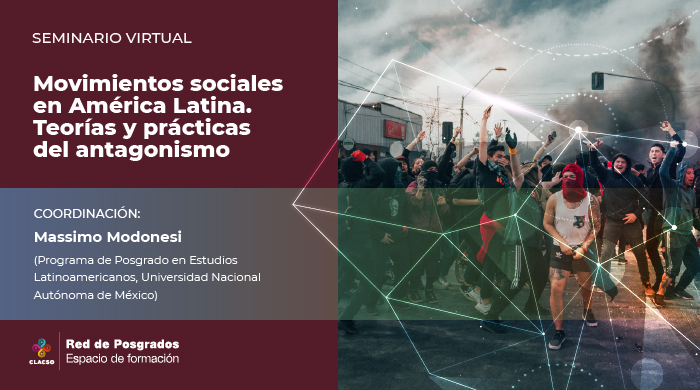
Seminar 2124
Chair: CLACSO
Coordination: Massimo Modonesi (National Autonomous University of Mexico)
Teaching team: Massimo Modonesi and César Enrique Pineda (National Autonomous University of Mexico)
Home: 31 / 05 / 2021 | Registration: 20/03/2021 al 24/05/2021
Workload: 12 weeks – 90 hours.
At the intersection of historicization and theorization, the seminar, aimed at students and researchers of social movements, opens a space for theoretical and analytical debate for understanding the place and role of social movements in the political dynamics of present-day Latin America.
Throughout the course, we will uphold and test the interpretive effectiveness of a theoretical approach based on unraveling the intertwined relationships and experiences of subalternity, antagonism, and autonomy.
The historical and political understanding of national processes, cartography, periodization, and, of course, case studies, which will form the basis of the course, require being implemented by critical hypotheses arising from the dialogue between branches of the sociology of collective action, Marxist and neo-Marxist thought on political subjectivation, and Latin American theorizations challenged by the emergence of anti-systemic movements in recent decades.
The course is structured in 10 sessions: the first three on theoretical issues, the next three on historical analysis of the cycles of mobilization and demobilization, and the last four on characterization of current movements.
GENERAL PURPOSE
To create a space for analysis and learning about Latin American social movements where participants can – through unconventional critical theoretical tools – analyze the regional political reality based on the interventions of a series of antagonistic subjects, understanding their subaltern limits and their autonomous and emancipatory potentials.
SPECIFIC OBJECTIVES
That the students:
- Learn about, discuss, and use critical theoretical categories for the study of Latin American social movements.
- Build a panoramic continental view of social movements, evaluating their limits and potential as actors of social transformation.
- Develop a historical perspective by analyzing the mobilization cycles in the region.
- Analyze the subaltern limits and autonomous powers of antagonistic subjects today, from a regional and comparative perspective.
- Practice analyses and interpretations, based on the theoretical and methodological tools of the course, in investigative processes or exercises of the participants themselves.
- Outline a critical theoretical and methodological agenda for the study of social movements from a Southern and Latin American perspective
- Theories and concepts for the study of antagonistic movements
- Community movements, infrapolitics, indignation and antagonism
- Theorizations on social movements in Latin America
- Historical cycles of national-popular and socialist-revolutionary mobilization
- Cycle of challenging neoliberalism 1994-2005
- Progressive governments and passive revolutions
- Movements in defense of land and territory in Latin America
- Indignant movements and feminisms in Latin America
- Rebellions of the Present
- Anti-systemic movements in the face of the global crisis and pandemic
- Gago, Verónica, Feminist power or the desire to change everything, Madrid, Traficantes de Sueños, 2019.
- García, Sergio, “Technopolitical movements in Latin America. A comparison of #YoSoy132 and the Chilean student movement” in International Journal of Political Thought1st Era - Vol. 12, 2017 (17-34)
- Pineda, César, “Ayotzinapa: Indignation and Antagonism. Student Movement and Assembly Politics” in Modonesi Massimo (coord.) Militancy, antagonism, and youth politicization in Mexico, UNAM-ITACA, 2017
- Araujo, Kathya, Tight Threads. To read the Chilean OctoberUniversity of Santiago de Chile, 2019.
- Eckstein, Susan (coordinator), Power and popular protest. Social movements Latin Americans. Mexico, Siglo XXI, 2001.
- Gaudichaud, Franck, Massimo Modonesi and Jeffery Webber, The progressive Latin American governments of the 21st century, UNAM, Mexico, 2019.
- Massimo Modonesi, “Crisis of hegemony?”, Jacobin Latin America, no. 1, Buenos Aires, 2020.
- Modonesi, Massimo and Mónica Iglesias, “Theoretical perspectives for the study of sociopolitical movements in Latin America: change of era or lost decade?” in Of diverse origin, No. 5., Postgraduate Studies in Latin American Studies, UNAM, 2016.
- Modonesi, Massimo, “Antagonistic Movements and a Changing Era in Latin America” in Lucio Oliver and Nayar López, Latin America: a region in conflictPlaza y Valdés, Mexico, 2009.
- Modonesi, Massimo, The antagonistic principle. Marxism and political action., FCPyS-UNAM and Itaca, Mexico, 2016.
- Modonesi, Massimo, Passive revolutions in Latin America, Ithaca, Mexico, 2017.
- Pineda, César, “Transnational Corporations versus Community Environmentalism: Environmental Antagonisms and Conflict”, in Mexican Journal of Social Sciences, Mexico, 2020.
- Pineda, César E., “Community, autonomy and emancipation” in Gaya Makaran (comp.), Return to Autonomy: Debates and Experiences for Social Emancipation from Latin America CIALC-UNAM, CIDES-UMSA, IIGG – UBA, 2019.
- Ramírez, Gallegos, Franklin, (coord.) October and the Right to Resistance: Popular Revolt and Authoritarian Neoliberalism in Ecuador Autonomous City of Buenos Aires, CLACSO, 2020.
- Sandro Mezzadra, “Inside and against the pandemic crisis: hypotheses of capitalist stabilization and class struggle”, September 2020
- Svampa, Maristella. The frontiers of neo-extractivism in Latin America: Socio-environmental conflicts, the eco-territorial turn, and new dependenciesUniversity of Guadalajara. CALAS.
- Zibechi, Raúl, Social movements in Latin America. The “other” world in motionUnderground Editions, 2017
|
|
Discount for payments made before 17/05 |
One payment |
|
CM Plenos |
$75 |
$150 |
|
CM Associates |
$95 |
$190 |
|
No link |
$95 |
$190 |
FAQ
The basic requirements for taking a seminar are:
- Availability of at least 4 hours per week to dedicate to the seminar course.
- Internet access.
- Reasonable handling of communication and computer tools.
- Language proficiency in the language in which the course will be taught. The official languages are Spanish and Portuguese.
If you have a link with a CLACSO Associated Center:
Paying in one payment: USD 150 (includes issuance and shipping costs of the digital certificate).
Paying BEFORE 17/05/2021: USD 75 (includes issuance and shipping costs of the digital certificate).
If you have a link with a Network or Institution Associated with CLACSO:
Paying in one payment: USD 190 (includes issuance and shipping costs of the digital certificate).
Paying BEFORE 17/05/2021: USD 95 (includes issuance and shipping costs of the digital certificate).
If you do NOT have a link with a CLACSO Associated Center:
Paying in one payment: USD 190 (includes issuance and shipping costs of the digital certificate).
Paying BEFORE 17/05/2021: USD 95 (includes issuance and shipping costs of the digital certificate).

