
Latin American perspectives on education in times of pandemic
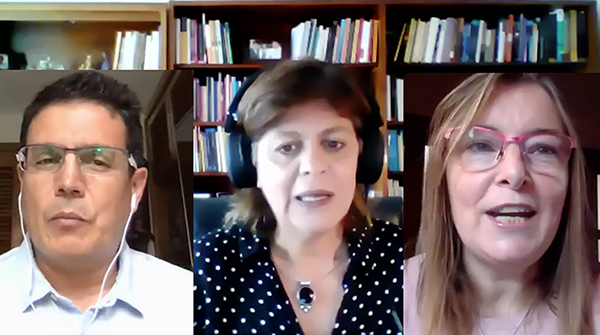

Conversation between CLACSO, UdeA and UNLP
The activity inaugurated the first of 6 conversations that will make up the International Cycle of talks: education and humanity in times of pandemic, multi-situated perspectives, organized by CALCSO, the University of Antioquia and the National University of La Plata, centers associated with the Latin American Council of Social Sciences.
The panel consisted of Myriam Southwell (Provincial Director of Secondary Education for the Province of Buenos Aires and professor at UNLP), John Jairo Arboleda Céspedes (Rector of the University of Antioquia), and Karina Batthyány (Executive Secretary of CLACSO). The discussion was moderated by Nicolás Arata (CLACSO) and Néstor David Restrepo Bonnett (education advisor and consultant). Arata stated that this, the first of six scheduled conversations, “is an extension of numerous dialogues that those of us interested in education have been holding in parallel; it is not a dialogue that began with the pandemic.” He called for “jointly articulating ideas and initiatives,” understanding that “Latin America and the Caribbean are in a position to unite efforts to redefine the society-state equation… and establish a common and shared position to send a message to the world.”
In her presentation, Myriam Southwell emphasized that “once again, it is necessary to think of ourselves as a collective, what we can generate to overcome this difficult situation and how we will return afterward, and also to envision ourselves in a bond of greater reciprocity, greater recognition, and collective action.” She then highlighted the role of educators in “reflecting on crises, on the ruptures that arise in a situation like this, in order to allow for some sense of continuity so that it becomes possible; and in this, an ethic linked to the transmission that we embody daily as educators is at stake.”
Then, Karina Batthyány emphasized, among other points, that “we know this pandemic has affected, globally and also in our region, direct attendance at educational establishments for children, adolescents, and young people. This point is particularly interesting because it brings us back to a discussion that, for those of us who come from the field of gender studies and feminist studies, concerns the relationship and coexistence between productive and reproductive labor. This was obviously the case in societies, especially pre-industrial ones; well, now it seems that we are, for a time, returning to that moment in which everything is centered in the same physical space, which is the home. Productive activities, teleworking, reproductive activities, and schoolwork or school-based education are all concentrated here.”
He also stated that “this also raises questions about the worsening of educational rights, where one of the central discussions that seems to be absent from the concerns of those making policies within the framework of this emergency, is what is the material and symbolic importance of the school, will we really be able to transfer everything to the homes and where has that component of interaction gone, that material and symbolic component associated with the school.”
And he concluded: “May this crisis, ultimately, be an opportunity to strengthen the quality of democracy in the broadest sense of the word—that democracy which begins in our daily lives, in our everyday interactions, and, of course, extends to the most aggregated levels of society. May this crisis also be an opportunity to consider universal access to common goods, which include education, and where the defense of education as a common good—that is, public education and education for all—holds a prominent place. But not only education, but also health, work, and care…”
In turn, John Jairo Arboleda Céspedes analyzed that “it took a particle, not even microscopic, a particle in the range of one thousandth of a million, to level the playing field in the world, to put us in an absolutely complex but common situation for everyone, which finally achieved what had not been achieved before: that everyone was aware and attentive to the situation generated by this pandemic. A pandemic that, of course, responds precisely to the need to be a little kinder as inhabitants of this earth. And it will ultimately serve so that, as a single citizen, as a single society, we can respond in the best way. In our country, in Colombia specifically, we face absolutely enormous challenges every time things like this happen… The enormous inequalities that exist, that underlie life, the rhythms of life that most of the inhabitants of our cities, our departments, in our countries have, are revealed, and what these situations do is reveal those enormous inequalities and those enormous difficulties in trying to face this situation as a single citizen. The other It clearly reveals the enormous deficiencies and vulnerabilities of public goods.”
Closing the Conversation, Néstor Bonnet thanked “the 768 people who participated in the Zoom meeting and the more than 12.000 who followed the talk on YouTube from Argentina, Brazil, Canada, Spain, Costa Rica, Mexico, Germany, Peru, Venezuela, Bolivia, Ecuador and different regions of Colombia.”
[+] Thinking about the pandemic

If you would like to receive more information about CLACSO's training programs:
[widget id=”custom_html-57″]
to our email lists.

