
Milei and Noboa, two failed governments that inspire De la Espriella in Colombia
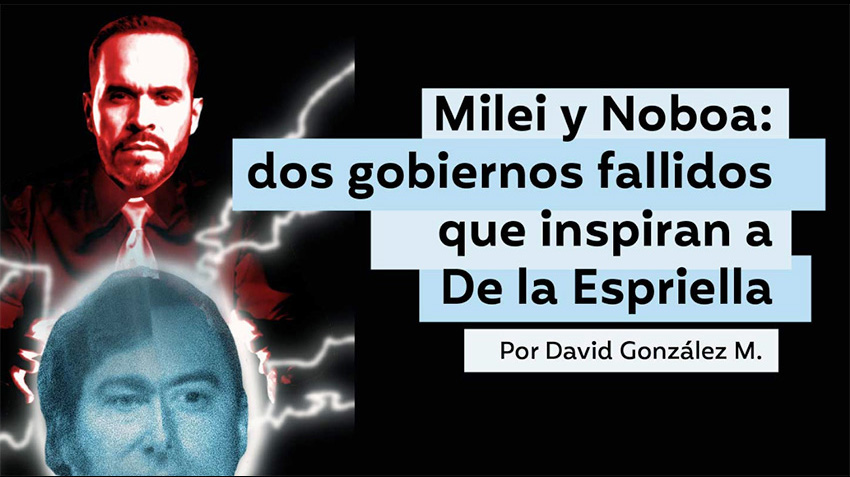
Abelardo de la Espriella is not an isolated phenomenon: his candidacy reflects characteristics of the right-wing governments in Argentina and Ecuador. Pablo Vommaro , executive director of CLACSO, defines them as “vassal right-wing movements”: projects that present the handover of resources as modernization, the weakening of the state as freedom, and subordination to Washington as a strategic alliance.
By: David González M. – Raya Magazine of Colombia, June 10, 2026
Abelardo de la Espriella, a U.S. and Colombian citizen, member of the U.S. Republican Party, and campaign donor to MAGA congresswomen like María Elvira Salazar of Florida, could become president of Colombia. These signs don't appear as an extraordinary local phenomenon, but rather as another link in a chain of radical right-wing movements that have come to power in South America. In several of these countries, their policies are already having visible impacts on the living conditions of the majority, state capacity, and economic sovereignty.
The similarities of this right-wing wave appear in several of its proposals: criticisms of traditional political systems of government; support from corporations with economic interests that call for the weakening of states to facilitate extraction; multimillion-dollar digital campaigns that seek to influence electoral behavior through digital platforms and algorithmic systems; and, above all, the support and direct political interference of the Donald Trump administration.
Argentine academic Pablo Vommaro, executive director of CLACSO, has followed and supported research on these far-right movements that are gaining central power in South American countries. He explains that, while they share similarities with traditional right-wing movements in their defense of the status quo and their embrace of security rhetoric, they also have other distinguishing elements: "One of them has to do with this characteristic of submission, of subordination, of subservience to the reactionary forces of the Global North, specifically those of the United States."
Vommaro explains that these are not right-wing movements seeking to expand a nation's or state's capabilities, but rather right-wing movements that surrender sovereignty. "They surrender territorial sovereignty, economic sovereignty, energy sovereignty, industrial sovereignty, financial sovereignty, fiscal sovereignty; in other words, they surrender the possibilities or the tools for development and submit to the designs, the mandates, in this case, of the current United States government."
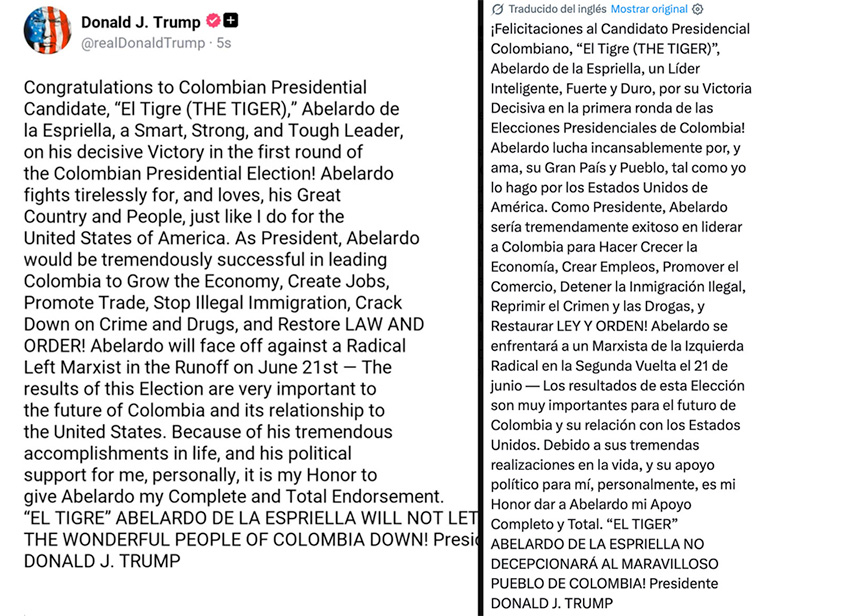
It is no surprise that, after the results of the first round of the Colombian presidential election were announced, in which Abelardo de la Espriella won by a narrow margin of 3 percentage points against Iván Cepeda, President Donald Trump came out to congratulate him and endorse his campaign. This public support opened a discussion about the extent of Washington's political intervention in a Colombian election and about how the local right wing seeks legitimacy through Trumpism.
“And that makes them right-wing movements that deepen processes of subjugation and dependency, and that, far from contributing to development or even growth in these countries, actually contribute to a shrinking, a reduction in state capacity, and a reduction in the possibilities for the development of life for the societies and populations that inhabit these countries,” Vommaro explains. One of the mirrors to see this in today is Milei’s Argentina.
From Milei to Abelardo: the Argentine case
If there's an "outsider" similar to Abelardo de la Espriella whose government one might imagine, it's the president of Argentina, Javier Milei: a leader who came to power without prior experience in executive government positions and who is currently facing scandals and accusations that have rocked his administration. Just over two years ago, Milei won the presidency with a campaign focused on digital media, a strong presence on social networks, and the backing of major business and financial sectors.
Today, Argentina is experiencing social upheaval; it has gone from being a country that receives migrants to one that sends its citizens abroad. Reports of people leaving the country have increased, and the debate on emigration has once again taken center stage in public discourse. Its internal climate is marked by austerity policies that first generated a sharp social collapse and then a statistical recovery applauded by foreign funds, but which is not reflected in the real purchasing power of the majority of its citizens, who report stagnant wages, a rising cost of living, the closure of small businesses, and difficulties making ends meet.
According to official INDEC figures, the cost of living in Argentina increased by 31,5% during 2025, with meat—in a historically cattle-producing country—seeking the largest price hike, exceeding 70%. Meanwhile, the Labor Ministry reports that more businesses are closing than opening, with a net loss of 17.323 companies. Milei has managed to alleviate some of the financial pressure after the International Monetary Fund approved a US$20.000 billion Extended Fund Facility agreement in April 2025, with a 48-month term. The program included an initial disbursement of US$12.000 billion and aimed to strengthen international reserves, make the exchange rate regime more flexible, and support the government's economic plan. But the question remains how sustainable this boost will be; his popularity is currently declining amid allegations and scandals plaguing his administration. According to the Atlas Intel polling firm, associated with these far-right political forces, Milei's disapproval rating in Argentina reaches 63% of the population.
Milei, like Abelardo de la Espriella in Colombia, had the direct support of President Trump and an aggressive, multimillion-dollar digital campaign on social media, financed by large corporations to which the government later responded. Because, in addition to deepening the social crisis, his main policies have favored big business interests at the expense of workers, from a controversial labor counter-reform to a contentious law that relaxes regulations on mining in protected glacial areas.
Vommaro explains that in Argentina, after two years of Milei's government, much has been lost: access to education and healthcare, a freeze on public works projects, and roads in poor condition that have led to an increase in accidents of up to 40%. Furthermore, he says, "the scientific and technological system has been destroyed, which also mortgages and jeopardizes the future of a country like Argentina."
All of this occurred in a short period, while the government responded with repressive measures and the use of police force against various social mobilizations. Even so, Argentina does not currently have a serious security problem like, for example, Ecuador under Daniel Noboa, another member of the Club of the Americas and another ally on whom candidate Abelardo de la Espriella relies.
Ecuador: the best –worst– example of the “vassal right” to Washington
It would be hard to find a country where the signs of submission to the Trump administration are more evident than in Daniel Noboa's Ecuador. A president who attempted to amend the Constitution to allow the installation of US military bases on its soil, a measure rejected by 61% of the population in a national referendum.
Even so, Ecuador has made other dangerous concessions to its sovereignty: in July 2025 it agreed to take in migrants from other countries expelled by the United States, it has signed agreements with mercenary companies such as Blackwater and has sought to pressure the Colombian government through trade sanctions that also affect its own economy.
And all this while the country is experiencing unprecedented violence in its recent history. After a year of Noboa's administration, Ecuador has suffered the highest number of homicides in its history, and although the prison population and arrests are increasing, the violence is not decreasing. Recent investigations by independent media outlets even denounce human rights violations and the rise in deaths within prisons. In 2025, more than three people deprived of their liberty died every day in Ecuador, an average of one every seven hours. Most of them died from hunger and disease.
The Noboa government has responded to this crisis of violence with militarization. It is a country where 41,7% of the population lives in poverty and hunger; as in Argentina, this is the fastest-growing trend. According to the 2025-2026 humanitarian analysis supported by the United Nations and the Integrated Food Security Classification, more than 2,6 million people in Ecuador—almost one in six—face critical levels of acute food insecurity.
Those subject to Trump's policies in South America are experiencing their worst moments, as are the populations under their rule. Vommaro sees common patterns in these right-wing figures like Milei or Noboa: "On the one hand, undoubtedly, the submission to foreign interests, to the United States government, which wants to see us dependent, subordinate, and which is not interested in any independent development, any possibility of regional integration, or in Colombia or any other Latin American or Caribbean country having its own growth, autonomy, sovereignty, and development."
On the other hand, he identifies other elements that could deepen the subjugation of South American nations: “the weakening of the State, the destruction of its capacities, of certain public policies, while leaving others untouched. That is, they continue to protect financial speculation, they continue to protect international criminal networks, they continue to protect those who speculate or profit from our money, but they destroy the capacity for public health, public education… And I think there is a great risk there,” he concludes.
The rapid decline of the right-wing parties allied with Donald Trump
The rapid exhaustion of the failed policies of right-wing vassals to Washington results in constant social protests in the face of evidence of the erosion of sovereignty and governments that prioritize foreign interests.
Two governments from that same Americas Shield Club, allied with Trump, are experiencing a collapse in their support in just a few months. This is the case, firstly, of Chile: José Antonio Kast assumed the presidency just last March 11, 2026; on his first day, he signed broad agreements to boost cooperation on critical minerals and security matters; he is even pushing for an indigenous law reform to allow the mortgaging of ancestral community territories.
In three months, according to the latest polls, his popularity has fallen from 56% to 36%. And in the main streets of Santiago and Valparaíso, massive social protests are already taking place, organized by citizen groups concerned about setbacks in rights and who see the current situation in Argentina as their worst-case scenario.
More alarming, undoubtedly, is the case of Bolivia under Rodrigo Paz, who won the elections after 20 years of MAS rule. Today, La Paz is blocked by protests from labor unions, teachers, and indigenous groups. The reason, as former Senate President Adriana Salvatierra explained to RAYA, is concern about the new government's political decisions, which are moving toward privatization, the transfer of strategic resources, and new alliances with the International Monetary Fund, as well as a prolonged economic crisis reflected in high inflation.
Vommaro explains that, once these subordinate right-wing parties come to power, the State loses the possibility of intervention, "of public action, including to respond to the needs or demands of different social groups and of the citizens themselves," which eventually deepens the submission to the interests of the Trump administration, an administration, moreover, weakened by its own low popularity a few months before the midterm elections.
Following soaring inflation in the United States, the strategic defeat in the war against Iran, and the scandals surrounding the partial cover-up of the Epstein files, Trump's second term is walking a tightrope. In the upcoming November elections, he could lose control of Congress and end up sitting in the Capitol facing impeachment proceedings that could lead to his removal from office. His approval ratings currently hover between 34% and 38% in all polls, with historically low disapproval ratings.
Even so, the "vassal right" of South America stakes all its legitimacy on the support it can obtain from this government in crisis. Along these lines, candidate Abelardo de la Espriella thanked Trump in an open letter for his full support of his candidacy, saying: "We are going to forge a partnership with the United States government and with President Trump like never before Colombia has had with any other government."
“[These right-wing groups] do things that even Trump himself doesn’t do in the United States. Because the United States is the king of ‘do as I say, not as I do.’ Domestically, Donald Trump is protectionist, he defends his industry, he doesn’t allow imports, for example, from China and other countries; but abroad he preaches a different message,” Vommaro explains. He also points out: “These governments buy into that canned rhetoric, they subordinate themselves, they submit.” All of this is also aimed at weakening the possibilities for regional integration.
“We are heading towards a world of regional blocs: the Asia-Pacific bloc, the Indo-Pacific bloc; Africa is making efforts to integrate and unite; there is the European Union. We know that Latin America has a chance in this changing world, in this world in transformation, if it consolidates its regional integration. I believe that weakening or dominating the possibilities of regional integration is also part of the objectives that these forces [the vassal right wing] have, precisely to condition the possibilities for more autonomous and more sustainable development,” he concludes.

