
Migration and human mobility
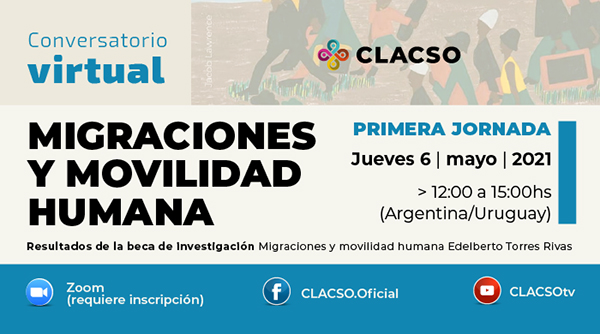
On Thursday, May 6, the CLACSO Research Directorate organized the First presentation of results of the Edelberto Torres Rivas scholarship entitled “Migrations and human mobility”.
In her opening remarks, Karina Batthyány, Executive Secretary of CLACSO, called for “rethinking the phenomenon of migration in the long term, which requires abandoning the traditional stigmatization of migrants and focusing on the economic, political, and social causes that force people to migrate, whether because they are seeking job opportunities or to improve their quality of life, or because they are suffering from armed, ethnic, and religious conflicts. (…) Migration and human mobility must be recognized as a basic human right. The challenge is to ensure that displacements occur in a just and mutually beneficial manner, with respect for human rights. (…) To transform this reality, we must consider this phenomenon in the long term, how to break with this more traditional, stigmatized view of migrants, and focus on understanding and addressing the economic, political, and social causes that force people to migrate in search of job opportunities.”
He then explained that “the scholarships address one of the central themes: human mobility and migration, with the aim of advancing knowledge, but also reflecting on the necessary actions (…) It was a very successful call for applications, with 705 submissions to our scholarship system, of which 234 completed the process, involving almost 400 researchers from more than 17 countries. Finally, 10 scholarships were awarded to 15 researchers from Venezuela, the Dominican Republic, Nicaragua, Mexico, Guatemala, Argentina, Honduras, Cuba, and El Salvador.”

The following people participated in the discussion:
Luis Bonilla (Venezuela): Orchids in the wind: the new generations of Venezuelans in the migratory processes 2014-2020.
Dora Díaz and Diana Claudeth Sabillón (Honduras): Reconstructive Education Policy A felt and prescriptive need for the integral integration of children and adolescents – migrant families.
Aime Gross (Cuba): Migration, gender and care. Cuban migrants in the care work of dependent elderly people in two migratory destinations.
Matías Bosch and Tahira Vargas (Dominican Republic): Invasion or coexistence? Relations and perceptions between Dominican women and Haitian migrants beyond the ideology of antagonism and state violence.
Isolda Rosalía Espinosa González (Nicaragua): Nicaraguans exiled in Costa Rica and the distribution of the economic burden that their care represents.
Commented by: Claudia Pedone, Alfonso Hinojosa and Liliana Rivera, tutors of the investigations.
Moderated by: Tomás Bontempo (CLACSO – Argentina)
If you would like to receive more information about CLACSO's training programs:
[widget id=”custom_html-57″]
to our email lists.

