
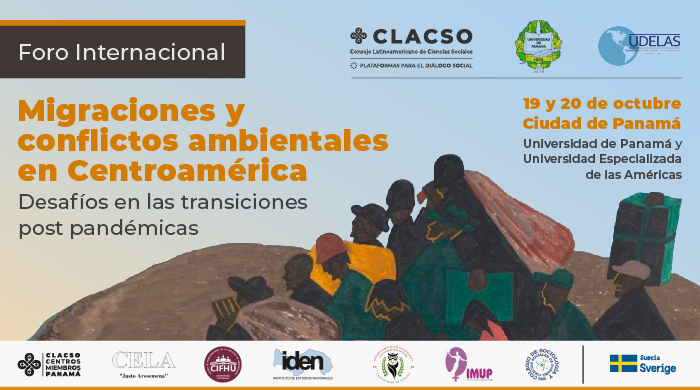
Migration and environmental conflicts in Central America
Platforms for Social Dialogue
Environment, climate change and social development | Migration and human mobility
19 and October 20 | Panama City
University of Panama and Specialized University of the Americas

El International Forum Migration and environmental conflicts in Central America: Challenges in post-pandemic transitions It is part of the Platforms for Social Dialogue Migration and human mobility y Environment, climate change and social development, which CLACSO has been promoting since 2022.
The objective of this proposal is to achieve the production of evidence-based, critical, situated knowledge with a high impact on policy definition, public opinion formation and the positive transformation of the living conditions of the most vulnerable populations.
This international forum seeks to bring together members of Latin American and Caribbean academia, social movements, organizations and collectives, and public policy decision-makers to reflect on and understand migration processes and migrant movements and their connection to environmental conflicts in Central America.
The event will include various activities:
- International Postgraduate School on Migration and Human Mobility
- International Graduate School on Environment, Climate Change and Social Development
- Training workshops
- Social dialogue tables
- Cultural activities
These spaces are designed as instances of training, exchange and social dialogue, where axes will be presented that energize the debates on the central theme of the Forum among a diversity of participants such as researchers, public policy decision-makers and members of social organizations.
INTERNATIONAL POSTGRADUATE SCHOOLS – TRAINING WORKSHOPS
DIALOGUE TABLES SOCIAL – CULTURAL ACTIVITIES

Workshop 1 – Human Mobilities and Migrations in Central America

Workshop 2 – Water: water policy and resistance

Workshop 3 – Gender-based violence in humanitarian situations

Workshop 4 – Migrations of Afro-descendant populations

Workshop 5 – Socio-environmental conflicts in the energy transition

Workshop 8 – Climate change and environmental risks


La International Postgraduate School on Migration and Human MobilityThis intensive, in-person, postgraduate-level training program, focused on comparative and regional perspectives, aims to equip students with the skills to analyze key dimensions of mobility and migration from the perspective of the "Right to Migrate," with a focus on countries in the Global South. Its purpose is to provide theoretical and practical tools for addressing migration conflicts, human rights violations, and migrant resistance from an intersectional approach that recognizes the central role of gender, class, and racial inequalities.
This training proposal is expected to contribute to strengthening the dialogue between representatives of academia, social movements and public policymakers regarding migration processes in all their complexity.
The International Postgraduate School on Migration and Human Mobility will be held in the Faculty of Humanities of the University of Panama.
The School's activities are free of charge (transportation, accommodation, and food will not be covered).
To pass the International Postgraduate School in Migration and Human Mobility you must complete the 4 workshops of the academic program (October 19 and 20) and participate in the forum activities (See the full program of activities). Digital certificates of participation will be issued (CLACSO).
The workshops can also be taken individually (they are free with limited places).
PROGRAM ACADEMIC FROM THE INTERNATIONAL GRADUATE SCHOOL
THURSDAY 19 OCTOBER
Coordination: Silvia Irene Palma (Guatemala) and Paul Córdoba (Panama)
Date and time: Thursday, April 19th, from 2 pm to 5 pm
Location: Room 302 of the School of Sociology, Faculty of Humanities - University of Panama
Coordination: Eusebia Solis (Panama)
Date and time: Thursday 10/19 from 11:30 to 13:30
Location: Room 302 of the School of Sociology, Faculty of Humanities - University of Panama
FRIDAY, OCTOBER 20
Coordination: Carmen Gómez (Ecuador), Zenaida Luisa Lauda Rodriguez (Brazil) and Florencio Díaz (Panama)
Date and time: Friday, October 20th, from 9 to 11am
Location: Faculty of Humanities Faculty Faculty Room - University of Panama
Coordination: Rebeca Yanis Orobio (Panama) and Gloria Amézquita (Dominican Republic)
Date and time: Friday 20/10 from 11:30 to 13:30h
Location: Room 302 of the School of Sociology, Faculty of Humanities - University of Panama
If you have any questions about the workshops, you can contact us by email: [email protected]
Or write via WhatsApp: +5491138801388
The International Graduate School on Environment, Climate Change, and Social Development, an intensive, in-person graduate-level program with a comparative and regional perspective, aims to equip students with the ability to critically understand and analyze environmental issues from diverse approaches and dimensions. Its purpose is to provide tools for debating and influencing public policy, thereby advancing the understanding of conflicts surrounding sustainable development.
This training proposal is expected to contribute to strengthening the dialogue between representatives of academia, social movements and public policymakers regarding the complexity of the link between environment and society.
The International School on Environment, Climate Change and Social Development will be held in the Faculty of Humanities of the University of Panama.
The School's activities are free of charge (transportation, accommodation, and food will not be covered).
To pass the International Graduate School in Environment, Climate Change and Social Development you must complete the 4 workshops of the academic program (October 19 and 20) and participate in the forum activities (See the full program of activities). Digital certificates of participation will be issued (CLACSO).
The workshops can also be taken individually (they are free with limited places).
PROGRAM ACADEMIC FROM THE INTERNATIONAL GRADUATE SCHOOL
THURSDAY 19 OCTOBER
Coordination: Carlos Alvarado (Honduras)
Date and time: Thursday, April 19th, from 2 pm to 5 pm
Location: Room 305 of the School of Sociology, Faculty of Humanities - University of Panama
Coordination: Aida Luz López (Mexico)
Date and time: Thursday 10/19 from 11:30 to 13:30
Location: Room 305 of the School of Sociology, Faculty of Humanities - University of Panama
FRIDAY, OCTOBER 20
Coordination: Carmen Gómez (Ecuador), Zenaida Luisa Lauda Rodriguez (Brazil) and Florencio Díaz (Panama)
Date and time: Friday, October 20th, from 9 to 11am
Location: Faculty of Humanities Faculty Staff Room - University of Panama
Coordination: Carlos Escudero y Nilva Góngora (Panama)
Date and time: Friday 20/10 from 11:30 to 13:30h
Location: Room 305 of the School of Sociology, Faculty of Humanities - University of Panama
If you have any questions about the workshops, you can contact us by email: [email protected]
Or write via WhatsApp: +5491138801388
GENERAL PROGRAM OF THE INTERNATIONAL FORUM
If you have not enrolled in the International Graduate School on Migration and Human Mobility or the International Graduate School on Environment, Climate Change and Social Development, you can enroll in each workshop individually:
Coordination: Silvia Irene Palma (Guatemala) and Paul Córdoba (Panama)
Date and time: Thursday, April 19th, from 2 pm to 5 pm
Location: Room 302 of the School of Sociology, Faculty of Humanities - University of Panama
Coordination: Carlos Alvarado (Honduras)
Date and time: Thursday, April 19th, from 2 pm to 5 pm
Location: Room 305 of the School of Sociology, Faculty of Humanities - University of Panama
Coordination: Edith Castillo (Panama)
Date and time: Thursday, April 19th, from 2 pm to 5 pm
Location: Room 303 of the School of Sociology, Faculty of Humanities - University of Panama
If you have any questions about the workshops, you can contact us by email: [email protected]
Or write via WhatsApp: +5491138801388
If you have not enrolled in the International Graduate School on Migration and Human Mobility or the International Graduate School on Environment, Climate Change and Social Development, you can enroll in each workshop individually:
Coordination: Eusebia Solis (Panama)
Date and time: Thursday 10/19 from 11:30 to 13:30
Location: Room 302 of the School of Sociology, Faculty of Humanities - University of Panama
Coordination: Aida Luz López (Mexico)
Date and time: Thursday 10/19 from 11:30 to 13:30
Location: Room 305 of the School of Sociology, Faculty of Humanities - University of Panama
If you have any questions about the workshops, you can contact us by email: [email protected]
Or write via WhatsApp: +5491138801388
Faculty of Humanities, University of Panama.
Participate
- Dr. Olmedo GarcíaDean of the Faculty of Humanities at the University of Panama.
- Dr. Juan Bosco Bernal. Rector of the Specialized University of the Americas, Panama.
- Dr. Karina BatthyányExecutive Director of CLACSO.
- Dr. Azael CarreraRepresentative of the CLACSO Steering Committee for Panama.
Dialogue table
MIGRATIONS AND CARE NETWORKS
Faculty of Humanities, University of Panama.
Participate
- Nischma VillarealNational Director of Social Policies, Ministry of Social Development, Panama.
- Juana CamargoWomen's Meeting Space, Panama.
- Nicolasa TerrerosSpecialized University of the Americas, Panama.
- Ana Silvia MonzónLatin American Faculty of Social Sciences, Guatemala.
- Koen VoorendInstitute of Social Research, Costa Rica.
Moderator:
- Montserrat Sagot. Center for Research on Women's Studies, Costa Rica.
Dialogue table
MIGRATIONS AND ENVIRONMENTAL CONFLICTS
Faculty of Humanities, University of Panama.
Participate
- Lollalty de CuvillierSan Miguelito Regional University Center, University of Panama.
- Iris Reyes Lindo. Human Rights Officer of the Ombudsman's Office, Panama.
- Eduardo gilConfederation of Trade Union Convergence and United People's Alliance, Panama.
- Zenaida Luisa Lauda Rodríguez. Institute of Advanced Studies, University of São Paulo, Brazil.
- María Carmen Gómez MartínLatin American Faculty of Social Sciences, Ecuador.
Moderator:
- José Clemente LassoSchool of Sociology, University of Panama.
If you have not enrolled in the International Graduate School on Migration and Human Mobility or the International Graduate School on Environment, Climate Change and Social Development, you can enroll in each workshop individually:
Coordination: Carmen Gómez (Ecuador), Zenaida Luisa Lauda Rodriguez (Brazil) and Florencio Díaz (Panama)
Date and time: Friday, October 20th, from 9 to 11am
Location: Faculty of Humanities Faculty Faculty Room - University of Panama
If you have any questions about the workshops, you can contact us by email: [email protected]
Or write via WhatsApp: +5491138801388
If you have not enrolled in the International Graduate School on Migration and Human Mobility or the International Graduate School on Environment, Climate Change and Social Development, you can enroll in each workshop individually:
Coordination: Rebeca Yanis Orobio (Panama) and Gloria Amézquita (Dominican Republic)
Date and time: Friday 20/10 from 11:30 to 13:30h
Location: Room 302 of the School of Sociology, Faculty of Humanities - University of Panama
Coordination: Carlos Escudero y Nilva Góngora (Panama)
Date and time: Friday 20/10 from 11:30 to 13:30h
Location: Room 305 of the School of Sociology, Faculty of Humanities - University of Panama
If you have any questions about the workshops, you can contact us by email: [email protected]
Or write via WhatsApp: +5491138801388
Specialized University of the Americas
9:00 to 11:00 am
Meeting on the CLACSO Platforms for Social Dialogue
11.30:1.30 a.m. to XNUMX:XNUMX p.m.
Meeting with representatives of the CLACSO Member Centers of the Central American region
Presentation of the book
Migration in the 21st Century: Conflicts, Policies, and Rights
Faculty of Humanities, University of Panama.
María Fernanda PampinDirector of Publications at CLACSO
Pablo VommaroDirector of Research at CLACSO
Dialogue table
THE PLACE OF CENTRAL AMERICAN MIGRANT MOVEMENTS IN THE POST-PANDEMIC ERA AND THE CHALLENGES OF PUBLIC POLICY
Faculty of Humanities, University of Panama.
Participate
- Julio Croci and Carlos CortiInternational Organization for Migration IOM/UN, Panama.
- Richard MoralesSanta Maria la Antigua University, Panama.
- Eusebia SolísAfro-Resistance, Panama.
- Silvia Irene Palma. Central American Institute for Social Studies and Development, Guatemala.
- Nelise Wielewski NarlochNational University, Costa Rica.
Moderator:
- Manuel Rivera. University of San Carlos, Guatemala.
Dialogue table
MIGRATIONS, CLIMATE CRISES AND JUST TRANSITIONS
Faculty of Humanities, University of Panama.
Participate
- Jackeline Romio. United Nations Population Fund, Panama.
- Maribel GordónUniversity of Panama, Panama.
- Carlos AlvaradoNational University of Agriculture, Honduras.
- Aida Luz López. Autonomous University of Mexico City. Mexico.
Moderator:
- Azael Carrera. Center for Latin American Studies "Justo Arosemena", Panama.
Closing artistic and cultural event
Faculty of Humanities, University of Panama.
The forum includes general questions to guide all activities. Similarly, each dialogue includes a series of questions designed to spark discussion.
General questions
- How has the Covid-19 pandemic impacted migration flows in Central America? What changes do you identify between the pre- and post-pandemic periods? How have the dynamics of migrant participation in local, national, and regional economies developed?
- What challenges do migration flows resulting from environmental conflicts or climate change pose for Central American states? How can public policy contribute to the development of just transitions that guarantee the inclusion and protection of migrants?
- What is the role of migrant movements in relation to mobility and displacement, especially those caused by environmental conflicts or climate change? What actions can be taken by civil society and academia to safeguard the human rights and integrity of migrants?
Dialogue Table 1: Migration and care networks
- What are the relationships between care networks and migration flows in Central America, the Caribbean, and Latin America in general?
- What challenges do care networks face in relation to migration movements in Central America, the Caribbean, and Latin America in general?
- What opportunities and limitations exist for strengthening care networks in Central America in the face of increasing migration flows?
- What is the role of transnational care networks in migration in Central America?
Dialogue Table 2: Migration and environmental conflicts
- How have climate change and environmental conflicts, within the context of the expansion of extractive models, affected migration flows in Central America? Is it possible to identify changes between the pre- and post-pandemic periods?
- How can sustainable development policies improve the situation of migrants in Central America, the Caribbean, and Latin America in general?
- What challenges do migrants from Central America face when they are displaced by environmental conflicts and the expansion of extractive models?
- How can governments and civil society organizations work together to prevent and/or resolve environmental conflicts that generate some migration in Central America, the Caribbean, and Latin America in general?
Dialogue Table 3: The role of migrant movements in Central America in the post-pandemic era and the challenges of public policy
- How has the COVID-19 pandemic impacted Central American and Caribbean migration movements? What have been the consequences of this process for migrants?
- What are the main challenges for public policy in addressing the needs of migrants in Central America, the Caribbean, and Latin America in general? How can we consider the limitations of citizenship for many migrants?
- How can the rights of migrants be guaranteed in the post-pandemic context? What role do states, academia, and social movements play in these processes?
- What is the role of the State and civil society organizations in protecting and safeguarding the rights of children and other populations?
Dialogue Table 4: Migration, climate crisis and just transitions
- How has climate change affected migration flows in Central America, the Caribbean, and Latin America in general?
- What role can governments and social organizations play in promoting just transitions in relation to migration flows linked to climate change? What challenges arise in implementing initiatives of this kind?
- What is the role of states, social movements, and academia in protecting and promoting the rights of migrants, especially those who migrate due to climate reasons?
- Crisis, responses and alternatives in the Greater Caribbean
- Political ecologies from the South/Abya-Yala
- The Central American isthmus: peripheral epistemological perspectives
- Feminisms, resistance and emancipation
- Social metabolism/Environmental justice
- Migration and South-South borders
- Emancipatory practices, common goods, and decolonial alter-global methodologies
- What development? Multi-stakeholder and multi-level dialogues
- Violence in Central America
- Violence, governments and democracy
Organized by


