
Mexico: Facing Covid-19 from the perspective of other pre-existing epidemics
Milton Gabriel Hernández García[1]
We had planned for this issue of The Field Day It was going to be about the water problem in Mexico: the causes and consequences of its privatization, citizen-led legislative initiatives to guarantee access and availability, pollution, and community actions for the restoration of contaminated water bodies, etc. But it couldn't be that way anymore. In a few weeks, days, hours, the world changed. The COVID-19 pandemic went global and quickly ceased to be a purely medical problem, becoming a phenomenon of geopolitical, economic, ideological, and even emotional scope. We still don't know the end, but philosophical voices predict a major shift. Some foresee a civilizational collapse, others, the end of capitalism. Still others assert that this crisis is functional to the dominant system and that it will emerge stronger, becoming even more atrocious.
From a country on the periphery of global capitalism like Mexico, we can say that we are facing the pandemic amidst other pre-existing epidemics: violence, poverty, inequality, femicide, diabetes, obesity, corruption, among others that we have inherited. All of these are what the process of change initiated in December 2019 is determined to eradicate. But reality caught up with us halfway between what was still dying and what was still being born. Examples abound: the country is littered with ghost hospitals. The governments of Fox, Calderón, and Peña Nieto, along with a host of corrupt governors, left 326 hospital projects unfinished, which they inaugurated with great fanfare. Most of these buildings, now mere rubble, are located in rural areas. In June 2019, Health Secretary Jorge Alcocer stated that at least 8 billion pesos (approximately $360 million USD) were needed to salvage abandoned hospital projects that never began operations due to a lack of funding, personnel, equipment, or simply because they remained unfinished. This situation is part of the legacy of corruption and neoliberal policies in the Mexican healthcare system, which was caught unprepared for the pandemic. We hope that those who defrauded the country with unfinished hospitals will be prosecuted for treason.
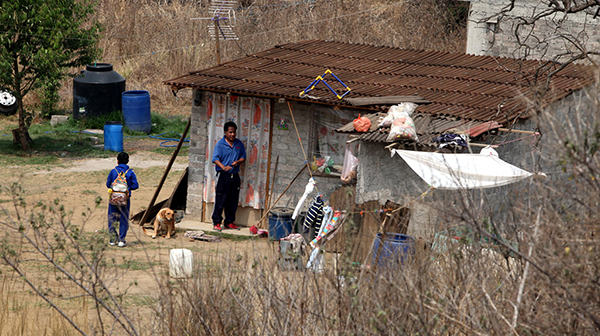
So far, much of what we know about the spread of the coronavirus in Mexico has been concentrated in cities, which are experiencing the fastest rate of infection. It is expected that the numbers will soon begin to shift toward rural areas, which in Mexico encompass the majority of the most impoverished population, lacking access to medical services, reliable and safe transportation, or sufficient drinking water. For example, in Oaxaca, infections have spread to the Papaloapan Basin, the Isthmus, and the Mixteca region, and in Puebla, they have reached twenty municipalities far from the capital, such as Teziutlán and Zautla.
While the virus has so far not discriminated based on social class, the medical and economic consequences of the pandemic will disproportionately affect the most vulnerable. In this regard, Undersecretary of Health Hugo López-Gatell stated on April 2nd: “We are concerned about rural areas. Currently, the distribution patterns of the epidemic show that it is relatively concentrated in urban areas. It still predominates in sectors with a certain level of economic capacity. At some point, this barrier will break down, and it will affect those with the fewest resources most severely.”
Alejandro Ernesto Svarch Pérez, head of the National Medical Coordination of the Institute of Health for Well-being (Insabi), announced plans to hire at least 2,000 doctors and nurses for rural areas. He explained that while Mexico should have 3.4 doctors per 1,000 inhabitants, it currently has only 1.6. However, the problem isn't just one of quantity, but also of distribution. Mexico City has five times more doctors than Tuxtla Gutiérrez, Chiapas; yet, in Tuxtla Gutiérrez, there are four times more than in the indigenous municipality of Las Margaritas. In short, Mexico has the same healthcare personnel shortage as countries like Sudan or Sri Lanka.
These are the conditions of the healthcare system under which the current government is confronting the pandemic in a country torn apart by violence, poverty, and inequality, and, to make matters worse, attacked on multiple fronts by coup-plotting business interests, purveyors of fake news, and the right wing, which virulently questions the strategy against this microscopic threat every minute. That right wing has left the country a graveyard.
In this context, this issue of The day in the countryside It attempts to address some important aspects related to the possible impacts of the pandemic in the rural world, including: the response of communities that are organizing to prevent infections; the forecasts of the Ministry of Health for the rural population; the situation of the more than 500 agricultural day laborers who spend a good part of the year moving; the situation in states such as Chiapas, Veracruz, Guerrero, Baja California and also a historical perspective, because it is not the first time that the world has faced a pandemic, among other topics.
We are in the midst of intense turbulence that prevents us from seeing the horizon. It seems that there is no room for hope. We are living in times of social distancing, but this should not mean giving up on building new forms of solidarity, because not everything is the government's responsibility. Let us not give up on the possibility of being called upon soon to embrace each other in the public squares of the country.
[1] Mexican journalist. Article published in: La Jornada del Campo.
If you would like to receive more information about CLACSO's training programs:
[widget id=”custom_html-57″]
to our email lists.

