
Participatory methodologies in times of crisis
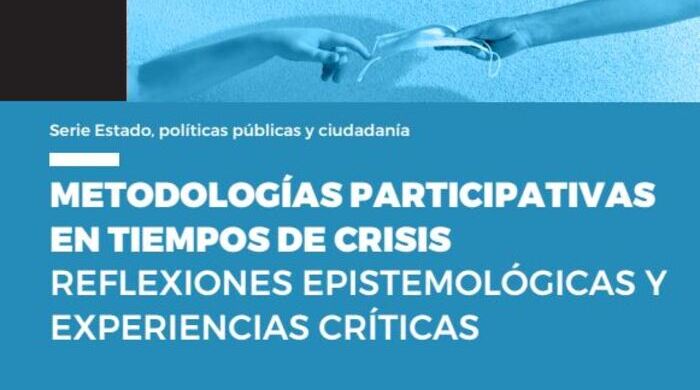

Epistemological reflections and critical experiences
Coordinator: Pablo Paño Yáñez. Mercedes Oraisón. Eryka Y. Torrejón Cardona. Humberto Macías Cuéllar. María del Carmen Ortega Ortíz. Mariano Suárez.
Authors: Igor Ahedo Gurrutxaga, Rosa Ynés Alacio García, Antonio Álvarez-Benavides, Ivanna Bollazzi Bach, Ramone Laíse Araújo Brandão, Gonzalo Bandera, Franco Barboza Piran, Andrea A. Benavidez, Daniel Buraschi, John Freddy Caicedo-Álvarez, Alejandra Cardozo, Víctor Caldas Freire, Fausto Cardoso Martínez, Leonel Del Prado, Javiera Cubillos Almendra, Luis Guillermo Forero Gómez, Valeria Gili Diez, Roberto David Fajardo Torres, Mauricio E. Giraldo Mejía, María Paola Granizo Riquetti, Luis Herrera Montero, Francisco Letelier Troncoso, Daniel Marostegan e Carneiro, Manuel Montañés Serrano, Gabriela Nélida Lucero, Natalia Oldano, María Agustina Palacios Delgado, Tomás Rodríguez Villasante, Victor Ribeiro Ferreira, Silvia Rattin. Natalie Robaina. Juliana Santos Silva. Alain Santandreu Carpio. Gisela Signorelli. Nidia María Soliz Carrión. Verónica Tapia Barria. Emanuel Telli. Alicia Tenze. Thaís Troncon Rosa. Fernanda Arias Gogin. Pablo Paño Yáñez. Eryka Y. Torrejón Cardona. Celsa Cáceres Rodríguez.
CLACSO Working Group on Participatory Processes and Methodologies
The unexpected and transformative context of the pandemic, experienced by almost everyone, prompted us to reflect on participatory methodologies and the processes that emerged in the face of this uncertainty and crisis. What attempts, strategies, reflections, practices, fields, and individuals were set in motion in these local contexts related to participatory practice? Through multiple analyses, this collective book sheds light on some of this, with experiences, actors, photographs, creations, and articles from Argentina, Mexico, Uruguay, Colombia, Ecuador, Chile, Brazil, the USA, the Basque Country, the Canary Islands, Madrid, and other countries.
Given the final product and its composition process, we can describe this book as diverse, flexible, and structured. It is diverse because its editors and authors come from different countries, Andean or coastal cities, different genders, and diverse family, cultural, social class, and ethnic backgrounds; their worldviews are similar, but not identical in their activism.
From the introduction
Working Groups Collection.
ISBN 978-987-813-600-4
CLACSO
Buenos Aires
October 2023

