
Memoirs of rebellions and plebiscites
Isabel Piper Shafir1
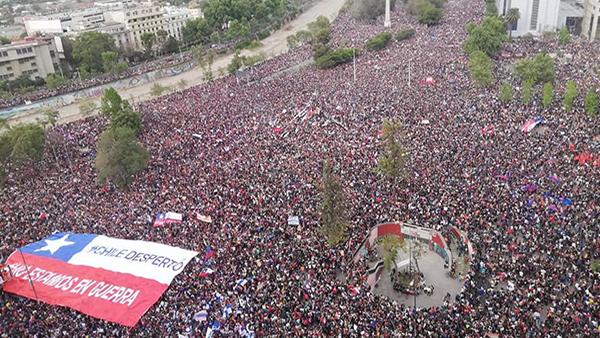
This October 18th, Chile marks one year of rebellion, and it shows no signs of ending. Although the Covid-19 lockdown brought mass protests to a halt, the rebellion continues through other practices that oppose various forms of power, exploitation, and oppression, such as community kitchens, solidarity networks, consumer and housing cooperatives, soup kitchens, and community healthcare networks.
These lateral resistance practices (Calveiro, 2019) are deployed in controlled spaces (such as many populations), turning them into resistant and alternative environments with respect to hegemonic networks.
And through their everyday actions, they create a social space for a dissident subculture (Scott, 1990). All these actions have the potential to build resistant collective subjects, to develop other forms of struggle, and to have a revolutionary experience that is the seed of greater changes.
The experimentation with these relationships, different from those naturalized by the neoliberal model, reveals that society can be transformed from these local spaces, even while under quarantine and with a long and inexplicable curfew.
October reminds us that we are no longer the same people who remained silent in the past, and that is why we take to the streets, showing that we continue to rebel, whether wearing masks or hoods. It also brings us a plebiscite in which we will declare our desire to approve constitutional reform through a Constitutional Convention.
But the hope of ending Pinochet's Constitution and collectively building the norms that will define the foundations of our society is overshadowed by some memories.
We remember another plebiscite in another October, in which with enormous mystique and hope we voted to overthrow Pinochet's civic-military dictatorship, only to find ourselves facing a disappointing transition that failed to deliver on its promises of freedom, justice, and social transformation.
In remembering, past and present merge, erasing the years that have passed and the transformed landscapes. The constraints that the political elites agreed upon for the constitutional process remind us of that other plebiscite and the negotiated transition, where, despite the "No" vote winning against Pinochet, we did not overthrow his dictatorship.
Collective memories allow us to understand the present and envision different courses of action. We are not in 1988. We can use our memories, fueled by outrage at the pitfalls of the transition, as a source of resistance that frees us from the condemnation of repeating the past.
The dominant narrative suggests that radical struggles end badly, while simultaneously urging us to maintain a tactical unity that presents stability and a clear horizon. It is time to liberate ourselves from this version of the past that has shaped us into fearful and resigned individuals, and instead build resilient memories that open up other possible futures.
We have been in rebellion for a year, and the State persists in persecuting, beating, torturing, mutilating, and murdering. But we have transformed the memories of fear into indignation, drawing on past struggles that have given us back the strength and joy of collective action, of solidarity, of reclaiming our territories, and the active enthusiasm to fight for a better world.
We know that history is ours and we make it. This plebiscite will not radically transform our society, but if it is accompanied by rebellion and resistance, by citizen mobilizations and anti-neoliberal struggles, it can create the conditions that will make it possible.
We know we are capable, as a society, of rewriting the memories of this present in terms of transformation, solidarity and hope, until dignity becomes the norm.
1- Lecturer and researcher in the Department of Psychology at the Faculty of Social Sciences of the University of Chile, and coordinator of the Social Psychology of Memory Program at this institution. Member of the Steering Committee of the Latin American Council of Social Sciences (CLACSO), where she also co-coordinates the Working Group on Collective Memories and Practices of Resistance and the specialization in Collective Memories, Human Rights and Resistance.
If you would like to receive more information about CLACSO's training programs:
[widget id=”custom_html-57″]
to our email lists.

