
Collective memories and political struggles
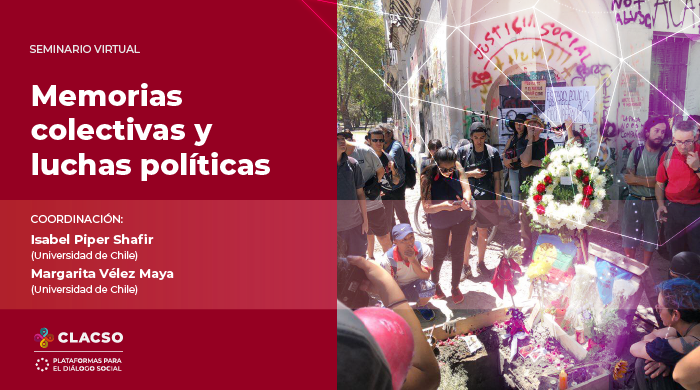
Seminar 2424
Coordination: Isabel Piper Shafir (University of Chile) and Margarita Vélez Maya (University of Chile)
Teaching team : Isabel Piper Shafir (University of Chile), Pilar Calveiro (National Autonomous University of Mexico), Ana Cacopardo (University of Lanús, Argentina), Ana Guglielmucci (University of Buenos Aires, Argentina), Francisca Fernández (Movement for Water and Territories, Chile), Jefferson Jaramillo (Javeriana University, Colombia), Juan Carlos Arboleda (University of Chile), Juan Pablo Aranguren (University of the Andes, Colombia), Loreto López (University of Chile), Margarita Vannini (Central American University, Nicaragua)
Home: 25 / 09 / 2024 | Registration: 16/05/2024 al 24/09/2024
Workload: 12 weeks – 90 hours.
This seminar seeks to critically reflect on the possible connections between collective memory processes and political struggles in Latin America within the context of contemporary neoliberalism, with the aim of understanding, decoding, and influencing the new sociopolitical reality. We begin with the premise that memory is a social process that produces meaning about the past and has the potential to constitute itself as a form of resistance.
The field of memory studies in Latin America has been shaped primarily around reflections on the political violence perpetrated in the context of military dictatorships, armed conflicts, and/or civil wars in our region's recent past. Its theoretical advances have gone hand in hand with the political actions undertaken by social organizations—mainly those linked to victims of human rights violations—to demand justice, truth, and reparations for the crimes committed, as well as with the development of public memory policies implemented in some countries within the framework of political transitions or peace agreements. In this seminar, we will critically analyze these practices, focusing on some emblematic cases in our region, such as Nicaragua, Colombia, Argentina, and Chile.
This analysis leads us to conclude that, despite significant contributions to understanding authoritarian processes, dictatorships, and political transitions in the region, as well as to confronting and processing their consequences for society and individuals, the challenge remains of understanding, decoding, or establishing links with the new sociopolitical realities developing in the region, where new and old forms of political violence and resistance intersect. This is a challenge we will address in this seminar, exploring the existing and potential relationships between collective memory processes and resistance practices within the context of contemporary neoliberalism. We will demonstrate how, in these contexts, memory becomes a political resource for action in the present, constituting a practice that contributes to transforming the current conditions in which new forms of violence unfold.
We will see how some current struggles against exploitation, dispossession, wealth concentration, and public and private violence draw upon memories that recover knowledge from other experiences. Although resistance movements in the global context tend to be local, memory allows for their articulation, despite temporal and/or spatial distance. We will review and analyze experiences of resistance in Mexico and in the Andean region of Peru, Argentina, and Chile.
We consider memory as a social and collective practice with political significance, not limited to the recovery of the past, but primarily focused on constructing meaning from shared experiences, which are enacted and reformulated in response to the needs of the present. We begin with the premise that memory is realized in the present and is inherently linked to the social and political context in which it is produced and to the social position from which its versions unfold. As part of a network of power relations, collective memory practices constitute a field of conflict where versions of the past struggle to establish themselves, becoming resistant when they manage to challenge the hegemonies of the present and envision other possible futures. To remember is to construct meaning about the past in relation to the needs of the present, in order to understand and act in the face of new hegemonies and their violence. It is then that memories can be considered resistant memories, and both practices—memory and resistance—reinforce each other.
GENERAL PURPOSE
To critically reflect on the possible connections between collective memory processes and political struggles in Latin America.
SPECIFIC OBJECTIVES
That students can:
• Describe and analyze resistance practices in different areas of Latin America.
• Describe and analyze memory policies related to past violence in different Latin American countries.
• To understand the potential of memory as a form of political action within the framework of resistance practices and political struggles.
- Collective memory: conceptual reflections
- From memory as a reconstructive technology to memories as transformative scenarios in Colombia
- Memory policies: a comparative analysis of Argentina and Chile
- Memory and socio-political crisis in Nicaragua. The citizen rebellion of April 2018
- Memory policies in Colombia
- The silences and the unspoken
- Testimony as a practice of memory and resistance
- Practices of resistance: conceptual reflections
- Indigenous resistance in Mexico
- Indigenous resistance in the Andean countryside: Argentina, Peru and Chile
- ARANGUREN-ROMERO, JP. The researcher facing the unspeakable and the ineffable (an ethics of listening). Nómadas 29: 20-33.
- BLAIR, E. (2011). Memory and power: (de)state memories and (de)center state power. Universitas Humanística, 72, 63-87
- BRICEÑO-DONN, M., UMPRIMMY, C, (2009). By way of introduction, unofficial memory initiatives. In Remembering in conflict: unofficial memory initiatives in Colombia. Ed. ICTJ- European Union, 107-119.
- CALVEIRO, P. (2016). Politics of fear and local resistance, Athenea digital, vol. 15. No. 4, http://atheneadigital.net/article/view/v15-n4-calveiro
- CALVEIRO, Pilar (2014). Political meanings of testimony in times of fear. Paper.
- NATIONAL CENTER FOR HISTORICAL MEMORY (2013).Enough is enough! Colombia: Memories of war and dignity. Bogotá: National Printing Office.
- FERNÁNDEZ, F. and FERNÁNDEZ, R. (2014). The tinku as a political expression: Contributions towards an activist citizenship in Santiago de Chile. Psicoperspectivas 14 (2), 62-71.
- FOUCAULT, Michel. (1993). Lecture of January 7, 1976. In Microphysics of Power. Ed. La Piqueta.
- GROPPO, B. (2002). The politics of memory. Sociohistorical, (11-12), 187–198.
- HERRERA, M., Cristancho, J. (2013). In the quarries of Clio and Mnemosyne: historiographical notes on the Historical Memory Group. Critical History, 50: 183-210.
- Report of the United Nations High Commissioner for Human Rights. Situation of human rights in Nicaragua (August 2018-July 2019). Human Rights Council. 42nd session. 9-27 September 2019.
- ISLA, A. (2003). The political uses of memory and identity. Estudios Atacameños, 26, 35-44
- JELIN, Elizabeth (2014). The multiple temporalities of testimony: the lived past and its present legacies, in Thematic Dossier Testimony: debates and challenges from Latin America, Clepsidra Magazine, no. 1, pp. 140-163
- JUAREZ, J; ARCIGA, S.; MENDOZA, J. (2012). Notion and elements of Collective Memory In: J. Juarez; S. Arciga; J. Mendoza (coords.) Collective Memory: psychosocial processes, Mexico: Ed. Porrua – UAM, 13- 45.
- MARTÍNEZ, M., SILVA, O, (2013). Institutions of memory on the Colombian armed conflict and their role in the production of initiatives and discursive constitution of the subject. In Violence, memory and society: debates and agendas in present-day Colombia. USTA Editions, 441-457.
- MOUFFE, Chantal. (1985). Hegemony, politics and ideology. In Martín del Campo, L. (Coord.) Hegemony and political alternatives in Latin America: Morelia Seminar. Ed. Siglo XXI. 125-145.
- PIPER, I.; Fernández, R.; Iñiguez, L. (2013). Social Psychology of Memory: Spaces and Politics of Remembrance, PSYKHE Journal, Vol. 22, 2, 19-31.
- POLLAK, M. (2006). Memory, Oblivion, Silence. The social production of identity in the face of extreme situations. La Plata: Ediciones Al Margen [The Testimony (53 – 112)].
- RAFFIN, Marcelo. (2008). The thought of Gilles Deleuze and Michel Foucault in question. The ideas of power, the subject and truth, Lessons and essays, 85, 17-44.
- RANCIERE, Jacques (2010). The Intolerable Image. In The Emancipated Spectator. Buenos Aires: Manantial, 85-104.
- RIAÑO, P. & Uribe, M. (2016). Constructing Memory amidst War: The Historical Memory Group of Colombia. International Journal of Transitional Justice.
- RUDERER, S. (2010). The politics of the past in Chile 1990-2006: a Chilean model? Universum (Talca), 25(2), 161–177.
- Salazar, CU (2012). Memory in the Victims' Law in Colombia: Right and duty. Human Rights Yearbook, 8, 135-143.
- SCHUSTER, S. (2017). Memory without history: a critical reflection on the recent “memorial wave” in Colombia. Metapolitics, 21(96): 44-52.
- SCOTT, James. (2003). The Dominated and the Art of Resistance. Era Publishing. Chapter I Behind the Official Story, pp. 23-40; Chapter II, pp. 41-70; Chapter VIII A Saturnalia of Power: The First Public Declaration of Hidden Speech, pp. 239-267
- SIERRA, M. (1997). Essentialism and autonomy: paradoxes of indigenous demands, Alteridades, 7(14), 131-143.
- VANNINI, Margarita: Public Spaces: Managua 1979-2016. Resignifications, Rewritings, Erasures. Unpublished thesis. Master's in Cultural Studies. Managua, IHNCAUCA. Chapter 1: Memories in conflict: “37 times 19”, pp. 8-20; Chapter 2: Public policies of memory in Nicaragua, 1979-2019, pp. 21-44.
- VÁZQUEZ, F. (2001). Memory as social action: relationships, meanings and imaginary. Barcelona, Ed. Piados. Chapter 2. 69-131.
- WINN, P. (2014) The battles for historical memory in the Southern Cone: comparative conclusions. In Winn and Stern (eds.) There is no tomorrow without yesterday. Ed. LOM. 327-358
|
|
Discount for one payment until 18/09 |
In one payment after 18/09 |
|
CM Plenos |
$85 |
$150 |
|
CM Associates |
$85 |
$150 |
|
No link |
$105 |
$190 |
FAQ
The basic requirements for taking a seminar are:
- Availability of at least 4 hours per week to dedicate to the seminar course.
- Internet access.
- Reasonable handling of communication and computer tools.
- Language proficiency in the language in which the course will be taught. The official languages are Spanish and Portuguese.
The seminars last 10 weeks, plus the completion of a final project. A total of 90 hours of dedication will be credited.
A course consists of 10 classes, each accompanied by required reading bibliography, supplementary bibliography, discussion forums and training activities proposed by the teaching team, partial deliveries and a final project.
The course is online and asynchronous. Some instructors may propose synchronous activities. In those cases, the time and date will be agreed upon beforehand between the teaching team and the students to ensure everyone's participation.
To pass the seminar, you must participate in at least 80% of the discussion forums and activities proposed by the teachers, have completed the scheduled partial deliveries, and pass the final work.
|
|
Discount for one payment until 18/09 |
In one payment after 18/09 |
|
CM Plenos |
$85 |
$150 |
|
CM Associates |
$85 |
$150 |
|
No link |
$105 |
$190 |
Inquiries: [email protected]

