
Collective memories, human rights and resistance
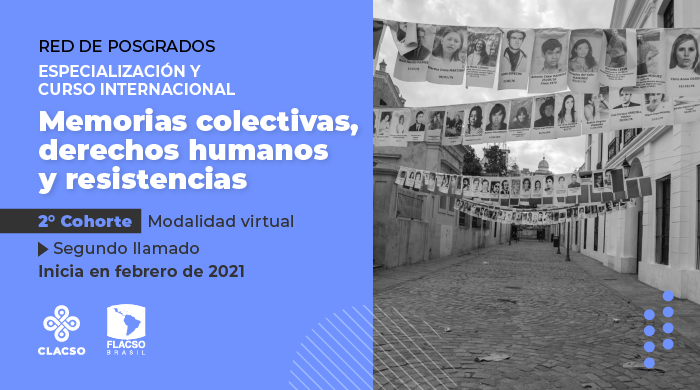
2nd Cohort (2021) – Second call
VIRTUAL MODALITY
Specialization: 40 credits, 360 lecture hours
International course: 9 credits, 90 hours/lecture
Duration: February to December 2021
The accreditation and certification of the Specialization and the International Course will be carried out by the Latin American Council of Social Sciences (CLACSO) and by the Latin American Faculty of Social Sciences (FLACSO Brazil).
GENERAL COORDINATION:
Isabel Piper Shafir – University of Chile
Pilar Calveiro Garrido – Autonomous University of Mexico City
ACADEMIC COORDINATION:
Belén Rojas – (University of Utrecht, Netherlands)
ACADEMIC COMMITTEE: Andrea Azevedo (FLACSO, Brazil), Isabel Piper Shafir (University of Chile and CLACSO), Pilar Calveiro Garrido (Autonomous University of Mexico City), Carolina Gomes Leme (Regional University of Cariri, Brazil), Peter Winn (Tufts University, United States)
PEDAGOGICAL COORDINATION:
Belén Rojas (University of Utrecht, Netherlands)
Andrea Azevedo (FLACSO, Brazil)
Concern for collective memory arises in societies attempting to overcome the violence of war, armed conflict, or dictatorship in order to build democratic forms of coexistence. Collective memory is presented as part of the transitional process, as a strategy for repairing the damage caused by violence, and as an element that would ensure such acts of violence never happen again. However, in the 21st century, the focus on this issue is shifting from reflections on violence and its traumatic effects to a quest to understand the present through its connection to the past. The central concern is no longer solely on recovering the memory of victims of human rights violations, but rather on the multiplicity of voices that construct narratives about the past, and on recovering not only experiences of pain but, above all, of struggles and resistance, and their connection to processes such as gender relations and migration.
We assume that collective memory constitutes a field of conflict where what is at stake is not only interpretations of the past, but also the meanings of who we are as a society and of our possible futures. The symbolic power of memory lies in its capacity to produce subjects, relationships, and social imaginaries—a power that makes it a potential source of resistance, instability, and transformation. But the mere act of remembering or forgetting certain events does not guarantee its transformative character; rather, this depends on the capacity of its practices to challenge the prevailing hegemonic versions within a given social order. Embracing this challenge, in this educational space we seek to jointly analyze the actions we undertake when remembering, problematizing the versions of the past they produce and, at the same time, promoting the construction of new interpretations and meanings that nourish different and dynamic ways of producing social subjects. The resurgence of authoritarian regimes in Latin America makes it urgent not only to remember the violence they have perpetrated in our recent history, but also to understand the elements that contributed to their reestablishment.
Always using memory as a key to understanding, we will explore its connections to the political struggles unfolding in the present. We will critically reflect on the construction and political uses of spaces of memory, the category of enforced disappearance and its current applications, as well as the phenomenon of contemporary migrations. We invite you to consider the possible relationships between memory and gender from a feminist perspective.
General objectives:
To know and understand contemporary debates on collective memory, its policies and practices; as well as the relationships between this and contemporary violence, especially those related to political action, gender violence and those linked to migration processes.Specific objectives:
▪ To learn about experiences in the development and implementation of policies on memory, human rights and resistance in Latin America.▪ To critically reflect on the connections between collective memory processes and political struggles in Latin America.
▪ To critically reflect on the articulation of the field of memory and gender and feminist perspectives, taking into consideration the theoretical, methodological and political consequences of this framework.
▪ To reflect on the critical potential of memory spaces to intervene in the debate on current dilemmas involving new forms of violence or violations of rights.
▪ Reflect on the transformation and analytical possibilities of the category of disappearance based on its transnationalization and current uses in various contexts.
▪ Describe and analyze how the analysis of the intersection between collective memories and migrations puts traditional understandings of both phenomena under tension and opens spaces for their reconsideration.
▪ To train in the ability to build critical and feminist memories around violent political conflicts and experiences of resistance.
▪ To contribute to the development of research on memory, human rights and social movements.
▪ To offer training to officials and social activists in the field of memory, human rights and resistance.
▪ Develop thematic, disciplinary and conceptual approaches that contribute to an integration of the theoretical propositions and debates addressed in the different curricular spaces of the Specialization.
The Specialization is aimed at postgraduate students; teachers at all levels; activists and members of organizations, movements and political parties; public officials; press workers; members and managers of non-governmental organizations and professionals interested in the fields of memory, Human Rights, feminism and migrant organizations and linked to their defense.


The Specialization in Collective Memories, Human Rights and Resistance will last one year and requires for its accreditation the completion of: an intensive seminar, an International Course and two elective virtual seminars from the curriculum; a writing support workshop; and the preparation of a final monograph.
Students in the specialization and international course will have the support of academic tutors who will accompany them through the virtual seminars and guide them in completing their final projects.
Once the seminars have concluded, students will have four months to submit their final project. If they still need to complete a credit, they will also have four months to do so.
The specialization certifies 360 hours/chair of work; the international course 90 hours/chair.
The online seminars will be offered in Spanish, Portuguese, or English. The course materials may be provided in any of the three official languages of the course, depending on availability. Student contributions to the discussion forums may also be in these languages. The final research paper may be written in Spanish, Portuguese, or English.
Abstract: This seminar will reflect on the processes of collective memory in Latin America, alongside denunciations and critiques of human rights violations and other forms of state-sponsored political violence. It will address key concepts such as the processes of naturalization surrounding the relationship between memory, human rights, and democracy.
Coordination : Belén Rojas Silva (University of Utrecht, Netherlands)
“Current debates surrounding collective memories, gender and human rights”
Summary: This course aims to foster dialogue among the knowledge and experiences surrounding collective memory processes, resistance practices, and human rights. It will feature the participation of thinkers from diverse disciplines and contexts who will analyze collective memory processes in relation to: public policy, gender and feminism, art and culture, migration processes, human rights, political violence, resistance practices, museums, memorial sites, and monuments.
Coordination: Isabel Piper Shafir (University of Chile)
Summary: This course reflects on the genealogy, transformation, and analytical possibilities of the category of disappearance. It has been used to describe cases in Argentina, Chile, and Uruguay in the 70s, in Mexico and Colombia today, and, looking further back, in the Spanish Civil War, Nazi Germany in the 40s, Khmer Rouge Cambodia in the 70s, and Bosnia during the war in the 90s. There are hundreds, thousands, millions of cases that are referred to as disappearances and missing persons.
Coordination: Gabriel Gatti (University of the Basque Country, Spain)
Abstract: This seminar seeks to reflect on how Latin American societies have confronted their past experiences of political violence, whether dictatorships or internal armed conflicts, during the 20th and 21st centuries, through the memorialization processes undertaken by various social actors. Through this seminar, we will address the public forms of memory constructed from these violent pasts, analyzing the critical capacity of the memorialization processes deployed in different countries of the region, such as Argentina, Brazil, Chile, Colombia, Peru, and Uruguay, to interrogate the present of these societies, particularly regarding new forms of violence and current conflicts.
Coordination: Ana Gugliemucci (University of Buenos Aires) and Loreto López (University of Chile)
Abstract: This course aims to explore the public uses of the past and the political interpretations of collective memory in order to understand how meanings, practices, and politics of memory and forgetting are constructed in the public sphere by civil society organizations, intellectuals, and state agencies. To this end, the course will describe and analyze—through various empirical cases and at multiple scales—those public uses of the past through which actors have intervened in the past and continue to intervene in the present.
Coordination: Ana María Barletta and Emmanuel Kahan (National University of La Plata, Argentina)
Abstract: In Latin America, the concept of collective memory has been linked to reflection on the political violence of the wars, armed conflicts, and military dictatorships of recent decades. Confronting these violent pasts has led to the development of memory policies, understood both as state policies and as political actions undertaken by social organizations or political groups involved in remembering the political conflicts experienced in their local contexts. We will examine some emblematic cases in our region, such as Nicaragua, Colombia, Argentina, and Chile.
We will examine how, in the current contexts of different regions and countries in Latin America, diverse resistance practices in the face of exploitation, dispossession, wealth concentration, and public and private violence draw upon a collective memory that recovers the various forms of knowledge from political struggle, transforming itself into an active memory. In the global context, resistance movements tend to be local. We will review and analyze resistance experiences in Mexico and in the Andean highlands of Peru, Argentina, and Chile.
The critical analysis of memory policies implemented in different Latin American countries leads us to argue that, despite significant contributions to understanding the authoritarian processes, dictatorships, and political transitions in the region, as well as confronting and elaborating on the consequences these have had on society and individuals, the challenge remains of understanding, decoding, or establishing links with the new socio-political realities developing in the region, in which new and old forms of political violence and resistance are articulated.
However, analyzing experiences of resistance in which memory is transformed into a political resource to act in the present will help us rethink memory as an agent that contributes to transformation.
Coordination: Pilar Calveiro (Autonomous University of Mexico) and Isabel Piper (University of Chile)
Abstract: This course addresses the relationship between gender and memory, emphasizing two ways of understanding this connection: first, understanding collective memory as constructed by gendered subjects, and second, exploring different feminist approaches present in this field of study. From this perspective, we analyze the memories constructed by activists, guerrillas, victims, and other social actors in relation to their gendered positions in both the present and the past; as well as the continuities and discontinuities of gender roles and dynamics that occurred in significant events they recount.
Through these analyses, we aim to examine counter-memory exercises (Arfuch, 2013; Luongo, 2013) or subaltern memories that emphasize themes and perspectives little explored in hegemonic narratives: for example, visualizing how gender structures are destabilized or preserved in the construction of these memories, or how hybrid processes of affectivity, political action, and resistance are structured when remembering certain events and contexts. This is because we understand that the subjects of memories are multi-positional agents who are linked through events/spaces (Zalaquet, 2011).
Finally, the course will analyze various studies of collective memory from Ibero-American countries that precisely incorporate a gender perspective into the understanding of the processes of collective memory construction, either to make visible experiences -of victimization and/or political resistance- that have been silenced by a hegemonic, masculinized, and heterosexist memory, or to establish gendered understandings of the past through a critical reading of the ways in which different episodes are narrated from the present.
Coordination: Marisela Montenegro (Autonomous University of Barcelona) and Caterine Galaz (University of Chile)
Summary: The objective of this course is to bring into dialogue the processes of collective memory and migrations, with the interest of illuminating new facets that allow us to better understand the complexity of each, in a context of globalization and advanced capitalism.
In this sense, we will address the particular nuances of issues considered fundamental by memory studies, such as places and commemorations; the disputes between official and unofficial memories; and museification and heritage preservation. This will be done with the aim of examining dynamics such as memories without a place and the "non-place" of migrations; the challenge to imaginaries of exclusion and the limits of belonging; and cultural initiatives as alternatives for managing political tensions, their conflictive nature, and also their potential.
We will also examine issues that are gaining prominence in the study of contemporary migrations, such as diaspora and transnational spaces; migrant subjectivity and the impacts of mobility regimes on its development. This will allow us to analyze the tension surrounding national boundaries as contours of collective memory; and the potential of memories and counter-memories in shaping resistance to subordination and articulating relationships based on difference (Braidotti, 2006) during migrant trajectories.
Coordination: Belén Rojas - University of Utrecht, Netherlands)
Summary: This workshop is a training space designed to guide the development of the final monograph for the specialization. It will support students in defining their object of analysis, translating it into a viable research problem, constructing a work plan, developing argumentative frameworks, and establishing analytical conclusions. These tasks will be carried out individually and collectively through peer exchange and with the workshop instructor, following a discussion forum format. The workshop's objective is to produce a draft of the final specialization paper. The final monograph may be written in Spanish, Portuguese, or English.
SPECIALIZATION AND INTERNATIONAL COURSE COLLECTIVE MEMORIES HUMAN RIGHTS AND RESISTANCES 2021
|
feb-21 |
Intensive Seminar |
|
|
|
|
|
|
Mar 21 |
|
|
|
|
|
|
|
|
Seminar "Recent History, Public Uses of the Past and Collective Action" |
Seminar "Disappearances: a transnationalized category" |
Seminar "Space and memory: pasts of political violence in Latin America" |
|
||
|
abr-21 |
|
International Course |
|
|||
|
May-21 |
|
|
||||
|
Jun-21 |
|
|
|
|
Methodological workshop |
|
|
Jul-21 |
|
|
|
|
|
|
|
ago-21 |
|
|
|
|
|
|
|
sep-21 |
|
|
Seminar "Migrant Memories" |
Seminar "Collective Memories and Political Struggles" |
Seminar "Collective Memories and Feminist Perspectives" |
|
|
oct-21 |
|
|
|
|||
|
nov-21 |
|
|
|
|||
|
dic-21 |
|
|
|
|
|
|
CM PlenosIf you belong to a Full Member Center of CLACSO.
CM Associates: Yes You belong to a CLACSO Associated Centre.
No linkIf you DO NOT has any of these links with CLACSO.
| One payment |
Discount for payments made before 19/01 |
Payment in 3 installments | |
| CM Plenos | $500 | $350 | USD 660 (3 x USD 220) |
| CM Associates | $600 | $450 | USD 870 (3 x USD 290) |
| No link | $800 | $500 | USD 1080 (3 x USD 360) |
In all cases, payment can be made by credit card, deposit or bank transfer.
CM PlenosIf you belong to a CLACSO Full Member Center
CM Associates: Yes You belong to a CLACSO Associated Centre
No linkIf you DO NOT has any of these links with CLACSO
| One payment |
Discount for payments made by 19/01 |
Payment in 3 installments | |
| CM Plenos | $200 | $100 | USD 270 (3 x USD 90) |
| CM Associates | $250 | $150 | USD 360 (3 x USD 120) |
| No link | $320 | $200 | USD 450 (3 x USD 150) |
In all cases, payment can be made by credit card, deposit or bank transfer.
The accreditation and certification of the Specialization and the International Course will be carried out by the Latin American Council of Social Sciences (CLACSO) and the Latin American Faculty of Social Sciences (FLACSO Brazil).
If any of the mandatory training sessions are owed, in all cases, an additional amount must be paid in order to retake said credit.
If the student decides not to enroll in the Specialization or International Course before its formal start date, they may request a refund of their tuition fees. CLACSO will retain the equivalent of 10% for administrative costs.
Exceptional Criteria: In exceptional cases, and within the first two months of the specialization, students may request to withdraw from the cohort and resume it the following year. In all cases, the reasons justifying the request must be submitted in writing. No requests will be accepted after two months from the start of the course.
The Specialization and the International Course are certified by CLACSO and FLACSO (Brazil).
The Specialization certifies 360 hours/chair of work; the International Course 90 hours/chair.
See the table of prices and options above.
If you wish to obtain certification from FLACSO, you will need to pay an additional fee.*
For those who wish to request only the diploma, the cost is USD 160,00 (one hundred sixty US dollars). For those who wish to request both diplomas and academic transcripts, the cost is USD 200,00 (two hundred US dollars). These costs cover the production, administrative processes, and processing of the aforementioned stamps and seals, as well as shipping costs. Payment can be made by credit card via PayPal invoice, which will be sent by email.
*Values subject to change
Any other questions can be directed to memoria [email protected]
Or send a WhatsApp message to +5491138801388
For group and institutional discounts, please contact [email protected]
More specializations and international courses
[widget id=”glob_block_5_widget-42″]
If you would like to receive more information about CLACSO's training programs:
[widget id=”custom_html-57″]
to our email lists.

